



On Thursday, a customer marketing manager vibe codes a community portal where customers can sign in, post questions, and search past answers. By Friday it’s live on Vercel, with a custom domain, an OPENAI_API_KEY for the AI search saved as a plain config variable, and a database full of customer names, emails, and support threads.
No ticket. No code review. No security sign-off. Nothing broke, so nobody looked.
Vercel has the settings to prevent every part of that. The harder question belongs to the security team: how do you know those settings are on, for every team, across the whole company?
The builder population just changed
Vercel used to be where front-end engineers shipped Next.js apps. Now it’s where AI ships apps for everyone else. Vercel’s v0 has crossed 4 million users (SaaStr), and CEO Guillermo Rauch says more than 60% of activity on Vercel is now driven by coding agents (The Stack).
Many of those apps belong to companies, not hobbyists. Researchers at Red Access found about 5,000 corporate apps among 380,000 public assets on AI app platforms, and about 40% of those exposed sensitive data (TechTarget).
Why your current tools only see part of it
Vercel isn’t a cloud account, a repo, or a typical SaaS app. It’s a control plane that sits between all three, so each tool you already own sees only part of it:
- CNAPP sees the AWS, Azure, or GCP accounts DevOps provisioned. Vercel isn’t one of them.
- AppSec scans the repos you point it at. An app built from a prompt may never pass through one.
- SSPM checks SaaS sign-in and access settings, but rarely Vercel’s deployment and firewall settings.
- Vercel’s own Security Dashboard, free on every plan since August 2026, is the best place to start. It scores a team on settings like MFA, owner count, token expiry, and secret storage (Vercel). But it covers one team at a time, a fixed list of checks, and only Vercel.
These settings are configured in Vercel, team by team, usually by whoever created the team: access tokens, environment variables, custom domains, deployment protection, SAML enforcement, firewall rules. That person usually isn’t on the security team.
Vercel’s dashboard tells one team how its settings look. Security teams need every team, more checks, and one place to work them next to the rest of their risk.
What Orca adds beyond Vercel’s dashboard
The integration supports Vercel Enterprise. You connect it with a Full Account access token created by a dedicated service user with the Enterprise Viewer and Security roles, so Orca’s access stays read-only. Set an expiration on the token and rotate it (Vercel access tokens). If your organization enforces SAML, connect each team with its own team token instead. There’s no agent to install, nothing to deploy in Vercel, and no change to how anyone builds.
Orca inventories every team the token can reach, including teams added later: projects, deployments, domains, members, access tokens, firewall settings, and environment-variable metadata, never the values. Each Vercel team shows up as an account in Orca, so you see every team in one place instead of one dashboard per team.
Orca runs a variety of detections out of the box. Some overlap with Vercel’s dashboard.
| Area | Orca adds | Also covered by Vercel’s dashboard |
| Identity and access | SAML configured but not enforced, invitations pending more than 14 days | Members without MFA, tokens with no expiration, too many owners, long-lived credentials that could use OIDC |
| Network exposure | Production deployments without protection, custom firewall (WAF) disabled, no bot blocking, no IP blocking rules, overly permissive bypass rules | Public preview deployments |
| Data protection | None | Secrets saved as readable Config variables, Git fork protection disabled, variables exposed to the browser |
| Best practices | Unprotected source maps, unverified Git commits | None |
| Neglected assets | Access tokens unused for 90+ days | Environment variables older than 90 days |
Four misconfigurations that AI-built apps make by default
These four issues come up most with AI-built apps. None is a mistake anyone makes on purpose. Each is a default, or a step builders skip because nothing breaks without it.
- Production URLs with no login. Vercel’s Deployment Protection covers preview URLs by default. Production is a separate setting. Builders rarely change it, because the app works fine either way. The result is a public, indexable production URL with nothing in front of it. The fix is free: since September 2026, every plan can put Vercel Authentication in front of production and make it the team default (Vercel).
- Secrets saved as readable Config variables. Since August 2026, Vercel stores each variable as Config (readable) or Secret (write-only) (Vercel). Values are encrypted at rest, but a STRIPE_SECRET_KEY saved as Config stays readable to anyone with project access. The name is the giveaway, and that’s what Orca flags.
- SAML connected but not enforced. The identity team links the IdP to Vercel. Nobody turns on enforcement, so members can still reach the team without a SAML session (Vercel).
- Long-lived and forgotten access tokens. A Full Account or Team token carries the role of the person who created it. Tokens set to never expire, or unused for 90 days, are standing credentials nobody is watching. Orca flags both. Project-scoped tokens limit any one token to a single project (Vercel).
One queue for every team
A dashboard per Vercel team works for the person who owns that team. It doesn’t work for a security team responsible for dozens of them.
In Orca, Vercel findings show up alongside your AWS, Azure, and GCP findings, in the same risk scoring, alert workflows, and ticketing integrations your team already uses. Each finding shows which Vercel team owns the project, so it reaches someone who can fix it. New teams are covered as soon as they’re created, without anyone registering them.
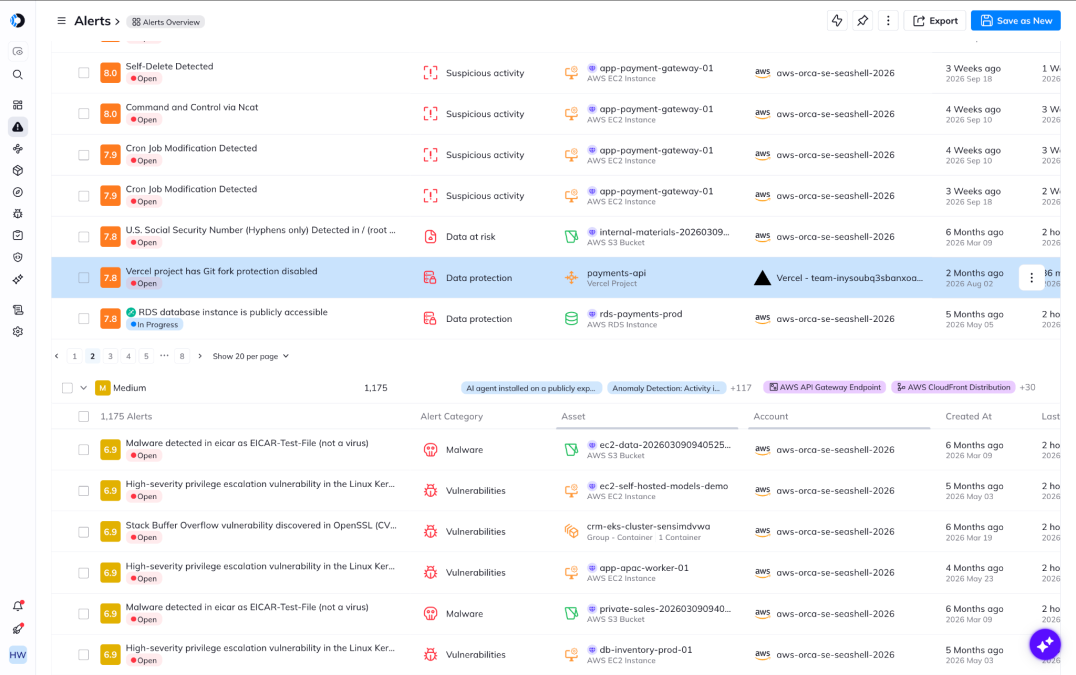
Vercel findings land prioritized in the same queue as your cloud findings in the Orca Platform
Vercel is one part of the AI-built app
An AI-built app has five parts: the model behind it, the agent or builder that made it, the platform it runs on, the database and login behind it, and the cloud account under it. Each comes from a different vendor and has a different owner. None of those owners is security.
Orca AI AppGen Security covers these parts in one platform instead of one tool per vendor. Today that means Vercel, where AI-built apps run, and Claude Enterprise, where many of them start, in the same inventory and the same queue. More platforms are coming.
The goal isn’t to slow builders down. They keep the tools they picked. Security gets enough visibility to say yes instead of no.
Want to see your Vercel teams in Orca? Book a demo today.
About the Orca Platform
Orca Security delivers security for the companies that build. As cloud, applications, AI and app generation expand the attack surface, Orca transforms security risk into the context teams need to act. The Orca Platform provides complete visibility across cloud, AI, and application environments, correlates risk across every layer, and prioritizes the exposures that matter most so organizations can remediate faster and innovate with confidence. Trusted by hundreds of organizations, including SAP, Autodesk, Gannett, Lemonade, and Digital Turbine, Orca is backed by leading investors including Temasek, CapitalG, ICONIQ Capital, and Redpoint Ventures.



 Chat with an Orca Expert