


Executive Summary
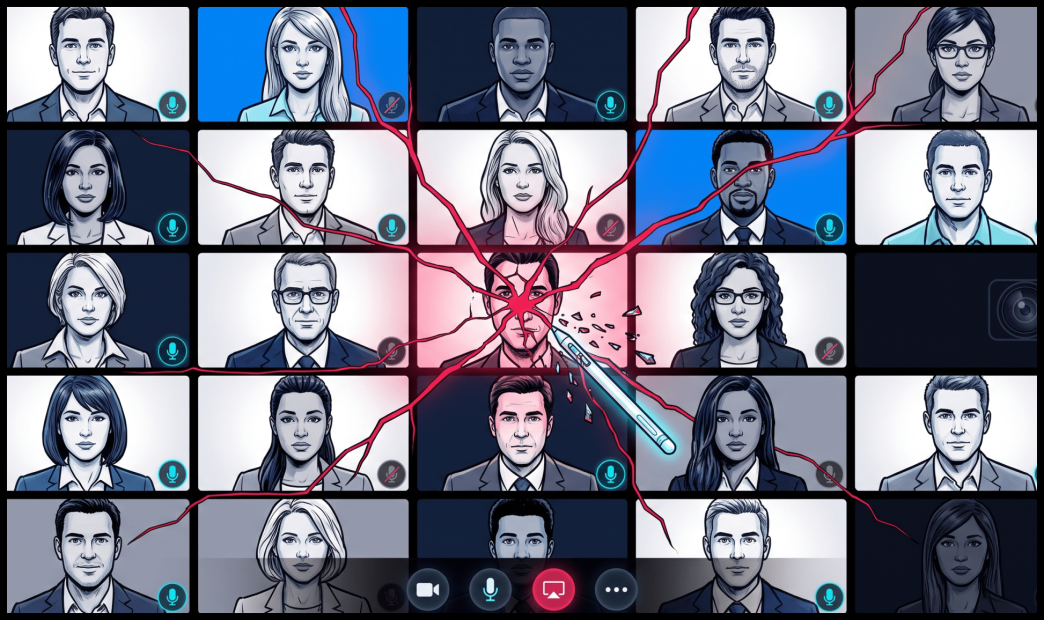
Multiple critical memory corruption vulnerabilities (CVE-2026-53413, CVSS 8.3/9.0 and CVE-2026-53415, CVSS 8.3/9.0) were disclosed affecting Zoom Workplace clients across all platforms, allowing attackers to achieve zero-click remote code execution against every participant in a meeting via malicious annotation messages. Due to the potential for full device compromise without any user interaction, immediate patching is required.
About CVE-2026-53413 and CVE-2026-53415
The issue originates from Zoom’s annotation engine (libannotate.so), the component responsible for collaborative drawing features during screen sharing. In CVE-2026-53413, the CAnnoFormatBlock::Deserialize function accepts 32-bit character counts from the network without bounds checking against fixed 128-byte buffers, leading to a stack buffer overflow. In CVE-2026-53415, a use-after-free condition in auto-shape metadata handling provides a write-what-where primitive. By joining a meeting and sending specially crafted annotation messages, an attacker can corrupt memory and gain arbitrary code execution on all other participants’ devices. No authentication beyond meeting access is required, and no user interaction is needed to trigger the exploit.
Two additional vulnerabilities were disclosed alongside the RCE flaws. CVE-2026-53414 (CVSS 6.5) is a heap buffer over-read in the same annotation parser that can cause denial of service or information disclosure. CVE-2026-53416 is a path traversal vulnerability specific to the Zoom Workplace VDI Client for Windows.
Security researchers at A Security demonstrated a working exploit chain developed in under 24 hours using fewer than 20 prompts on publicly available AI models, underscoring both the ease and the scale of potential exploitation. The macOS ARM64 variant bypasses ASLR using leaked pointers, with no PAC or stack canaries present. The Android variant uses heap spraying and vtable corruption to achieve code execution.
Affected Systems
The following components are affected: Zoom Workplace clients (Windows, macOS, iOS, Android) before versions 7.1.5 and 7.0.6, Zoom Workplace VDI Client for Windows before versions 7.0.11 and 6.6.16, Zoom Rooms (all platforms) before version 7.1.5, and Zoom Meeting SDK (all platforms) before version 7.1.5. The vulnerable libannotate.so library compiles identically across all platforms, meaning the same exploit logic works on every supported operating system. Organizations using end-to-end encrypted meetings face elevated risk because Zoom’s server-side filtering cannot inspect E2EE traffic to block malicious annotation messages.
Users should upgrade to Zoom Workplace 7.1.5 or later (or 7.0.6 for the extended support track). VDI client users should update to version 7.0.11 or 6.6.16. Zoom Rooms and Meeting SDK deployments should update to version 7.1.5. For non-E2EE meetings, Zoom has deployed server-side filtering that blocks malicious annotation messages as an interim layer of protection. Organizations should also enforce minimum client versions in meeting preferences, enable waiting rooms and passcodes, and consider disabling annotations, file transfer, whiteboarding, and remote control features until all endpoints are patched.
Risk Impact
At the time of writing, a working proof-of-concept exploit chain has been publicly demonstrated by the discovering researchers, and no known exploitation in the wild has been reported. Regardless, the severity, the zero-click nature, and the ease of weaponization make these vulnerabilities extremely high risk, especially for organizations relying on Zoom for sensitive communications.
Successful exploitation could allow attackers to execute arbitrary code on participant devices, activate cameras and microphones for surveillance, and steal sensitive data or install persistent malware, leading to full device compromise, data exposure, and potential lateral movement across enterprise environments.
How Orca Can Help
Orca enables customers to quickly identify assets running vulnerable Zoom client versions, understand their exposure in context, including internet accessibility, runtime reachability, and asset criticality, and prioritize remediation based on real risk rather than CVSS alone. Orca’s platform highlights affected assets directly in the alert view, helping security teams focus on the most critical remediation paths first.




 Chat with an Orca Expert