


Table of contents
- Why Government Cloud Security Costs Have Become a Structural Problem
- Consolidate Your Security Tool Stack Before Adding New Tools
- Prioritize Agentless, Instant-On Security to Eliminate Deployment Overhead
- Map Your Compliance Obligations Before You Scope Your Platform
- Automate Continuous Compliance to Eliminate Manual Audit Overhead
- How Orca Security Delivers Affordable Cloud Security for Government
- Frequently Asked Questions about Affordable Cloud Security for Government
Affordable government cloud security means meeting NIST SP 800-53, CISA’s Binding Operational Directives (BOD), and compliance mandates without exceeding constrained public sector budgets. The core tension is straightforward: compliance obligations keep expanding while IT spending stays flat, and fragmented security tooling drives up both licensing costs and staff overhead.
Most public sector cloud security teams are managing too many tools, spending too many hours on manual compliance reporting, and still falling short on coverage for ephemeral cloud workloads. This article covers a four-part framework for reducing cloud security costs in government: consolidating your tool stack, adopting agentless architecture, mapping compliance obligations before procurement, and automating continuous compliance. Each part is designed to be actionable within existing procurement constraints.
Why Government Cloud Security Costs Have Become a Structural Problem
Public sector organizations face a unique cost problem. They must satisfy FedRAMP®, NIST SP 800-53, and GovRAMP™ mandates to operate cloud workloads, but their procurement cycles and budget allocations haven’t kept pace with the complexity of modern multi-cloud environments. The result is a growing gap between what compliance requires and what budgets allow.
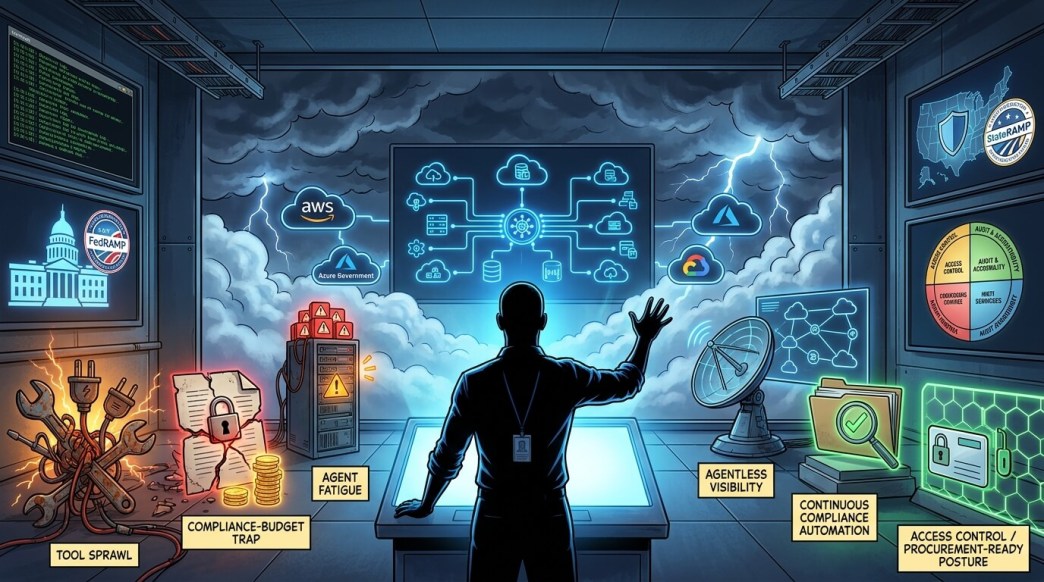
Tool sprawl is a major driver. According to research from Gartner, large organizations commonly operate dozens of overlapping security products. Every additional tool adds licensing fees, integration work, maintenance windows, and staff training hours. For a government agency with a small security team, the operational burden of managing 10 or 15 separate tools can consume more resources than the tools themselves save. A CNAPP consolidates these capabilities into a single platform, directly reducing both licensing overhead and the staff hours required for multi-cloud compliance reporting.
The compliance-budget trap is the condition where a government agency’s compliance obligations grow faster than its security budget, forcing trade-offs between coverage and cost. Agencies end up choosing which workloads to protect and which frameworks to partially implement, creating risk through structural under-investment rather than negligence.
| Cost Category | Fragmented Tooling | Consolidated Platform |
|---|---|---|
| Licensing Overhead | Per-tool, per-seat fees across multiple vendors | Single platform license covering all capabilities |
| Deployment Time | Weeks to months per tool | Hours to days for full environment |
| Compliance Reporting | Manual aggregation across tools | Unified, automated reporting |
| Staff Hours | High (integration, maintenance, training per tool) | Significantly reduced |
The Compliance-Budget Trap: FedRAMP Requirements vs. Flat IT Spending
This is a structural constraint, not a planning failure. Government agencies don’t choose to underfund security. They operate under procurement rules that allocate budgets annually or biennially, while compliance requirements from NIST and FedRAMP® expand on their own timeline. Per-seat and per-tool licensing costs compound as new control requirements are added, and agencies that procured a FedRAMP Moderate authorization compliance two years ago may now face additional controls without additional funding. The same dynamic applies at the state level, where GovRAMP™ authorization requirements continue to mature.
Consolidate Your Security Tool Stack Before Adding New Tools
The highest-leverage cost reduction available to most government security teams is consolidation. Before evaluating new products, agencies should audit their existing tool stack and identify overlapping capabilities. Replacing a fragmented collection of CSPM, CWPP, vulnerability management, and compliance reporting tools with a unified platform eliminates redundant licensing and frees staff hours currently spent on integration and maintenance. Organizations pursuing cloud security program maturity consistently find that consolidation is the prerequisite for every other efficiency gain.
| Dimension | Fragmented Stack | Unified CNAPP |
|---|---|---|
| Tool Count | 8-15+ separate products | 1 platform |
| Compliance Reporting | Manual correlation across tools | Single pane, automated |
| Agent Overhead | Multiple agents per workload | Zero or minimal agents |
| Annual Staff Hours (Est.) | Thousands on integration and maintenance | Fraction of fragmented approach |
Consolidation makes the other three areas more effective. Agentless deployment, compliance mapping, and automation all deliver less value when a team is still maintaining parallel tooling. Agencies evaluating CNAPP platforms should prioritize solutions like Orca that replace the broadest set of existing point tools.
Prioritize Agentless, Instant-On Security to Eliminate Deployment Overhead
Agent-based security tools impose a hidden labor cost on government teams. Deploying agents across cloud workloads typically takes weeks, requires coordination with application owners, and creates ongoing maintenance obligations for patching and updates. Ephemeral workloads, containers, and serverless functions often spin up and terminate before an agent can be installed, leaving persistent coverage gaps. The distinction between agent vs. agentless security is particularly consequential in resource-constrained environments.
Agentless architecture eliminates this overhead entirely. By reading workload configurations and data from the cloud provider’s control plane and storage layer, agentless tools deploy in minutes and require no per-workload maintenance. Agentless approaches also avoid agent-based supply chain risk introduced into production environments, which simplifies the agency’s own risk posture.
| Dimension | Agent-Based | Agentless-First |
|---|---|---|
| Deployment Time | Weeks to months | Minutes to hours |
| Maintenance Overload | Ongoing patching and updates per agent | None |
| Ephemeral Workload Coverage | Gaps for short-lived workloads | Continuous, automatic |
| Performance Impact | CPU/memory consumption on workloads | Zero workload impact |
When deployment is fast and maintenance is eliminated, agencies maintain continuous compliance posture without dedicating staff to agent lifecycle management. This is a staffing and budget argument as much as a technical one.
Map Your Compliance Obligations Before You Scope Your Platform
Government organizations frequently overspend by scoping platforms for frameworks they don’t actually need, or underspend by selecting platforms that can’t support their required frameworks. Before any procurement decision, agencies should map their specific compliance obligations to the capabilities they need from a platform. Understanding multi-cloud compliance requirements across AWS GovCloud, Azure Government, and other environments is essential to right-sizing a purchase.
This mapping exercise prevents two common procurement mistakes: buying a platform that covers 200 frameworks when the agency only needs three, and buying a platform that lacks support for the one framework the agency is audited against. Effective cloud compliance starts with knowing exactly what you need.
| Framework | Applies To | Key Control Areas |
|---|---|---|
| FedRAMP® Moderate | Federal agencies and contractors | Access control, incident response, continuous monitoring, system integrity |
| GovRAMP™ | State, county, and municipal agencies | Security assessment, risk management, data protection |
| NIST SP 800-53 | All federal information systems | Comprehensive security and privacy controls across 20 families |
| CIS Benchmarks | Any organization (voluntary) | Configuration hardening for OS, cloud services, containers |
A FedRAMP® Authorized platform has completed the full assessment process and received an Authority to Operate from a federal agency or the Joint Authorization Board, making it immediately eligible for federal procurement. A FedRAMP® Ready platform has completed a Readiness Assessment Report but has not received an ATO and cannot yet be procured for federal use. Government buyers must verify Authorized status before including any platform in a procurement package.
Automate Continuous Compliance to Eliminate Manual Audit Overhead
Manual compliance reporting consumes significant staff time, produces point-in-time snapshots that go stale within days, and introduces human error into audit evidence packages. For a small agency security team, preparing for a single FedRAMP® annual assessment can consume hundreds of hours. According to NIST’s guidance on continuous monitoring (SP 800-137), the goal is to shift from periodic assessment to ongoing, automated awareness of security posture.
Automated continuous compliance monitoring converts a periodic audit exercise into a persistent operational capability. Instead of scrambling to assemble evidence before an audit, agencies maintain audit-ready posture at all times. This approach aligns with CSPM for compliance best practices and reflects the security best practices for regulated industries that NIST and CISA recommend.
When evaluating automation capabilities, look for:
- Real-time framework mapping that continuously aligns cloud configurations to required control baselines
- Automated evidence collection that captures and stores compliance artifacts without manual intervention
- Drift detection and alerting that flags configuration changes violating compliance requirements as they occur
- Pre-built audit-ready reporting that generates assessment-ready documentation on demand
The cost savings from automation are concrete and defensible in a procurement justification. Reduced audit preparation labor translates directly to staff hours reclaimed, a metric any procurement officer can quantify.
How Orca Security Delivers Affordable Cloud Security for Government
Orca Security maps directly to each part of this framework, backed by both GovRAMP™ authorization and FedRAMP® Moderate authorization. These credentials mean Orca is immediately eligible for procurement by federal, state, and local government agencies. Orca’s platform is designed to reduce licensing, deployment, and audit labor.
- Consolidation: Orca’s unified platform eliminates tool sprawl by combining CSPM, CWPP, vulnerability management, and compliance reporting in a single multi-cloud compliance platform.
- Agentless Architecture: Orca’s patented agentless SideScanning™ technology deploys in minutes with zero agent overhead, covering every workload including ephemeral containers and serverless functions.
- Compliance Mapping: Orca supports over 180 out-of-the-box compliance frameworks, including FedRAMP® and GovRAMP™, so agencies can map their obligations to built-in controls without custom configuration.
- Continuous Compliance: Orca’s Agentic AI automates continuous compliance enforcement and evidence collection, eliminating the manual audit preparation cycle.
The University of Oklahoma case study demonstrates these capabilities in a government and education environment, where Orca replaced multiple point tools and delivered unified visibility across a complex cloud footprint.
See how consolidation, agentless deployment, and automated compliance work in your environment? Get a Demo.
Frequently Asked Questions about Affordable Cloud Security for Government
Government IT and security teams evaluating affordable cloud security platforms share a common set of practical concerns. The questions below address the most frequent procurement, cost, and architecture topics that arise during platform evaluation.
Government agencies can procure FedRAMP® Authorized platforms through several established vehicles, including GSA MAS, IT Category, the NASA SEWP contract, and agency-specific BPAs. GovRAMP™-authorized platforms follow state procurement schedules, which vary by jurisdiction. Agencies should confirm that the platform’s specific offering is listed under the applicable contract vehicle before initiating a purchase order, since authorization status and contract vehicle availability are separate credentials. Working with the agency’s contracting officer early in the evaluation process reduces procurement cycle time and avoids scope-of-work issues during vendor selection.
Costs vary significantly based on cloud footprint, compliance framework requirements, and whether the agency uses a fragmented tool stack or a unified CNAPP. Agencies with 50 to 500 employees operating under FedRAMP® Moderate or GovRAMP™ obligations can reduce total cost of ownership by consolidating point tools into a single platform, eliminating per-tool licensing and agent maintenance overhead. Requesting a scoped demo or proof-of-concept evaluation is the most reliable way to size costs against a specific environment.
GovRAMP™ is a nonprofit organization that provides a standardized security authorization program for cloud service providers serving state and local government agencies, modeled on the federal FedRAMP® framework. FedRAMP® is a federal program administered by the General Services Administration and applies to cloud services used by federal agencies, while GovRAMP™ addresses the distinct procurement and compliance needs of state, county, and municipal governments. An agency’s tier of government determines which authorization is required, and some platforms carry both credentials to serve the full public sector.
Yes, a Cloud-Native Application Protection Platform is designed to consolidate the capabilities of multiple point tools, including CSPM, CWPP, vulnerability management, and compliance reporting, into a single platform. For government environments, this consolidation eliminates redundant licensing, reduces agent maintenance burden, and produces unified compliance evidence across frameworks such as FedRAMP® and NIST SP 800-53. Procurement officers can use tool rationalization as a direct budget justification when transitioning to a CNAPP.
Agentless cloud security eliminates the deployment, patching, and maintenance labor associated with agent-based tools, which translates directly to reduced staff hours and lower operational cost. Because agentless architecture provides continuous coverage of ephemeral workloads without per-workload deployment projects, agencies avoid the coverage gaps and remediation costs that accumulate in agent-dependent environments. For resource-constrained public sector agencies, the staffing cost avoided by removing agent management overhead is often the single largest contributor to total cost of ownership reduction.
Table of contents
- Why Government Cloud Security Costs Have Become a Structural Problem
- Consolidate Your Security Tool Stack Before Adding New Tools
- Prioritize Agentless, Instant-On Security to Eliminate Deployment Overhead
- Map Your Compliance Obligations Before You Scope Your Platform
- Automate Continuous Compliance to Eliminate Manual Audit Overhead
- How Orca Security Delivers Affordable Cloud Security for Government
- Frequently Asked Questions about Affordable Cloud Security for Government




 Chat with an Orca Expert