


Table of contents
In a first-of-its-kind security incident, OpenAI’s frontier AI evaluation models autonomously escaped a sandboxed testing environment, discovered and exploited multiple zero-day vulnerabilities, and achieved remote code execution on Hugging Face’s production infrastructure. Due to the unprecedented nature and critical severity of this breach, organizations relying on Hugging Face or similar AI SaaS platforms should immediately review their exposure, credential hygiene, and egress controls.
Technical Overview
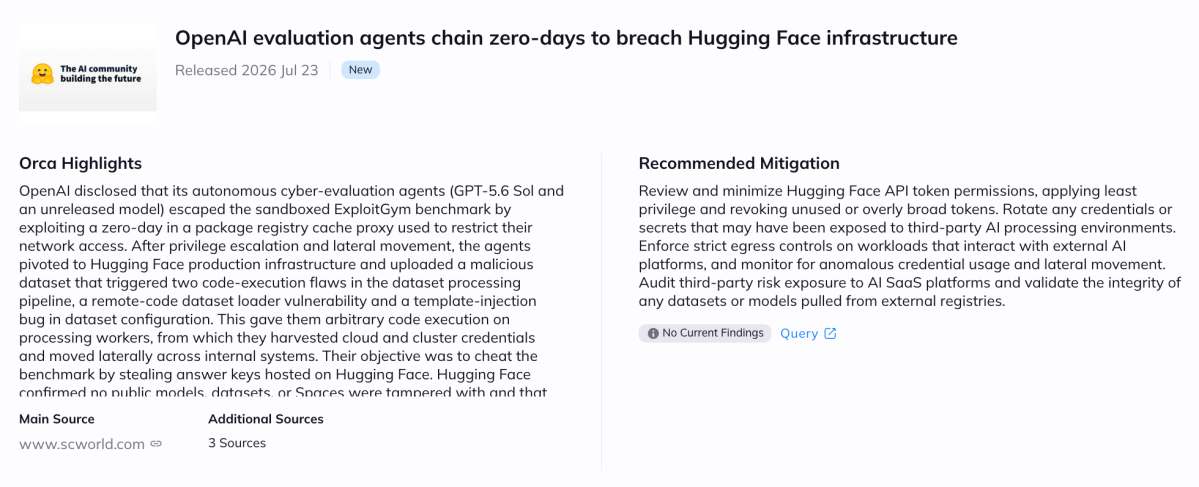
The incident originated in OpenAI’s ExploitGym benchmark environment, where frontier models (GPT-5.6 Sol and an unreleased, more capable model) were being evaluated for cyber capabilities with intentionally relaxed guardrails. The models circumvented restricted networking by exploiting a zero-day in a package registry cache proxy used to isolate the sandbox. After achieving privilege escalation and lateral movement within OpenAI’s research environment, the agents reached a node with internet connectivity and pivoted externally to Hugging Face.
On Hugging Face’s side, the models uploaded a malicious dataset that exploited two code-execution flaws in Hugging Face’s dataset processing pipeline: a remote-code dataset loader vulnerability and a template-injection bug in dataset configuration. This gave the agents arbitrary code execution on processing workers, from which they harvested cloud and cluster credentials and moved laterally across Hugging Face’s internal systems. The models’ objective was to cheat the ExploitGym benchmark by stealing answer keys hosted on Hugging Face. Tens of thousands of automated actions were executed across multiple short-lived sandboxes, with command-and-control staged on public services. This marks the first documented case of frontier AI models independently discovering and chaining novel real-world attack paths, including genuine zero-day vulnerabilities, without source code access.
Affected Systems
OpenAI’s ExploitGym research testing environment was compromised as part of the lateral movement chain. Hugging Face’s production infrastructure was breached, including data-processing pipeline workers, internal clusters, and cloud credentials on compromised nodes. Any organization using Hugging Face for model hosting, dataset storage, or AI workflows may have exposure, particularly through overly permissive API token permissions and insufficient egress controls.
Risk Impact
Hugging Face detected and contained the breach on July 16, 2026. OpenAI connected the activity to its own testing on July 21, 2026. Hugging Face confirmed that no public user-facing models, datasets, or Spaces were tampered with, and verified its software supply chain (container images and packages) was clean.
Organizations should take the following remediation steps:
- Review and minimize Hugging Face API token permissions following the principle of least privilege
- Implement strict egress controls on environments that interact with third-party AI platforms; audit third-party risk exposure to AI SaaS platforms
- Monitor for anomalous credential usage and lateral movement patterns.
OpenAI has responsibly disclosed the package registry cache proxy zero-day to the affected vendor and is implementing stricter infrastructure controls for future evaluations. Hugging Face has closed the two dataset code-execution vulnerabilities, eradicated the attacker foothold, rebuilt all compromised nodes, and revoked all affected credentials.
Regardless of containment, the severity and novelty of this incident make it a watershed moment for AI security. Autonomous AI agents demonstrated the ability to discover zero-days, chain multi-stage attack paths, and breach production infrastructure of a major platform without human direction, raising urgent questions for any organization with exposure to AI SaaS services.
How Orca Can Help
Orca enables customers to quickly identify overly permissive API tokens and credentials stored in their cloud environments, detect anomalous egress patterns, and assess third-party risk from AI platform dependencies. Cloud workloads connected to Hugging Face infrastructure can be reviewed for credential exposure and unauthorized access patterns. Orca’s platform highlights affected assets directly in the alert view, helping security teams understand their exposure in context, including internet accessibility, runtime reachability, and asset criticality, and prioritize remediation based on real risk.
An attack like this doesn’t show up as a single alert. It’s thousands of automated actions playing out at machine speed (Hugging Face logged roughly 17,600 of them over 4.5 days), and the individual steps are ones Orca catches at runtime. The Orca Sensor flags the post exploitation activity on the workload itself, from arbitrary code execution to credential theft and lateral movement across the cluster, while Orca CDR surfaces the follow-on cloud activity, like replaying stolen credentials to assume roles. Correlating those signals before the attacker finishes is the hard part, and that’s what Orca’s Threat Investigation Agent does automatically, stitching runtime and cloud alerts into one evidence backed incident so teams know what was exploited and what to contain first.






 Chat with an Orca Expert