



Executive Summary
A critical vulnerability (CVE-2026-32475, CVSS 9.0) was disclosed affecting the Elementor Pro WordPress plugin, allowing attackers to upload arbitrary PHP files and achieve remote code execution via the Forms module’s File Upload handling. Due to the potential for full server compromise, immediate patching is required.
About CVE-2026-32475
The issue originates from the Forms module’s file upload processing logic, where the extension validation check and the file-move step run in two separate loops with different handling of empty file entries. By submitting two file parts for a single File Upload field, an unauthenticated attacker can bypass the extension blocklist entirely. The uploaded PHP file is written to the publicly accessible directory wp-content/uploads/elementor/forms/<uniqid>.php, granting the attacker arbitrary code execution on the server. No authentication is required to exploit this issue.
Affected Systems
The following component is affected: Elementor Pro Forms module, versions up to and including 4.2.1. Elementor Pro is a widely used commercial WordPress page builder plugin deployed across millions of websites. Any WordPress site running an affected version that has at least one published page containing a Form widget with a File Upload field is vulnerable. The File Upload field’s “Required” toggle is off by default, so no unusual configuration is needed for exploitation.
Related: WordPress core CVE-2026-65640 (CVSS 8.8, fixed in 7.0.4) allows an Author-level user or higher to achieve remote code execution via a malicious PostScript upload. It affects WordPress core versions 4.7 through 7.0, but exploitation requires both Imagick and Ghostscript to be in use on the server, as the underlying flaw is in Ghostscript’s handling of embedded files. Site owners should address both issues.
Risk Impact
Successful exploitation could allow attackers to execute arbitrary PHP code on the web server, install persistent webshells and exfiltrate sensitive data, and potentially pivot laterally across the hosting environment, leading to service disruption, data exposure, or full infrastructure compromise.
At the time of writing, no public proof-of-concept exploit has been released, and no active exploitation campaigns have been publicly confirmed. Regardless, the severity and ease of exploitation make this vulnerability high risk, especially in internet-facing deployments.
Remediation
Users should upgrade Elementor Pro to version 4.2.2 or later, which was released on August 19, 2026. Additionally, administrators should audit the wp-content/uploads/elementor/forms/ directory for unexpected PHP files, review all Elementor forms exposing File Upload fields to assess whether they are necessary, and update WordPress core to version 7.0.4. As an interim mitigation, WAF rules blocking PHP file uploads through form endpoints can reduce exposure.
How Orca Can Help
Orca enables customers to quickly identify assets running vulnerable versions of Elementor Pro, understand their exposure in context, including internet accessibility, runtime reachability, and asset criticality, and prioritize remediation based on real risk rather than CVSS alone. Orca’s agentless SideScanning can detect WordPress installations and their plugin versions across cloud workloads, allowing security teams to pinpoint cloud-hosted WordPress instances running Elementor Pro 4.2.1 or earlier. Orca’s platform highlights affected assets, helping security teams focus on the most critical remediation paths first.
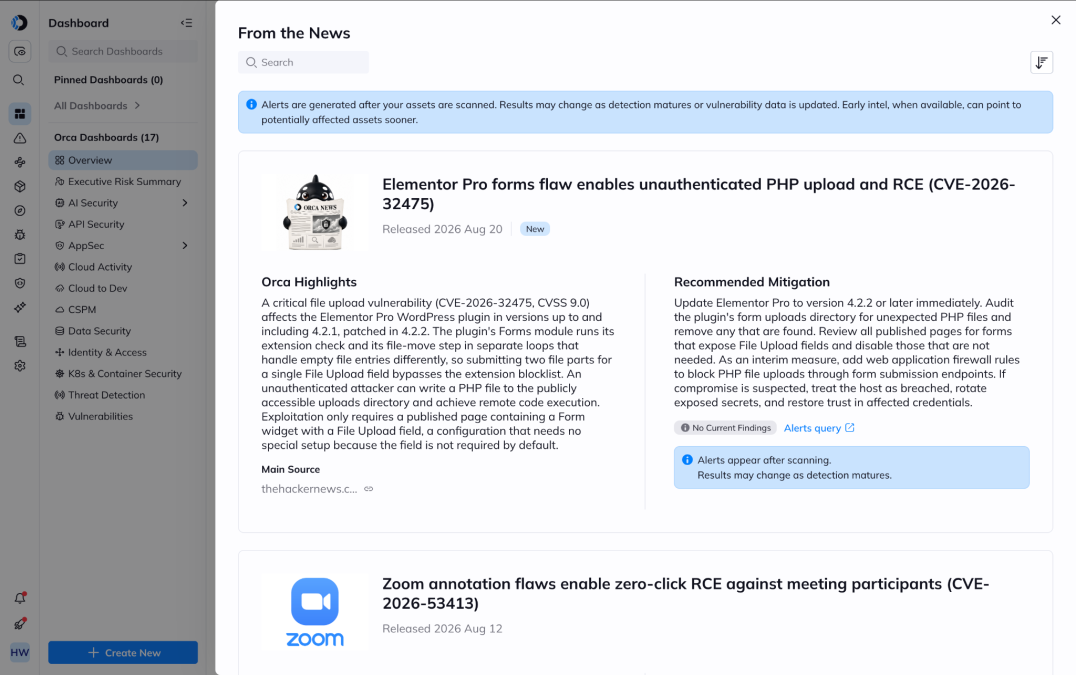
From the News Item in the Orca Platform






 Chat with an Orca Expert