



Executive Summary
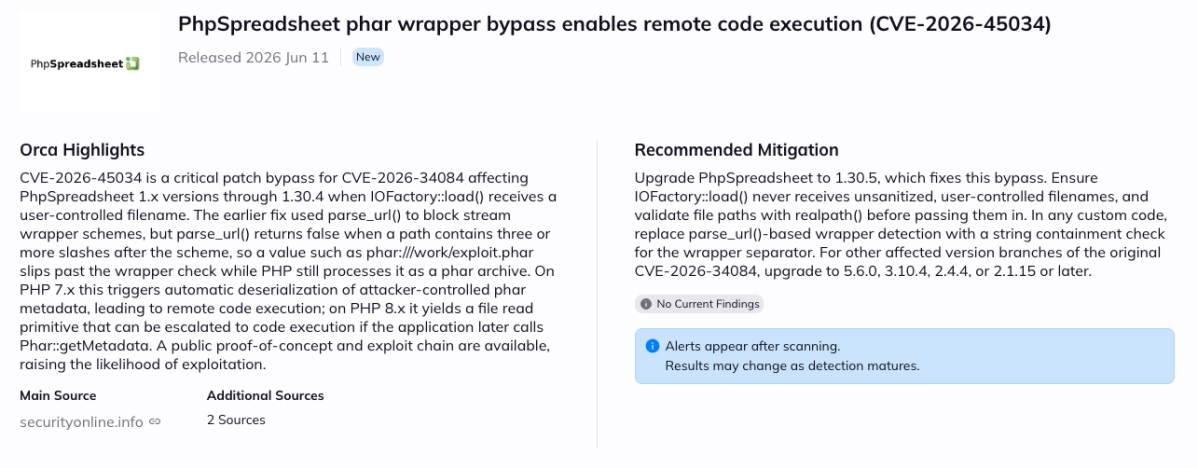
A critical vulnerability (CVE-2026-45034, CVSS 9.8) was disclosed affecting PhpSpreadsheet, the widely-used PHP library with over 312 million downloads, allowing attackers to achieve remote code execution via a bypass of the previous wrapper protection mechanism. Due to the potential for full server compromise and data exposure, immediate patching is required.
About the Vulnerability: CVE-2026-45034
The issue originates from the File::prohibitWrappers() function introduced to fix CVE-2026-34084, where a quirk in PHP’s parse_url() function leads to a complete bypass of stream wrapper detection. When a path contains three or more slashes after the scheme (e.g., phar:///path/to/exploit.phar/dummy.csv), parse_url() returns false instead of the expected scheme string. This causes the is_string($scheme) check to be skipped entirely, while PHP’s stream layer still recognizes the path as a valid phar wrapper. By sending a specially crafted filename containing triple slashes to IOFactory::load(), attackers can trigger automatic phar metadata deserialization on PHP 7.x, potentially gaining full remote code execution. On PHP 8.x, the same technique yields a file read primitive, with RCE restored if the application later invokes Phar::getMetadata(). No authentication is required to exploit this issue when the filename argument is user-controlled.
The following versions are affected:
- phpoffice/phpspreadsheet, all 1.x versions through 1.30.4
These components are used by thousands of PHP applications and frameworks that rely on PhpSpreadsheet for reading and writing Excel, CSV, and other spreadsheet formats, particularly when file upload or import functionality is enabled. Other frameworks or services relying on PhpSpreadsheet’s IOFactory::load() with user-supplied filenames may also be impacted.
Risk Impact
At the time of writing, a working proof-of-concept and full exploit chain (exploit.phar) are publicly available, disclosed by researcher @everping. While no confirmed exploitation in the wild has been reported yet, the public availability of the PoC significantly increases the likelihood of active exploitation. Organizations that previously patched against CVE-2026-34084 should be aware that the earlier patch was proven incomplete.
Successful exploitation could allow attackers to execute arbitrary code on the server, read sensitive files from the filesystem, and potentially pivot to compromise additional infrastructure, leading to service disruption, data exposure, or full infrastructure compromise.
Mitigation Recommendations
Upgrade to the following patched version immediately:
- PhpSpreadsheet 1.30.5, which addresses this bypass
Additionally:
- Organizations that previously patched against CVE-2026-34084 should verify they have also applied this latest fix, as the earlier patch was proven incomplete
- Replace parse_url()-based wrapper detection with string containment checks (such as str_contains($filename, ‘://’)) in any custom validation code
- Ensure that IOFactory::load() never receives unsanitized user-controlled filenames
How can Orca help?
Orca enables customers to quickly identify assets running vulnerable versions of PhpSpreadsheet, understand their exposure in context, including internet accessibility, runtime reachability, and asset criticality, and prioritize remediation based on real risk rather than CVSS alone. Orca’s platform highlights affected assets directly in the newItem view, helping security teams focus on the most critical remediation paths first.





 Chat with an Orca Expert