



A critical credential-harvesting campaign dubbed “FortiBleed” has been exposed, systematically targeting over 430,000 FortiGate firewalls worldwide and exploiting CVE-2026-35616 (CVSS 9.1) in FortiClient EMS, enabling attackers to gain admin access, deploy packet sniffers, and fuel ransomware operations at scale. Due to the massive scope and active exploitation, immediate patching and credential rotation are required.
Users should upgrade FortiClient EMS to version 7.4.7 or later, or apply the out-of-band hotfix for 7.4.5 and 7.4.6. All credentials on FortiGate-managed infrastructure should be rotated immediately, including VPN, RADIUS, NTLM, Kerberos, and admin accounts. Organizations should audit FortiGate admin accounts for the unauthorized “adminin” backdoor account, restrict FortiClient EMS port 8013 to trusted IP ranges, enable MFA on all FortiGate administrative interfaces, and hunt for FortigateSniffer indicators of compromise. Known C2 infrastructure (83.138.53.110 and associated Tor exit nodes) should be blocked.
About FortiBleed
The operation, attributed to a Russian-speaking initial access broker (IAB), scanned the entire internet-facing FortiGate attack surface and achieved admin-level access on 409 targets, with 354 suffering full domain compromise. The attackers deployed a custom Golang packet sniffer called “FortigateSniffer” on approximately 12,000 devices, abusing FortiOS’s native diagnose sniffer packet command to passively intercept authentication traffic across 24 protocols. This approach allowed the operators to harvest RADIUS, NTLM, and Kerberos credentials at scale, amassing over 110 million credentials without triggering traditional intrusion detection.
SOCRadar’s Threat Research Unit directly linked the FortiBleed operation to the INC Ransom and Lynx ransomware-as-a-service (RaaS) groups. An operator with access to FortiBleed infrastructure was discovered actively logged into both INC and Lynx ransomware negotiation panels, and victim data overlapped between the campaigns. At least 12 confirmed ransomware deployments with hundreds of encrypted endpoints resulted from FortiBleed-sourced initial access.
About CVE-2026-35616
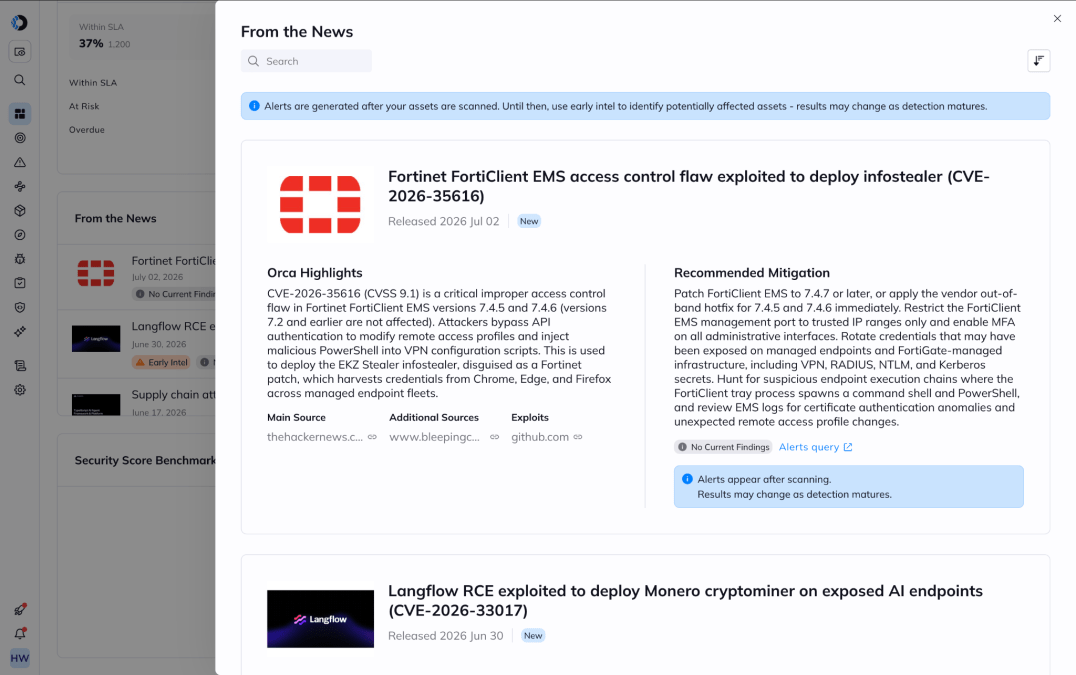
In parallel, CVE-2026-35616 (CVSS 9.1), an improper access control flaw in Fortinet FortiClient EMS versions 7.4.5 and 7.4.6, is being actively exploited in the wild. Arctic Wolf observed attackers exploiting this vulnerability to modify remote access profiles, inject malicious PowerShell into VPN configuration scripts, and deploy the EKZ Stealer infostealer (disguised as “FortiEndpoint_Patch.exe”) across managed endpoint fleets. EKZ Stealer extracts credentials from Chrome, Edge, and Firefox, including bypassing Chromium’s encrypted password storage. CISA added CVE-2026-35616 to its Known Exploited Vulnerabilities catalog on April 6, 2026. No authentication is required to exploit this issue.
Affected Systems
The following components are affected: FortiGate firewalls (all internet-facing deployments) and FortiClient EMS versions 7.4.5 through 7.4.6. These components are widely deployed across enterprise environments, particularly in manufacturing, technology, and logistics sectors in LATAM and APAC. Organizations using FortiGate-managed VPN or remote access infrastructure are at heightened risk, as credentials may have been passively captured via the sniffer component. Investigators also assess the threat actors may possess an undisclosed Nextcloud zero-day, and SOCRadar discovered artifacts indicating potential targeting of Citrix remote access infrastructure.
Risk Impact
At the time of writing, FortiBleed is confirmed as an active campaign with at least 12 ransomware deployments traced back to its access brokering, and CVE-2026-35616 has been added to CISA’s KEV catalog confirming active exploitation. The severity, scale, and direct link to ransomware operations make this threat exceptionally high risk, especially for organizations with internet-facing Fortinet infrastructure.
Successful exploitation allows attackers to harvest credentials passively at massive scale, gain persistent administrative access to network infrastructure through backdoor accounts, and deploy ransomware across fully compromised domains, leading to service disruption, data exposure, credential theft, and full infrastructure compromise.
How Orca Can Help
Orca enables customers to quickly identify assets running vulnerable FortiClient EMS versions and internet-facing FortiGate deployments, understand their exposure in context, including internet accessibility, runtime reachability, and asset criticality, and prioritize remediation based on real risk rather than CVSS alone. Orca’s platform highlights affected assets directly in the From the News widget, helping security teams focus on the most critical remediation paths first.






 Chat with an Orca Expert