



A critical vulnerability (CVE-2026-41089, CVSS 9.8) was disclosed affecting all supported Windows Server versions configured as domain controllers, allowing attackers to achieve remote code execution with SYSTEM-level privileges via the Netlogon RPC interface. Due to the potential for full Active Directory domain takeover, immediate patching is required.
About CVE-2026-41089
The issue originates from the Netlogon RPC interface, where a stack-based buffer overflow in the service’s packet handling logic leads to arbitrary code execution. By sending a specially crafted network request to a domain controller, attackers can gain SYSTEM-level privileges without any prior authentication or user interaction, potentially compromising every domain-joined system in the environment.
Affected Systems
The following components are affected: Microsoft Windows Netlogon Remote Protocol (MS-NRPC) service on all supported Windows Server versions, including Windows Server 2012, Windows Server 2012 R2, Windows Server 2016, Windows Server 2019, Windows Server 2022, and Windows Server 2025, when configured as Active Directory domain controllers. Legacy out-of-support versions such as Windows Server 2008 R2 are also vulnerable.
Background & Discovery
The vulnerability was discovered by Microsoft’s internal Windows Attack Research and Protection (WARP) offensive security team and patched in the May 2026 Patch Tuesday release on May 12, 2026. Active exploitation in the wild was confirmed on May 29, 2026, with Belgium’s Centre for Cybersecurity (CCB) issuing a public warning. Public proof-of-concept code is available, and the flaw has been described as “the most dangerous threat to corporate networks” in the May 2026 patch cycle.
Recommended Actions
Users should upgrade to the May 2026 cumulative security updates on all domain controllers. Critically, all domain controllers in a given environment should be patched in the same maintenance window, as partial patching creates an indefensible state where attackers can target the remaining unpatched controllers. For legacy out-of-support systems (Server 2008 R2, 2012, 2012 R2), micropatches are available from 0patch.
In addition to patching, organizations should restrict Netlogon traffic at the network layer to limit exposure of domain controllers from untrusted or segmented networks. Security teams should monitor for indicators of exploitation, including unexpected Netlogon service crashes, anomalous traffic from non-DC sources, and authentication failures following suspicious network activity.
Risk Impact
At the time of writing, public proof-of-concept exploit code is available, and multiple threat actors are actively exploiting this vulnerability in the wild. The severity, ease of exploitation, and lack of authentication requirements make this vulnerability exceptionally high risk, especially for internet-facing or inadequately segmented domain controllers.
Successful exploitation could allow attackers to execute arbitrary code with SYSTEM privileges on domain controllers, take over the entire Active Directory domain, and potentially deploy malware, exfiltrate credentials, create backdoor accounts, and pivot across all domain-joined systems, leading to full infrastructure compromise.
How Orca Can Help
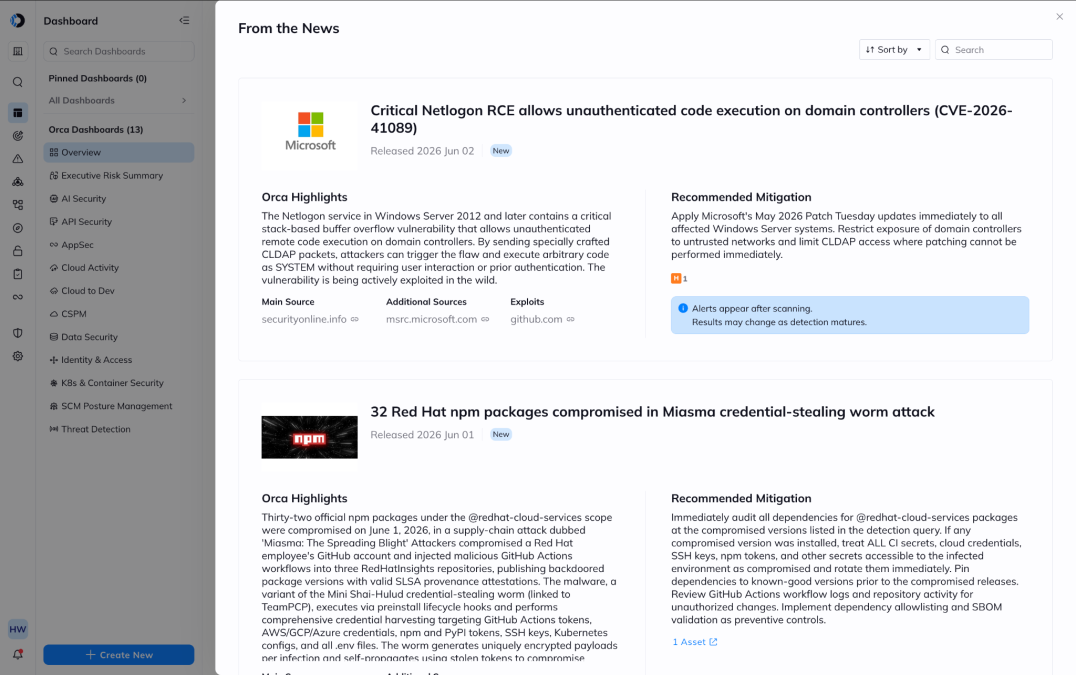
Orca enables customers to quickly identify assets running vulnerable Windows Server versions, understand their exposure in context, including internet accessibility, runtime reachability, and asset criticality, and prioritize remediation based on real risk rather than CVSS alone. Orca’s agentless SideScanning technology can detect unpatched Windows Server instances across cloud environments and flag domain controllers missing the May 2026 security updates. Orca’s platform highlights affected assets directly in the newItem view, helping security teams focus on the most critical remediation paths first.





 Chat with an Orca Expert