



Executive Summary
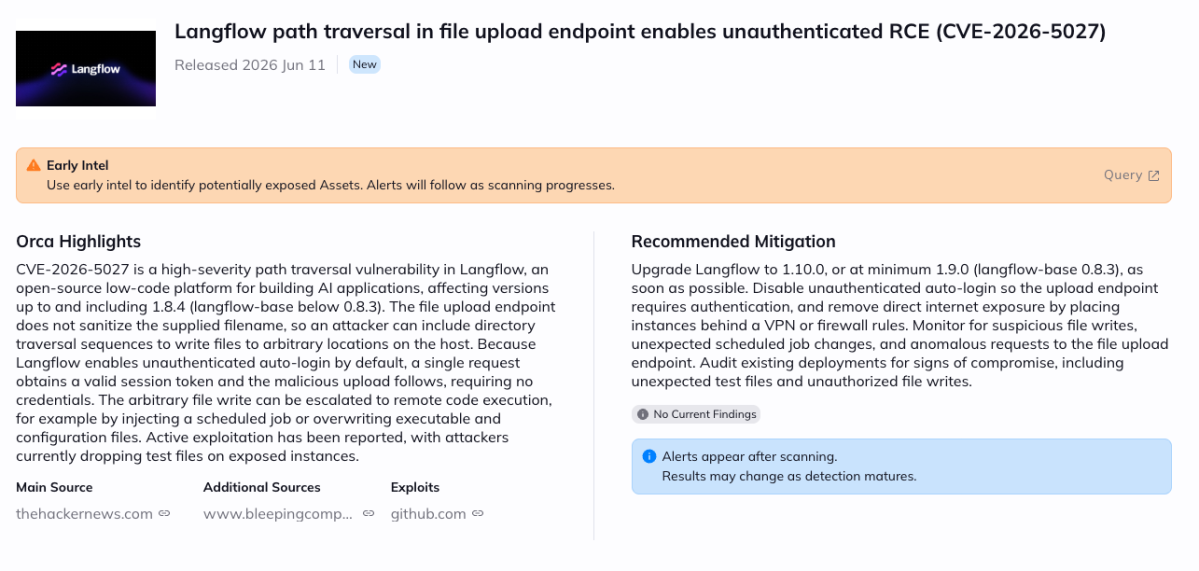
A high-severity vulnerability (CVE-2026-5027, CVSS 8.8) was disclosed affecting Langflow, an open-source low-code platform widely used for building AI applications, allowing attackers to achieve remote code execution via a path traversal in the file upload endpoint. Due to the potential for full system compromise and the trivial nature of exploitation, immediate patching is required.
About the Vulnerability: CVE-2026-5027
The issue originates from Langflow’s POST /api/v2/files endpoint, where the upload_user_file() function in the backend fails to sanitize the filename parameter in multipart form data. By sending specially crafted filenames containing directory traversal sequences (../), attackers can write arbitrary files to any location on the server’s filesystem. Because Langflow enables unauthenticated auto-login by default, a single request is all that is needed to obtain a valid session token and exploit the vulnerability — no credentials required.
The following versions are affected:
- langflow-base versions below 0.8.3
- Langflow versions up to and including 1.8.4
These components are used across AI development workflows and production pipelines, particularly when Langflow is deployed with default auto-login settings and exposed to the network. Censys scans have identified approximately 7,000 publicly exposed Langflow instances, primarily in North America, underscoring the breadth of potential exposure.
Risk Impact
Tenable discovered the vulnerability and attempted responsible disclosure, contacting Langflow maintainers three times between January and February 2026 before publicly disclosing as advisory TRA-2026-26 on March 27, 2026. VulnCheck has since confirmed active exploitation in the wild, with honeypots detecting attackers dropping test files onto vulnerable instances. A public proof-of-concept exploit is available. Prior Langflow vulnerabilities, including CVE-2026-0770, CVE-2026-33017, and CVE-2025-34291 (weaponized by the MuddyWater threat group), demonstrate sustained adversary interest in agentic AI applications infrastructure.
Successful exploitation could allow attackers to write malicious files to arbitrary filesystem locations, escalate to full remote code execution through cron job injection or overwriting configuration files, and potentially pivot across the environment, leading to service disruption, data exposure, or full infrastructure compromise.
Mitigation Recommendations
Upgrade to the following patched versions immediately:
- Langflow 1.10.0 (released June 10, 2026) or at minimum version 1.9.0 / langflow-base 0.8.3
Organizations should also:
- Disable the default auto-login configuration to require authentication
- Restrict network exposure by placing Langflow behind a VPN or firewall
- Monitor for suspicious file write activity, unexpected cron job modifications, and anomalous requests to /api/v2/files
How can Orca help?
Orca enables customers to quickly identify assets running vulnerable versions of Langflow, understand their exposure in context — including internet accessibility, runtime reachability, and asset criticality — and prioritize remediation based on real risk rather than CVSS alone. Orca’s agentless scanning detects Langflow installations across cloud environments through software composition analysis, while Orca’s platform highlights affected assets directly in the alert view, helping security teams focus on the most critical remediation paths first.




 Chat with an Orca Expert