

Unified Data Model
Finally, Your Tools Show One Clear View of Risk
Every cloud and AI asset, configuration, identity, and risk, stitched into one live model. The context every security decision depends on is already connected before you ask the question.
The Challenge
Fragmented Tools Produce Conflicting Risk Pictures
Most teams don’t lack security tools. They lack a single resolved verdict between them. Each scanner sees a fragment, scores it differently, and leaves the security team to reconcile six conflicting pictures of the same asset by hand.
Disconnected tools each hold a partial view, so no single system knows an asset’s full risk.
Correlating findings across posture, identity, data, and runtime becomes manual work that doesn’t scale.
AI workloads enter the environment faster than fragmented tooling can discover or contextualize them.
Our Approach
Your Data, Transformed Into Context That Drives Decisions
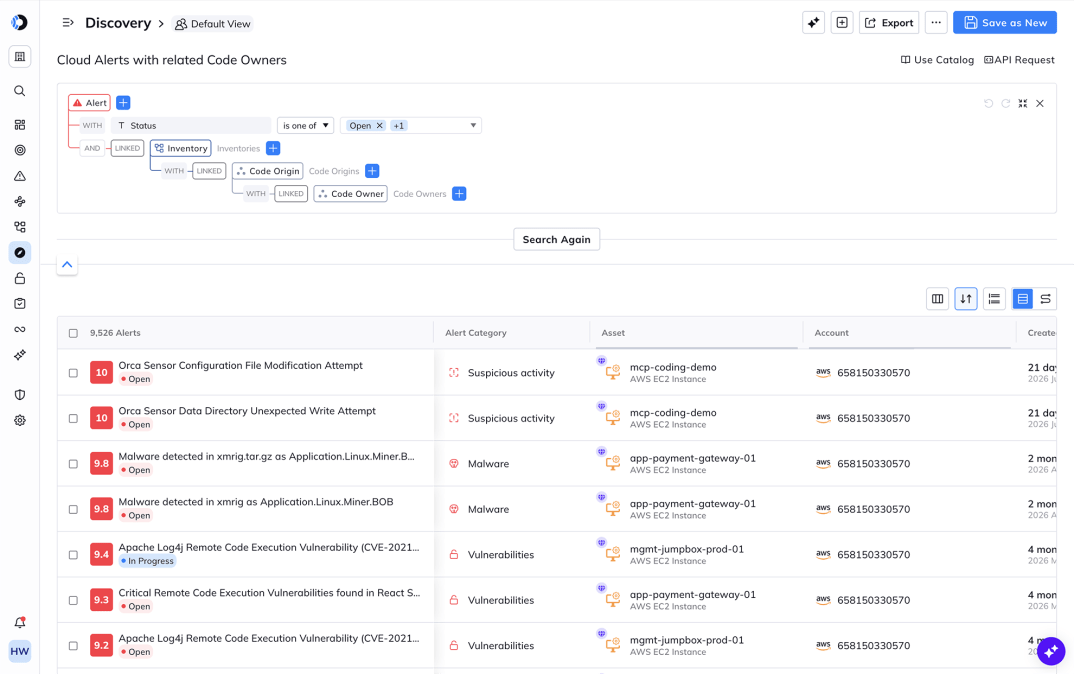
One model unifies signals across your entire cloud and AI estate, so risk is understood in full context, not in isolation. That shared context is what makes prioritization accurate and agentic workflows trustworthy.

Know your true cloud exposure and prove to the board your risk is under control.

Govern every AI system in your cloud before it becomes a liability on your watch.

Catch risky code before it reaches production.

Harden every cloud workload without slowing your pipelines down.

Catch cloud and AI attacks as they unfold and contain the blast radius.
Every Team Works From the Same Context Across Every Cloud and AI Environment
Normalize data across cloud service providers without breaking a sweat.
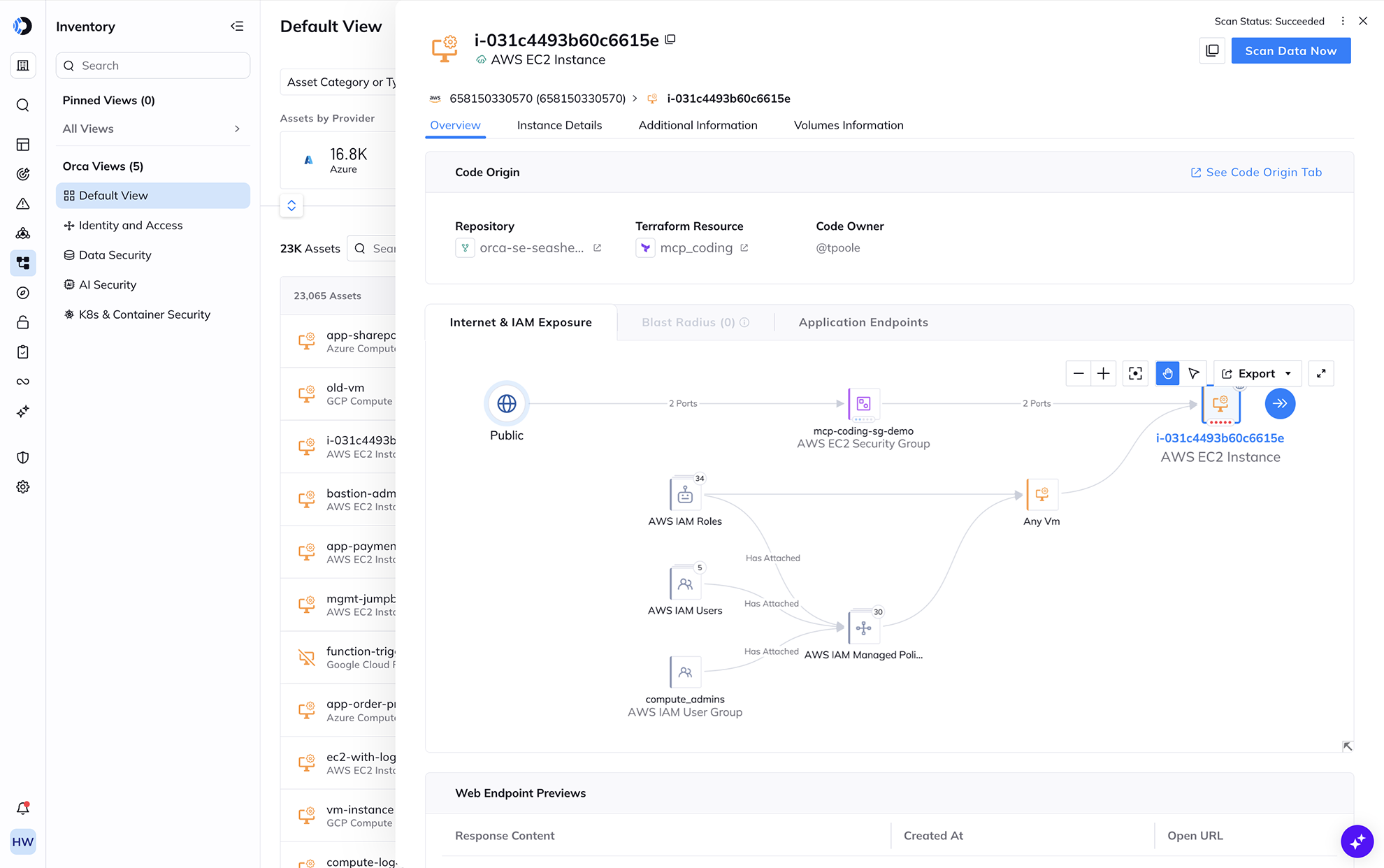
Orca’s Unified Data Model continuously maps every asset, configuration, identity, network path, and data store across AWS, Azure, GCP, Alibaba, Oracle, Tencent, and more into a single model. Complete coverage means no asset, and no risk, hides in a gap between tools.
Context That Changes the Decision, Not Just the Alert Count
Escalate the risk that matters.
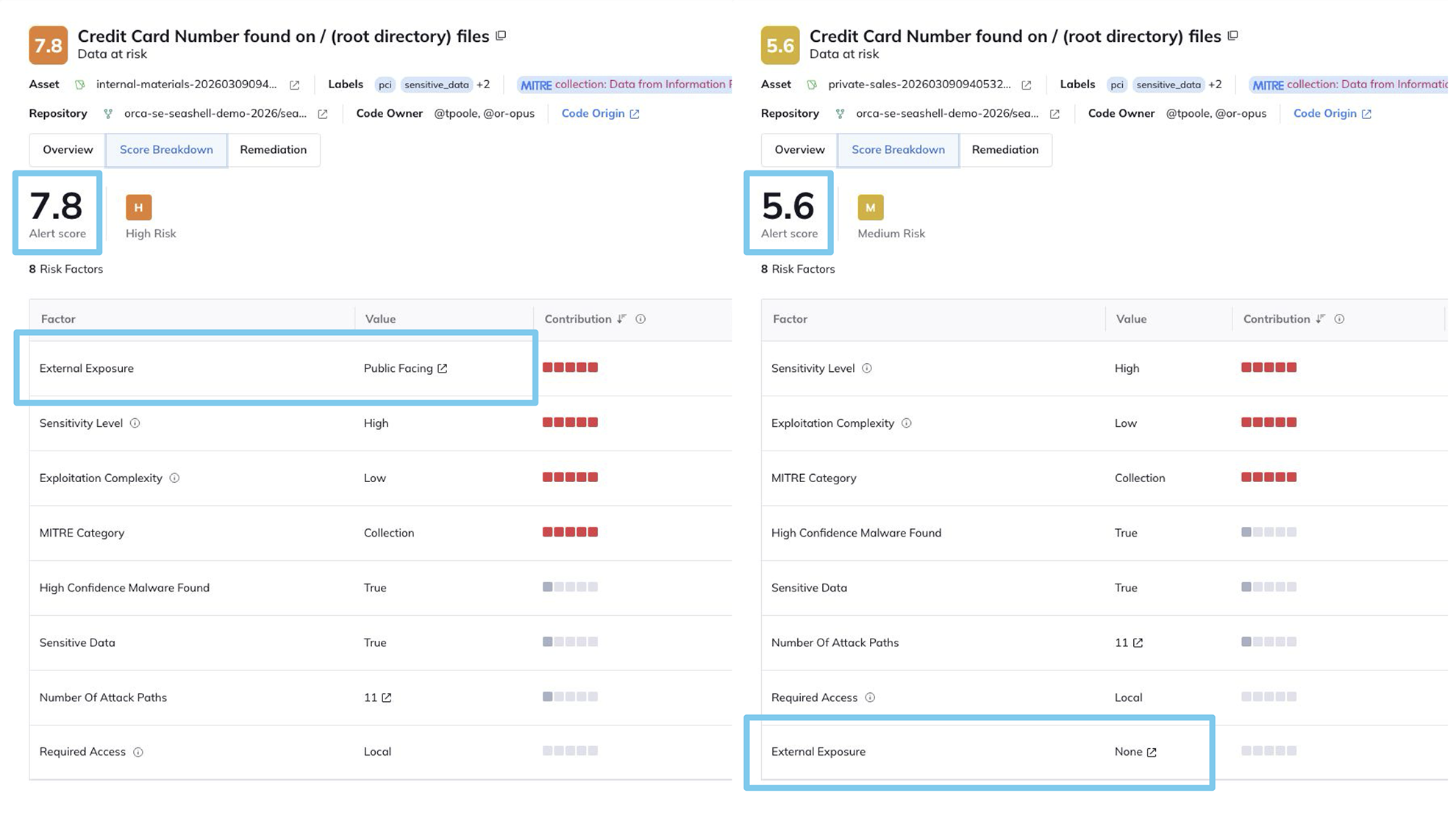
A critical CVE on an isolated dev box is noise; the same CVE on an internet-facing workload with access to sensitive data presents real risk. Because the model holds every relationship between assets, Orca prioritizes by evaluating risk across severity, asset exposure, blast radius, data sensitivity, and more.
Security That Fits the Way Your Team Already Works
Context only helps where work happens.
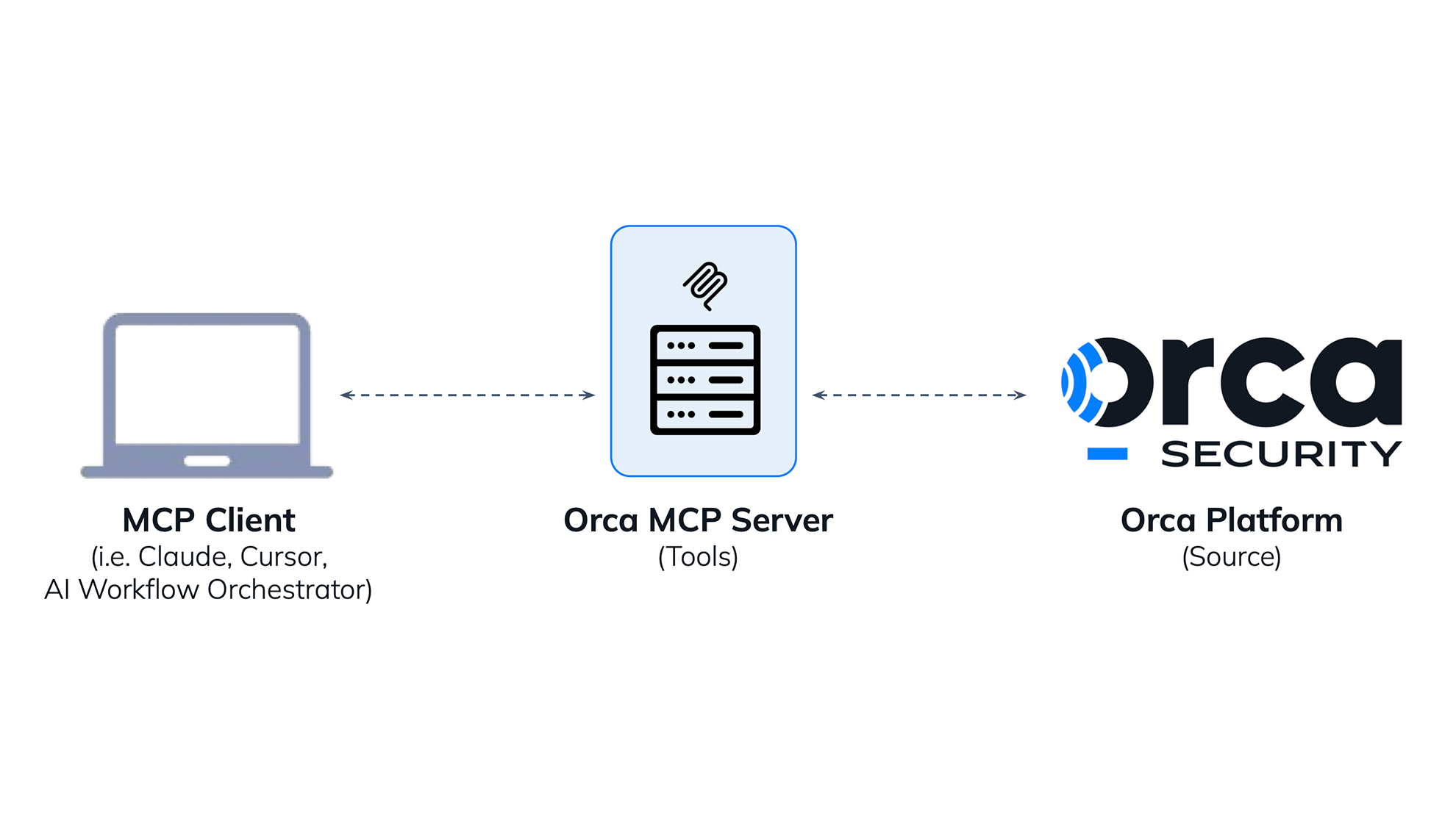
Orca connects through native integrations and an MCP server, so the Unified Data Model feeds the workflows and copilots your team is already relying on. Risk context travels to your developer, your pipeline, or your own LLM, without forcing anyone into another console.
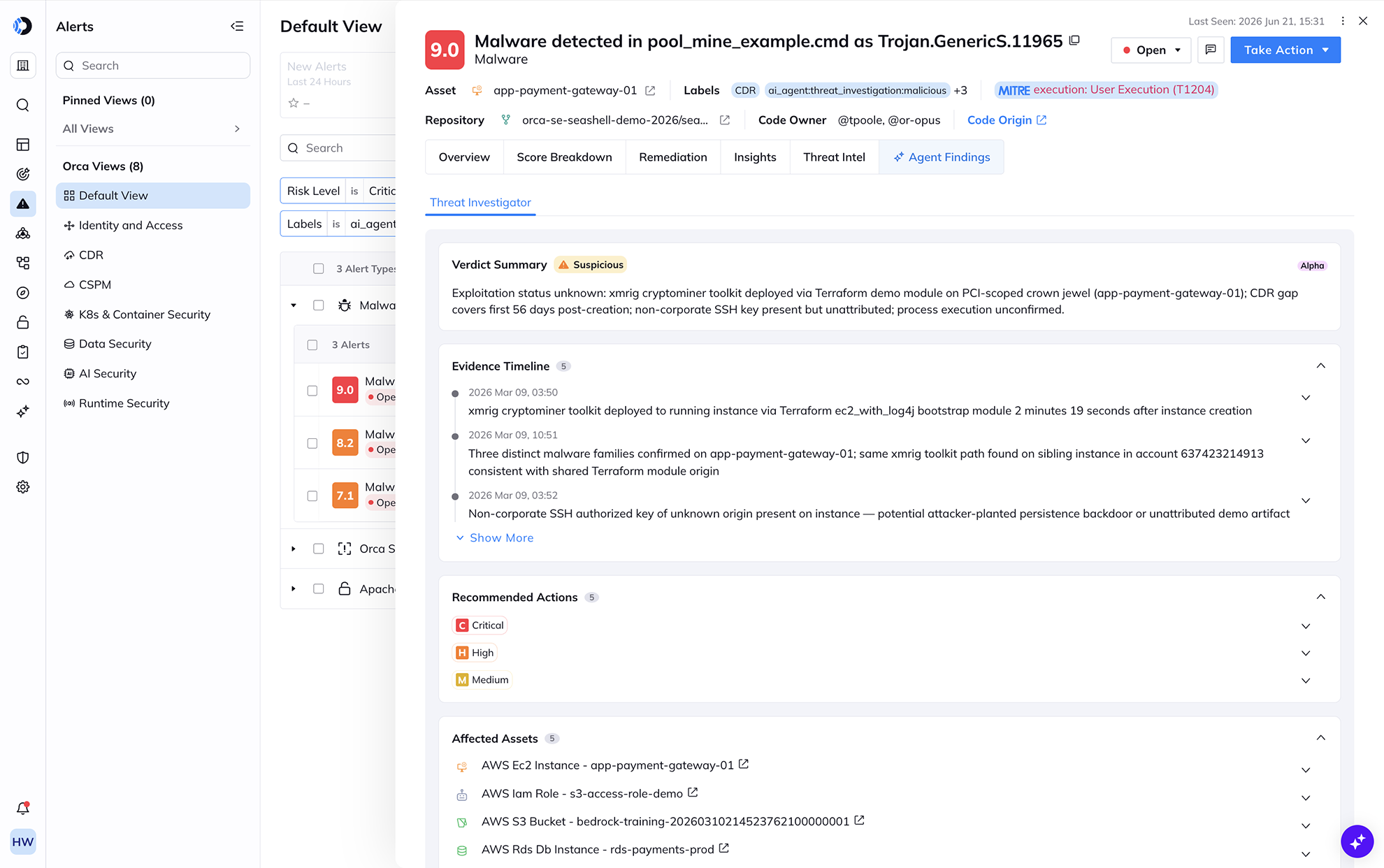
Agentic Conclusions You Can Actually Trust
Every conclusion traces back to the connected facts behind it.
By grounding Orca AI and external agents in one Unified Data Model instead of scattered, conflicting data, investigations and remediations run on a consistent foundation. The result is automation that proposes the right fix because it understands the full picture, not a plausible guess.
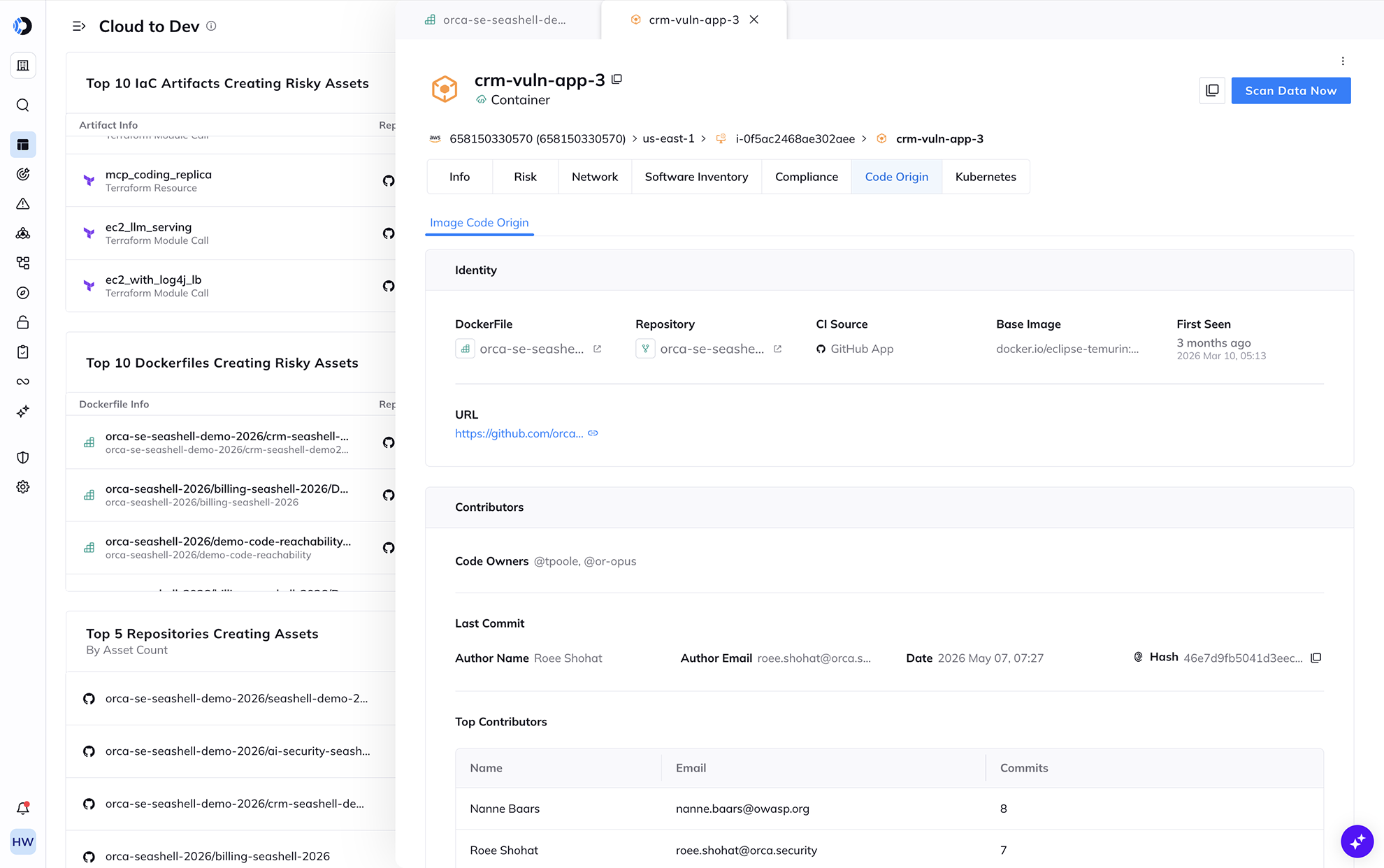
From Code to Cloud to Runtime in One Connected Lineage
Trace runtime exposure back to the code commit that caused it.
When a runtime exposure appears, Orca already knows the IaC template, the repository, and the commit that produced it. That lineage closes the loop between detection and prevention. You fix the root cause in code instead of patching the same misconfiguration in production again next sprint.
Related Resources


2025 Gartner® Market Guide for CNAPP
2025 Gartner® Market Guide for Cloud-Native Application Protection Platforms (CNAPP) Read the report to learn why Gartner is recommending that…
Orca Cloud Security Platform Delivers 198% ROI
Report Orca Cloud Security Platform Delivers 198% ROI In this updated 2026 Return on Investment (ROI) analysis, TAG Analysts evaluated…
Frequently Asked Questions
Unlike solutions that simply report on the severity of each siloed security issue, Orca’s multi-dimensional approach prioritizes risks based on a consolidated assessment against multiple factors:
- Severity: What type of threat is it? What is the CVSS and EPSS score?
- Exploitability: How easy is it for someone to exploit this risk?
- Accessibility: Is the asset public facing? Is there a lateral movement risk?
- Business impact: Is the asset business-critical? Does it contain PII or is it adjacent to assets that do?
The benefits include:
- Improved risk detection: By recognizing when seemingly unrelated, low priority issues can be combined to create dangerous attack paths, organizations can avoid missing critical risks.
- Reduce alert fatigue: By reducing hundreds of alerts to a handful of prioritized attack paths, security teams will feel much less overwhelmed and will not become desensitized.
- Focus on crown jewels: By using the company’s crown jewels as the focus point, security teams can prioritize threats that could lead to damaging breaches, rather than just treating all threats as if they are of equal importance.
- Improved efficiency: Instead of wasting time sifting through low priority alerts, teams can focus on higher-value activities to further improve the organization’s cloud security posture.
- Remediate more strategically: Instead of trying to fix all alerts in the attack path, teams can now start by fixing the ones that break the chain to quickly stem the most immediate danger.
CNAPP actually combines the capabilities of CSPM (detect misconfigurations and compliance), CWPP (detect vulnerabilities, malware, and exposed secrets in cloud-based workloads across virtual machines (VMs), containers, and serverless functions), CIEM (manage access rights and permissions for your cloud resources), Data Security Posture Management (DSPM), Kubernetes and container security, API security, and more.
Orca Cloud Security Platform was built from the ground up as a truly unified cloud native platform: a single platform that provides 100% coverage, detects risks at every layer of your cloud estate, and sees the bigger picture to effectively identify the most critical risks that security teams should focus on.
Because Orca is agentless-first, the platform deploys in minutes with no downtime and without impacting workload performance or DevOps workflows—while maintaining full visibility as your cloud estate evolves. In addition to containers, serverless, and cloud infrastructure, Orca discovers and monitors idle, paused, and stopped workloads, orphaned systems, and devices that can’t support agents.
A good analogy for SideScanning is a medical MRI scanner. Instead of using needles and scalpels to conduct invasive exploratory surgery, the MRI machine diagnoses health issues through non-invasive scanning to obtain a detailed picture of all organs and tissues. The patient is never actually touched by the physician during the procedure.
SideScanning is similar in that it visualizes all cloud assets and connectivity to build a complete model of your cloud environment. It then uses this model to determine risk in the proper context without affecting cloud assets or their functionality in any way.
Orca SideScanning doesn’t run on your workloads so it can examine 100% of your cloud environment without impacting your workload performance. And since the SideScanning process doesn’t use agents that require installation, it can be deployed at any time and won’t impact your IT or DevOps teams.

Chat with Us
See Orca Security in Action
Gain visibility, achieve compliance, and prioritize risks with the Orca Cloud Security Platform.
 Chat with an Orca Expert
No Slack account required.