



Table of contents
- Key Takeaways
- How AI Code Security Is Changing Software Development
- Why Does Pattern-Matching SAST Miss Business Logic Vulnerabilities?
- Reasoning-Driven Scanning with Orca’s Code Security Auditor Red Agent
- AI Reasoning Advantage Paired With Complete Cloud Context
- Expanding the AI Agent Pod
- Security for the Companies that Build
- Learn More
Key Takeaways
- AI has changed who writes code and how fast it ships, and that means more code moving through the pipeline than ever before, with more of it being generated by AI.
- Traditional SAST tools catch what matches a known rule or signature. They’re structurally unable to catch the vulnerability classes that live in logic instead of syntax, like broken authorization, privilege escalation, race conditions, and multi-step business-logic flaws.
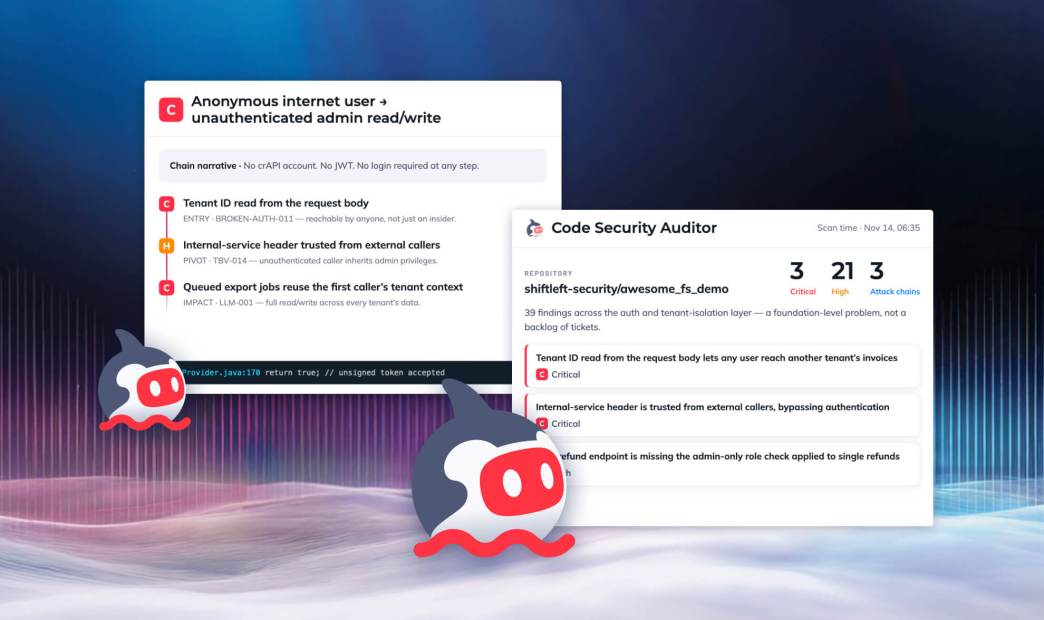
- Orca launches the Code Security Auditor Red Agent, an AI reasoning engine that traces cross-file data flows and reconstructs full attack chains to determine what’s actually exploitable, not just what matches a pattern.
- It runs alongside Orca’s existing deterministic engines (SAST, SCA, secrets, IaC, malicious package detection) without re-hunting what they already cover, so every finding it surfaces is net new.
- The Code Security Auditor belongs to Orca’s Red Pod, one of the purpose-built agent families (Red, Blue, Green) that make up Orca’s Core Agents, with Custom Agents available for teams who want to build their own.
How AI Code Security Is Changing Software Development
Code ships faster than it used to, and AI is a big part of why. Developers lean on AI assistants to write more of it, review less of it line by line, and merge on a schedule no human team could keep up with unassisted. That’s a real productivity gain, but it also means more logic moving through the codebase that nobody fully traced by hand before it went live.
Traditional static analysis was built for a different problem. It’s excellent at catching what it already knows to look for such as a hardcoded secret, an outdated library, a known-bad function call. What it can’t do is reason about intent. A rule-based scanner can tell you a line of code matches a risky pattern. It can’t tell you that an API endpoint checks the wrong user ID before returning sensitive data, or that two functions that are each safe in isolation combine into a privilege escalation path when called in sequence. Those vulnerabilities don’t show up in a signature database at all. There’s no isolated line or pattern a scanner could flag. The exposure only emerges from the logic itself.
This results in a pile of pattern-matched findings that need to be triaged, and a class of the most damaging vulnerabilities that never shows up in that pile in the first place.
Why Does Pattern-Matching SAST Miss Business Logic Vulnerabilities?
Deterministic scanners are valuable for exactly what they do well. SAST, secrets detection, and IaC scanning all catch known-bad patterns and practices fast and at scale, and that coverage is still necessary. Their real limitation isn’t speed, it’s that they are only scoped to flag what resembles something already in a rule set.
That leaves an entire category of exploitable risk untouched. Things like broken object- and function-level authorization, auth bypass, privilege escalation, business-logic flaws, race conditions, trust-boundary violations, second-order injection, or multi-hop SSRF are not a single suspicious line. They’re the product of how a request moves through multiple files, functions, and trust boundaries before it does something it shouldn’t. Catching that requires understanding what the code is trying to do, not just what it looks like.
That’s the gap pattern-matching alone can’t close, and it’s the gap growing fastest as more code ships with less manual review behind it.
Reasoning-Driven Scanning with Orca’s Code Security Auditor Red Agent
The Code Security Auditor Red Agent reasons about data flow and business logic across your full repository, surfacing exploitable issues pattern-matching scanners are structurally unable to catch.
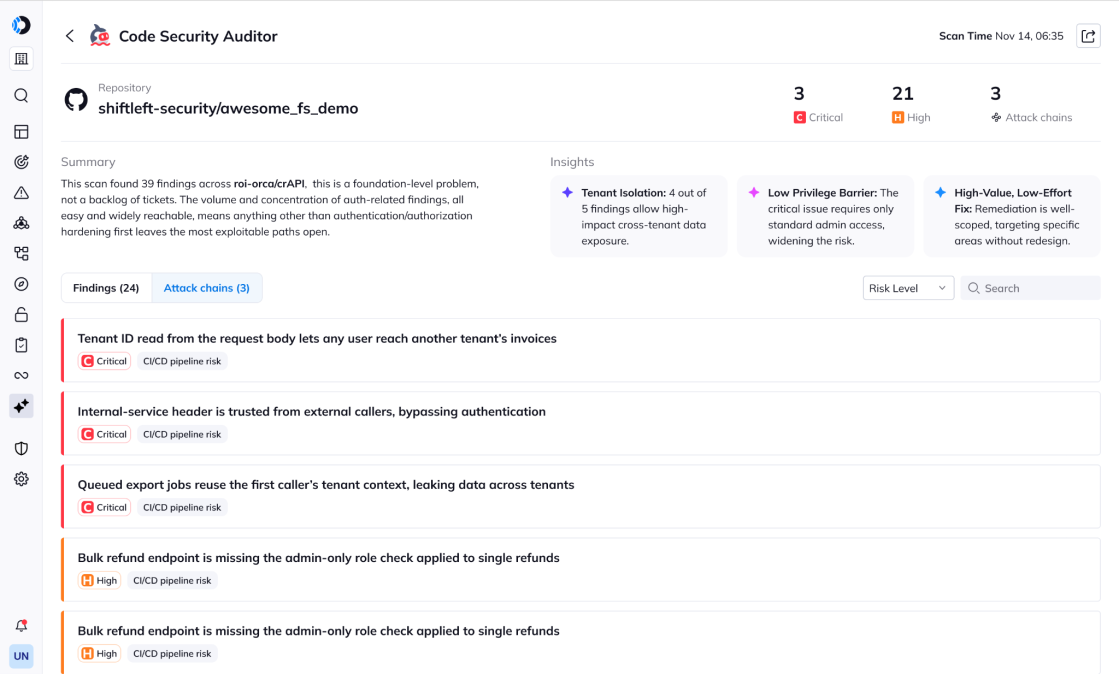
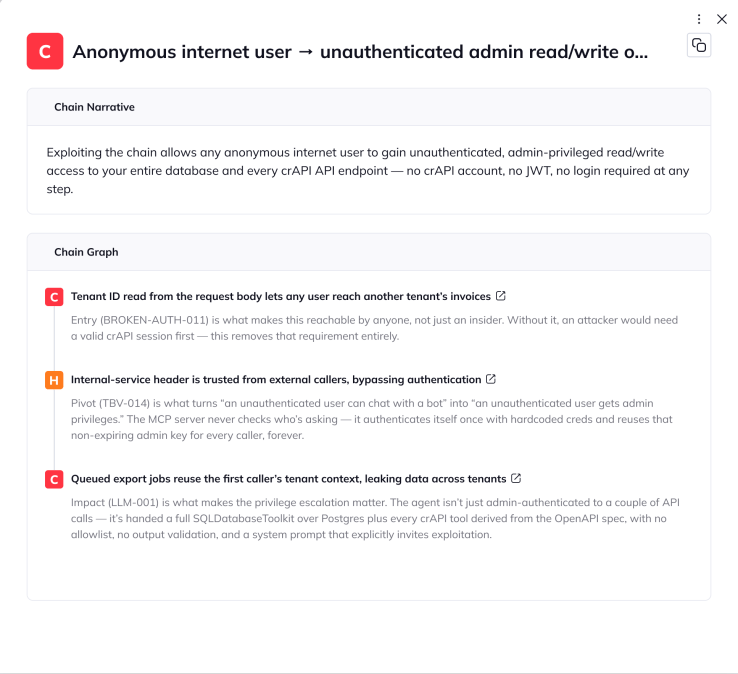
The Code Security Auditor Red Agent scans your full code repository using AI reasoning instead of static rules. Rather than flagging every pattern match, it traces how data actually moves across files and functions, reconstructing the complete attack chain an attacker would take rather than isolated, disconnected lines.
That reasoning is what surfaces the risk classes deterministic tools structurally miss, the same ones outlined above. These are exploitable issues that never resemble a known signature, so they never would have surfaced from pattern matching alone, no matter how current the rule set.
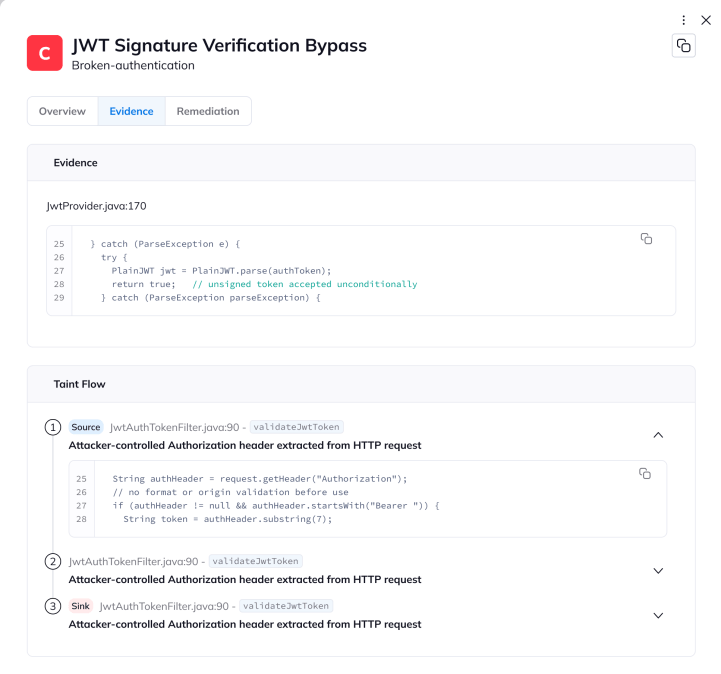
It’s also designed to complement the scanning you already run. The agent works alongside Orca’s existing deterministic engines like SAST, SCA, secrets detection, IaC, and malicious package detection, and doesn’t re-hunt what those engines already cover, so every finding it returns is additive, not a repackaged alert you already have in your queue.
On top of that reasoning, it adds the same cloud exposure context that powers the rest of Orca’s risk prioritization. A vulnerability in a function that’s internet-facing and touching production data is a different conversation than the same flaw in code that never leaves an isolated test environment, and the agent carries that context into every finding instead of leaving it for someone to trace by hand afterward.
AI Reasoning Advantage Paired With Complete Cloud Context
AI-assisted SAST is quickly becoming a checkbox most vendors can claim. Much of the industry markets some version of AI-powered code security, but most of that is triage, explanations, and remediation bolted onto an existing pattern-matching engine. The underlying detection is still signature-based. The AI just helps you make sense of what it found. AI-driven code reasoning as the detection method itself, rather than a layer bolted onto one, is a true need in the market, providing significant benefits over pattern matching alone.
Where Orca’s approach differs further is the starting point. Pure-play SAST vendors live in the code layer and treat cloud context as a nice-to-have, if they have access to it at all. Orca starts from the cloud context it already maintains and extends into code, so a finding comes with a reachability answer attached from the moment it’s surfaced, not a rule match that still needs to be traced back to production impact by a human.
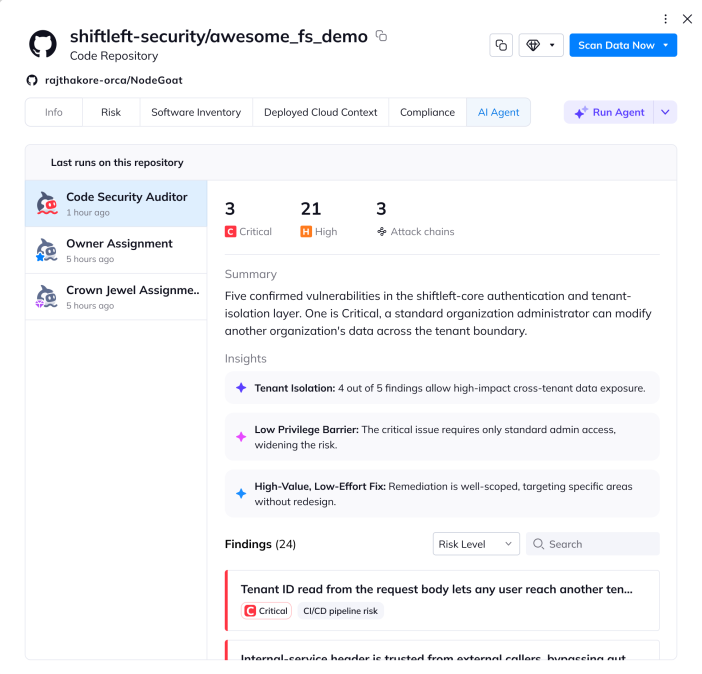
Combined with Orca’s existing visibility across cloud, code, and AI, the Code Security Auditor Red Agent turns the vulnerability classes that used to slip through pattern-matching scanners into something your team can see and prioritize alongside everything else you already track in Orca.
Expanding the AI Agent Pod
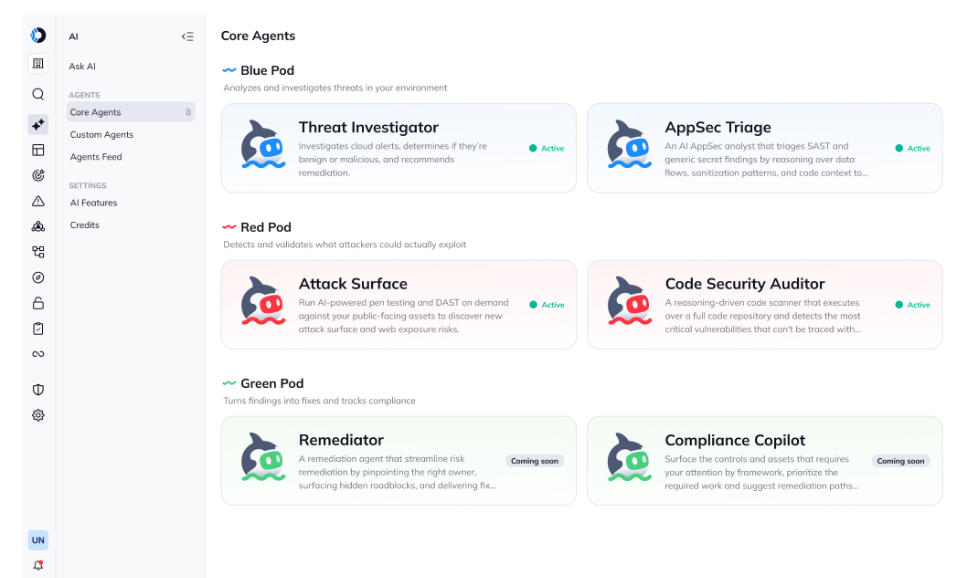
The Code Security Auditor is one of Orca’s Core Agents, specialized agents built out of the box by the Orca team and organized into families by function, Red for attacking, Blue for investigation and triage, and Green for remediation, each purpose-built for a specific need. Orca’s Custom Agents add another layer of flexibility, letting you start from templates and frameworks or build entirely from scratch, so you can shape an agent around your own environment, processes, and use cases. Orca fits the way you work, not the other way around.
The Code Security Auditor belongs to Orca’s Red Pod. Red Pod agents think the way an attacker does: they look for the way in, test whether it holds, and follow it as far as it goes. What reaches you isn’t a list of things that look risky. It’s what an attacker could actually use, with the evidence behind it.
Security for the Companies that Build
Orca offers a unified and comprehensive cloud security platform that identifies, prioritizes, and remediates security risks and compliance issues across AWS, Azure, Google Cloud, Oracle Cloud, Alibaba Cloud, and Kubernetes. The Orca Cloud Security Platform leverages Orca’s patented SideScanning™ technology to provide complete coverage and comprehensive risk detection, built for the companies that build.
Learn More
Interested in seeing how the Code Security Auditor and the Orca Security Platform can help you stay ahead? Schedule a personalized 1:1 demo.



 Chat with an Orca Expert