


Table of contents
- Key Takeaways
- Quick Answer: CIEM vs IAM vs PAM at a Glance
- What Is IAM (Identity and Access Management)?
- What Is PAM (Privileged Access Management)?
- What Is CIEM (Cloud Infrastructure Entitlement Management)?
- CIEM vs IAM vs PAM: Key Differences
- CIEM vs IAM: How They Compare
- CIEM vs PAM: How They Compare
- How CIEM, IAM, and PAM Work Together
- Related Acronyms (Don’t Get Confused)
- Which Do You Need for Cloud Security?
- How IAM, PAM, and CIEM Fit Together
- Frequently asked questions about CIEM vs IAM vs PAM
Key Takeaways
- IAM, PAM, and CIEM all manage access but solve different problems: IAM decides who can log in and what they can do, PAM protects the most powerful accounts, and CIEM right-sizes cloud entitlements for human and machine identities.
- IAM and PAM grew up around human users and on-premises systems. CIEM is the cloud-native layer they were never built to cover, including non-human identities and multi-cloud permission sprawl.
- They complement each other; they do not replace each other. CIEM cannot authenticate users or vault passwords, and IAM and PAM cannot tell you that a service account can reach a database it never uses.
- Most cloud organizations need IAM and CIEM at minimum, plus PAM wherever humans hold privileged access. Larger or regulated estates add IGA, PIM, and ITDR.
- Orca analyzes effective cloud permissions agentlessly and ties each over-privileged identity to the attack path it opens, so teams fix the entitlements that matter first.
IAM, PAM, and CIEM all manage “access,” which is exactly why teams confuse them. The acronyms sound interchangeable, and every vendor draws the lines a little differently. They solve genuinely different problems, and in the cloud the gaps between them are where breaches happen.
Here is the short version. Identity and Access Management (IAM) authenticates a user and decides what that user is allowed to do. Privileged Access Management (PAM) protects the small set of powerful accounts that can change or destroy your environment. Cloud Infrastructure Entitlement Management (CIEM) measures and right-sizes the permissions every identity actually holds across your cloud, including the machine identities IAM and PAM tend to miss.
This article defines each category, compares them across the axes that matter, shows how they layer, and clears up the related acronyms (PIM, IGA, CSPM, SIEM, ITDR) that pile onto the confusion.
Quick Answer: CIEM vs IAM vs PAM at a Glance
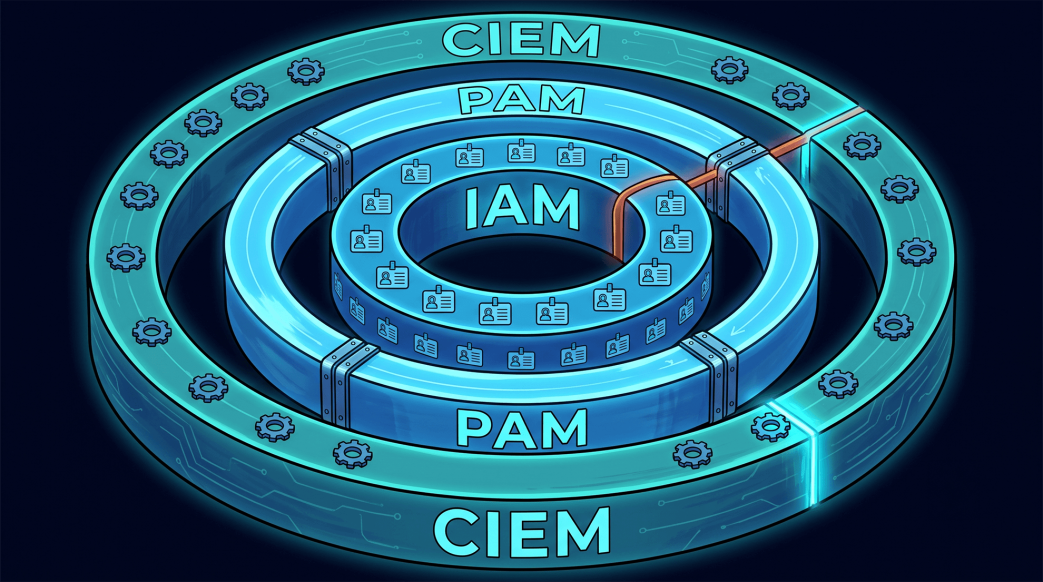
IAM, PAM, and CIEM are three layers of identity security, not three names for the same tool. IAM manages identities and their access rights. PAM secures and monitors privileged accounts. CIEM analyzes and reduces the cloud entitlements those identities accumulate. You typically run them together: IAM as the foundation, PAM around privileged human access, and CIEM as the cloud-native layer that catches over-permissioned human and machine identities at scale.
One access event seen through all three lenses makes the split concrete. IAM lets the user log in and confirms their role. PAM vaults the admin’s credentials and records the privileged session. CIEM flags that the user’s role has effective access to a production database it has never used, helping you remove the unnecessary entitlement.
What Is IAM (Identity and Access Management)?
IAM is the framework that authenticates identities and authorizes what they can access. It is the foundation every other identity control sits on, and it answers two questions: who is this, and what are they allowed to do.
In practice, IAM handles the identity lifecycle. It provisions an account when someone joins, adjusts entitlements when they change roles, and deprovisions access when they leave. It enforces authentication through single sign-on (SSO) and multi-factor authentication (MFA), and it structures permissions through role-based access control, groups, and policies. Cloud providers ship their own IAM services, and identity providers like Okta or Entra ID federate access across them.
Where IAM stops matters as much as what it does. IAM grants permissions, but it rarely tells you whether those permissions are used. A role defined once tends to accumulate access over months, and IAM has no native view of the effective, cross-account permissions an identity ends up with in a multi-cloud estate. It governs human users well and treats machine identities as second-class, a problem when service accounts and roles outnumber people.
What Is PAM (Privileged Access Management)?
PAM secures, controls, and monitors the accounts that hold elevated privileges, the ones that can reconfigure systems, reach sensitive data, or shut things down. If IAM governs everyone, PAM wraps a tighter layer around the few accounts an attacker most wants.
The core mechanisms are specific. PAM vaults privileged credentials so admins check them out instead of knowing the password, and it rotates those secrets automatically after use. It brokers and records privileged sessions for audit and forensics. It grants elevation just in time, so an engineer holds admin rights for the twenty minutes a task needs rather than permanently, and it keeps a break-glass path for emergencies. The goal is to shrink standing privilege and leave a clean trail of who used it.
PAM was built around human administrators and traditional infrastructure: domain admins, root accounts, jump servers, network devices. That heritage is also its limit in the cloud. PAM secures the credentials it knows to vault, but it does not enumerate the thousands of cloud roles and service accounts that grant privilege without a password to check out. It protects access to an account; it does not analyze whether that account’s entitlements are excessive in the first place.
What Is CIEM (Cloud Infrastructure Entitlement Management)?
CIEM is the category that discovers, analyzes, and right-sizes the entitlements of every identity in your cloud, human and non-human. Gartner named the category in 2020 to describe a problem IAM and PAM were not designed for: permissions sprawl across AWS, Azure, and Google Cloud, where a single account can hold tens of thousands of possible actions.
CIEM works by collecting the identity and policy configuration across your cloud accounts, then computing each identity’s effective permissions, the real access that results after roles, group memberships, resource policies, and trust relationships combine. From there it surfaces what is excessive: permissions granted but never used, identities that can escalate to admin, and trust paths that let one role assume another across accounts. It then recommends least-privilege policies, and the better platforms connect an over-permissioned identity to the attack path analysis it enables.
The non-human identity coverage is the part IAM and PAM miss most. Service accounts, CI/CD pipelines, functions, and workload roles authenticate with keys and tokens, not passwords, and they now far outnumber human users in most clouds. CIEM treats them as first-class identities and flags, for example, a build pipeline whose role can assume a production admin role it never needs. CIEM does not authenticate users or vault credentials; it governs the entitlements that IAM grants and PAM protects, which is why it sits alongside them rather than replacing either.
CIEM vs IAM vs PAM: Key Differences
The three categories differ across scope, identities, environment, core function, and the gap each one leaves. The table is the fastest way to see the split; the axis notes underneath explain why each line matters.
| Axis | IAM | PAM | CIEM |
|---|---|---|---|
| Scope | All identities and their access rights | Privileged accounts only | Cloud entitlements for all identities |
| Identities | Mainly human users | Privileged human (and some service) accounts | Human and machine (non-human) identities |
| Environment | On-prem, hybrid, and cloud | On-prem and hybrid first | Cloud-native, multi-cloud |
| Core Functions | Authenticate and authorize; manage lifecycle | Vault, rotate, broker, and record privileged access | Analyze effective permissions and enforce least privilege |
| Key Gap | No view of unused or effective cloud permissions | Blind to un-vaulted cloud roles and service accounts | Does not authenticate or vault credentials |
Focus and Objective
IAM’s objective is the identity lifecycle: grant the right access at onboarding and remove it cleanly at offboarding. PAM’s objective is containment: keep standing privilege low and watch every use of it. CIEM’s objective is right-sizing: continuously measure the permissions identities actually hold and pull them back toward least privilege.
Identity Types Covered
IAM and PAM were designed around people. IAM manages human users at scale and treats service accounts as an afterthought, and PAM focuses on privileged human operators. CIEM gives equal weight to non-human identities, which is decisive in a cloud where machine identities authenticate constantly and outnumber humans many times over.
Environment
IAM and PAM both carry on-premises DNA. They work in the cloud, but their model assumes named accounts, vaultable passwords, and a relatively stable directory. CIEM starts from the cloud’s reality: ephemeral workloads, cross-account role assumption, and provider-specific policy engines across AWS, Azure, and GCP that no single directory unifies.
Core Function and What Each One Misses
IAM decides access but cannot tell you which granted permissions go unused. PAM protects the accounts it vaults but cannot enumerate the cloud roles it never sees. CIEM analyzes effective permissions and attack paths but does not authenticate a login or store a secret. Read together, the three gaps explain why mature cloud teams run all three instead of picking one.
CIEM vs IAM: How They Compare
IAM and CIEM are not competitors; CIEM extends IAM into territory IAM was never built to manage. IAM creates and grants. CIEM audits what those grants add up to and trims the excess.
The practical difference is the effective-permission view. IAM shows you the policy attached to a role. CIEM computes what that role can actually do once every inherited policy, group, and trust relationship resolves, then flags the actions it has never used. The decision rule: use IAM to define and assign access, and use CIEM to verify it stayed least-privilege and to catch the non-human identities IAM treats lightly.
CIEM vs PAM: How They Compare
PAM and CIEM both reduce privileged risk, but they work at different points. PAM controls how a privileged account is accessed and used. CIEM controls how much privilege an identity holds before anyone uses it.
The decision rule: reach for PAM to protect and monitor privileged human sessions, and reach for CIEM to discover and right-size cloud entitlements across the whole identity population, especially the machine identities PAM never vaults. Many teams run both, with CIEM feeding PAM a prioritized list of which privileged paths to lock down first.
How CIEM, IAM, and PAM Work Together
The three form layers, not alternatives. IAM is the foundation that establishes identities and base access. PAM is the reinforced layer around privileged human accounts. CIEM is the cloud-native governance layer that watches the entitlements both of them produce, for every identity type, across every cloud account.
A single scenario shows the handoff. A developer signs in through IAM with SSO and MFA and assumes a role scoped to their team. When that developer needs production admin rights, PAM grants the elevation just in time and records the session. Behind both, CIEM is analyzing the cloud identities at rest and notices two things IAM and PAM cannot: the developer’s everyday role has accumulated read access to a customer-data bucket it has never touched, and a CI/CD service account can assume a cross-account admin role that is reachable from an internet-facing workload.
That second finding is the cloud identity gap in one sentence. IAM granted each permission legitimately, PAM never saw the service account because there was no password to vault, and only the effective-permission analysis exposes the chain an attacker would use for lateral movement. IAM authenticates, PAM contains privileged human access, and CIEM closes the standing-entitlement gaps neither was built to see.
Related Acronyms (Don’t Get Confused)
The identity-security space is dense with three-letter acronyms, and several get mistaken for the three above. Quick disambiguation follows.
PIM vs PAM
Privileged Identity Management (PIM) and Privileged Access Management (PAM) overlap heavily, and some vendors use them interchangeably. The useful distinction: PIM focuses on managing which identities are eligible for privileged roles and granting that elevation just in time, common in Microsoft Entra. PAM is the broader discipline that also vaults credentials, brokers sessions, and records activity. PIM is commonly delivered as part of a broader PAM program, particularly in Microsoft environments. In a pam vs pim vs iam framing, IAM is the base, PAM is the privileged-access discipline, and PIM is the just-in-time elevation piece within it.
IGA vs IAM
Identity Governance and Administration (IGA) sits on top of IAM. IAM enforces access in real time: it authenticates the login and applies the policy. IGA governs access over time through access reviews, certification campaigns, segregation-of-duties rules, and audit reporting. If IAM is the engine that grants access, IGA is the oversight program that periodically asks whether each person should still have it. Regulated organizations often add IGA to support access reviews, certification campaigns, and audit requirements.
CIEM vs CSPM
Cloud Security Posture Management (CSPM) and CIEM are complementary cloud-security categories with different objects. CSPM finds misconfigurations in cloud resources, such as a public storage bucket, an open security group, an unencrypted database. CIEM finds excessive entitlements in cloud identities. You need both, and modern CNAPP platforms increasingly deliver them together, correlating identity risk with posture findings instead of treating them as separate problems. The broader question of when to choose dedicated cloud security tools versus a unified CNAPP platform is a separate architectural decision.
CIEM vs SIEM
These two get confused on spelling alone, and they are unrelated in function. Security Information and Event Management (SIEM) aggregates and correlates log and event data to detect and investigate threats. CIEM analyzes cloud entitlements to reduce identity risk before anything is detected. SIEM is detection over events; CIEM is prevention over permissions.
Where ITDR Fits
Identity Threat Detection and Response (ITDR) covers the runtime side of identity security: detecting and responding to identity-based attacks in progress, such as credential misuse, token theft, and privilege escalation. CIEM reduces the standing entitlements an attacker could abuse; ITDR catches the abuse when it occurs. The two pair naturally, with CIEM shrinking the attack surface and ITDR watching what is left.
Which Do You Need for Cloud Security?
Start from your environment, not the acronyms. If you run anything in the cloud, you already have IAM, because every cloud provider requires it; the question is how well you govern it. The next two decisions are where most teams land.
For a typical cloud-first organization, IAM plus CIEM is the practical minimum. IAM establishes identities and access, while CIEM continuously validates that those permissions remain least privilege as cloud environments evolve. Add PAM wherever humans hold privileged access to systems you cannot afford to lose. Layer IGA and PIM when audit and segregation-of-duties requirements demand formal governance, and add ITDR when you need runtime detection of identity attacks. A zero trust program builds on all of these, combining continuous verification with least-privilege access.
CIEM is where cloud teams most often have a gap, because IAM and PAM rarely expose effective permissions or non-human identity risk. Orca delivers CIEM agentlessly, analyzing the effective permissions of every cloud identity without deploying anything, and ties each over-privileged identity to the attack path it would open. That context is the difference between a list of thousands of excessive permissions and a short, ranked set of the ones that actually expose sensitive data or escalate to admin.
How IAM, PAM, and CIEM Fit Together
IAM, PAM, and CIEM are not three labels for one product, and they are not rivals. IAM authenticates identities and manages their access. PAM protects and monitors the privileged accounts attackers prize. CIEM governs the cloud entitlements both produce, for human and machine identities alike, and closes the standing-privilege gap that IAM and PAM were never built to see. Together they close the cloud identity gap that none of them closes alone.
For most cloud organizations the fastest win is adding CIEM to the IAM and PAM you already run, because that is where over-permissioned identities and attack paths hide. See how Orca surfaces and prioritizes them with full attack-path context. Get a demo.
Frequently asked questions about CIEM vs IAM vs PAM
Yes. Many cloud-first organizations adopt CIEM before PAM because their biggest challenge is managing cloud permissions rather than privileged administrator sessions. CIEM helps identify excessive permissions, unused entitlements, and risky machine identities across cloud environments, while PAM becomes more important as the number of privileged human users and administrative workflows grows.
Yes. CIEM makes access reviews more efficient by continuously identifying excessive permissions, unused entitlements, and high-risk identities. While it does not replace governance or audit processes, it provides the visibility needed to demonstrate least-privilege access across cloud environments.
Modern cloud environments often contain far more service accounts, workload identities, functions, and CI/CD pipelines than human users. These identities constantly receive permissions, but many are rarely reviewed. CIEM continuously analyzes their effective permissions to identify unnecessary access that could increase the blast radius of a compromise.
No. IGA governs how access is requested, approved, reviewed, and certified throughout an identity’s lifecycle. CIEM focuses specifically on analyzing cloud permissions and reducing excessive entitlements. Organizations with mature identity programs often use both together.
Cloud permissions should be reviewed continuously rather than only during quarterly or annual access reviews. Roles, workloads, and machine identities change constantly, making automated monitoring far more effective than periodic manual reviews at maintaining least-privilege access.
Table of contents
- Key Takeaways
- Quick Answer: CIEM vs IAM vs PAM at a Glance
- What Is IAM (Identity and Access Management)?
- What Is PAM (Privileged Access Management)?
- What Is CIEM (Cloud Infrastructure Entitlement Management)?
- CIEM vs IAM vs PAM: Key Differences
- CIEM vs IAM: How They Compare
- CIEM vs PAM: How They Compare
- How CIEM, IAM, and PAM Work Together
- Related Acronyms (Don't Get Confused)
- Which Do You Need for Cloud Security?
- How IAM, PAM, and CIEM Fit Together
- Frequently asked questions about CIEM vs IAM vs PAM





 Chat with an Orca Expert