


Table of contents
Key Takeaways
- Challenge: cloud environments now change faster than traditional, agent-based approaches to security can track, and the addition of AI development has only accelerated that pace.
- Cloud security posture management (CSPM) starts with a comprehensive asset inventory across your cloud native application’s architecture, whether it runs on a single cloud service provider or across multiple providers.
- CSPM solutions continuously monitor for misconfigurations, mismanaged secrets, vulnerabilities, overprivileged identities, and compliance gaps.
- Orca’s CSPM solution reduces time spent on investigation, prioritization, and validation by correlating context across domains (assets, policies, exposure, and now data sensitivity), assigning risk scores per alert and asset, and visualizing attack paths.
- CSPM provides the foundation for proactive cloud security hygiene, and today that same foundation is extending into a broader CNAPP platform.
Introduction
The cloud revolution transformed how businesses build, giving teams the flexibility and speed to ship faster than ever. But that same speed means security teams are now trying to secure environments that change by the hour, built by developers, platform teams, and increasingly, AI agents, all moving faster than any manual review process can follow. Cloud Security Posture Management (CSPM) emerged as the first real answer to this problem.
In this guide, we’ll explore what CSPM is, why it came to life, how it differs from other cloud security tools, and why it’s still essential today, as the strong foundation that today’s broader, consolidated platforms like CNAPP are built on.
What is CSPM?
Cloud Security Posture Management (CSPM) is a collection of security capabilities that identify, control, and remediate misconfigurations in cloud infrastructure. CSPM detects issues like internet-exposed virtual machines and storage buckets, unchanged default settings, open ports not in use elsewhere in your infrastructure, and more.
CSPM remains one of the most foundational cloud security capabilities, and the market around it keeps growing. But the CSPM market has consolidated and shifted toward CNAPP. CSPM today is best understood not as a product category of its own but as the visibility layer inside a broader platform.
Evolution and significance in the cybersecurity landscape
In 2014, Gartner coined the term “Cloud Security Posture Management” to describe an emerging category. As AWS, Microsoft Azure, and Google Cloud gained adoption, CSPM emerged to solve a problem that Cloud Workload Protection Platforms (CWPP) weren’t built for, keeping the configuration of cloud services themselves secure and compliant.
Unlike CWPP, CSPM let organizations maintain proper configuration of their cloud services, satisfying their end of the shared responsibility model with cloud service providers. That model still holds today, with organizations responsible for their cloud assets and services while providers secure the underlying infrastructure.
CSPM helped meet that responsibility, and it was purpose-built for configuration, not runtime. CWPP and the other capabilities that followed, such as CIEM, DSPM, and API security, added visibility into the workloads themselves, catching vulnerabilities, malware, and exposed secrets running inside them.
The risks of cloud misconfigurations
Cloud misconfigurations remain one of the most common causes of cloud breaches, and a few factors keep driving them:
- Neglected cloud assets: forgotten assets accumulate vulnerabilities over time, and they remain a very common reality of real cloud estates. According to Orca’s State of Cloud Security Report, the majority of organizations still carry at least one public-facing neglected asset with exploitable open ports, a wide open door for initial access and lateral movement.
- Lack of cloud visibility: many organizations rely on siloed tools or agent-based coverage that only reaches a fraction of their assets, leaving real gaps in what’s actually monitored.
- Unaltered default values: default usernames, ports, and credentials often go unreviewed, leaving known and publicly documented weaknesses in place.
- Insufficient monitoring: without logging and monitoring built into cloud configuration, critical issues go unnoticed until they become incidents.
- Overprivileged identities: excessive access turns a single compromised credential into a much bigger problem. This risk has grown with non-human identities like service accounts, API keys, and AI agents, which now outnumber human identities in most cloud environments and often carry excessive, unreviewed permissions.
- Mismanaged secrets: plaintext passwords, API keys, and access tokens significantly raise the odds and impact of compromise.

report
State of Cloud Security 2025
Understanding Cloud Security Posture Management and how it protects your cloud
CSPM continuously scans cloud environments for violations of security policy and industry best practice, giving teams centralized visibility into the entire control plane and the ability to run risk assessments across it. This is the starting point for what we think of as complete visibility, seeing everything running across every environment before a misconfiguration becomes a breach.
By flagging misconfigurations early, CSPM helps reduce cost, catch risk before it compounds, and give teams a shared, accurate picture of what they’re actually running.
The role of Cloud Security Posture Management in modern cloud security
As a foundational capability, CSPM fulfills several important functions:
- Security policy enforcement: monitoring for misconfigurations and identifying compliance risk.
- Multi-cloud configuration management: centralizing visibility of the cloud control plane across providers.
- Cloud control plane audits: connecting via API for instant access and auditing across multi-cloud environments.
- Compliance reporting: continually checking configurations against compliance frameworks.
- Threat intelligence integration: ingesting native cloud provider threat data to further prioritize misconfiguration risk.
How does Cloud Security Posture Management work?
Cloud asset inventory
CSPM provides a cloud infrastructure inventory that gives organizations visibility into every asset running in the cloud, as well as the foundation for reporting on risk and taking action on it.
Continuous cloud compliance monitoring
CSPM continuously monitors cloud resources against a wide range of compliance frameworks and regulations that vary by region, state, country, industry, and more, keeping standards current so organizations can identify, mitigate, and remediate compliance risk.
Common compliance frameworks include:
- Center for Internet Security (CIS) benchmarks
- General Data Protection Regulation (GDPR)
- Health Insurance Portability and Accountability Act of 1996 (HIPAA)
- ISO 27001
- PCI-DSS
- System and Organizational Controls 2 (SOC 2)
Examples of compliance risk that CSPM identifies include unencrypted personally identifiable information (PII) and storage buckets or databases lacking restricted access.
CSPM platforms provide a cloud infrastructure inventory which gives organizations visibility into all the assets that are running in the cloud. This enables the CSPM to report on risks found in your infrastructure, while also allowing your teams to then remediate and take action based on this information.
Common compliance frameworks
- Center for Internet Security (CIS) benchmarks
- General Data Protection Regulation (GDPR)
- Health Insurance Portability and Accountability Act of 1996 (HIPAA)
- ISO 27001
- PCI-DSS
- System and Organizational Controls 2 (SOC 2)
Examples of compliance risks that CSPM technology identifies include unencrypted personal identifiable information (PII) and the absence of restricted access to PII data or storage buckets.
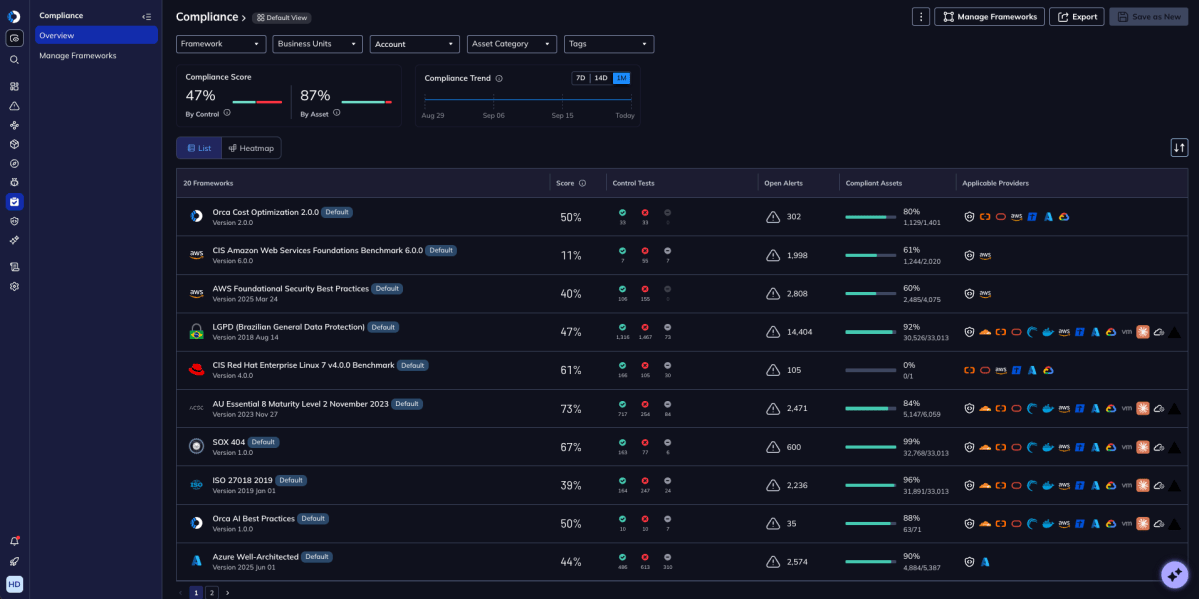
CSPM solutions continuously monitor for compliance framework violations
Cloud compliance standards
CSPM platforms use predefined standards to strengthen your organization’s cloud security posture, and to help meet mandatory requirements wherever customer PII, such as social security numbers, protected health information, or passport numbers, is involved.
Policy-based definitions
CSPM defines and enforces policies governing who can access results, reports, and data tied to compliance standards.
Detection of cloud threats
CSPM identifies weaknesses that could compromise cloud infrastructure, and many solutions prioritize alerts by categorizing threats as hazardous, imminent compromise, or active compromise, along with the asset types affected, so teams can track the health of their environment over time.
Incident response
Many CSPM platforms let teams review how threats are detected, contained, and remediated, and document responsibility for responding to them. Integration with ticketing (Jira, ServiceNow) and alerting systems (Slack) helps teams identify, respond to, and remediate threats inside their existing workflows.
Auto-remediating cloud risks and compliance issues
After identifying risk, CSPM offers automated and guided remediation, in some cases generating step-by-step fixes directly, and integrating remediation steps with the ticketing and alerting systems teams already use.

Case Study
Learn about Banco Progretto’s CSPM success story
Cloud Security Posture Management vs other solutions
While among the most popular cloud security solutions, Cloud Security Posture Management platforms are often used in tandem with other security tools since CSPM does not discover all risk areas, such as vulnerabilities and malware.
Below we compare CSPM to other popular cloud security products:
| CSPM | CNAPP | CWPP | CIEM | |
|---|---|---|---|---|
| Goals | Identify and remediate cloud misconfigurations and compliance issues | Via a unified platform, identify, prioritize, and remediate security risks and compliance issues across the entire cloud estate | Protect host systems and workloads | Manage access and permissions |
| Key capabilities | Misconfiguration detection, compliance reporting | Misconfiguration detection, compliance reporting,, vulnerability management, identity governance, entitlement management, API security, data security, container and Kubernetes security, AI security, Shift Left security, cloud detection and response (CDR) | Runtime protection, vulnerability management, malware detection | Identity governance, entitlement management |
| Threats covered | Misconfigurations, policy violations | Vulnerabilities, misconfigurations, malware, lateral movement, IAM risk, data risk, API risk, active breaches | Host and container vulnerabilities, malware | Excessive permissions, IAM risks |
| Best uses | Comprehensive cloud environment monitoring | Unified End-to-end cloud security | Protection of cloud workloads across environments | Access controls in multi-cloud environments |
CSPM vs. CWPP
CSPM tools cover cloud environments and any misconfigurations that could present risks to them. On the other hand, cloud workload protection platforms (CWPPs) focus on securing cloud-based workloads across virtual machines (VMs), containers, and serverless functions. They largely focus on what’s currently running on the cloud rather than their configuration
CSPMs cover the control plane (configurations), while CWPPs cover the data plane. Both CWPPs and CSPMs provide needed capabilities for effective cloud security.
CSPM vs. CIEM
While CSPM solutions provide essential visibility into misconfigurations, cloud infrastructure entitlement management (CIEM) solutions manage access rights and permissions for your cloud resources. CIEMs remain critical for building a strong security strategy based on the principle of least privilege (PoLP). CIEM solutions offer several major advantages, including scalable entitlements visibility, compliance assurance, and more.
CIEM and CSPM solutions are complementary and both are necessary for cloud security.
CSPMs vs. CNAPPs
CSPM platforms lack the functionality of CWPP and CIEM. On the other hand, cloud-native application protection platforms (CNAPPs) offer all these capabilities in one platform, along with API security, container and Kubernetes security, Shift Left security, and more.
Since Gartner first named the CNAPP category in 2020, the platform is now a popular alternative to using a standalone CSPM tool and other disparate cloud security solutions. CNAPPs tend to produce cost advantages, enhanced user experiences, improved efficacy, and more compared to other cloud security products. According to Gartner, 75% of new CSPM purchases will come from CNAPP offerings by 2025.

Case Study
Paidy Saves Two FTEs and $500,000/Year in Cloud Security Management Costs
Limitations of CSPM: Expanding into CNAPP
CSPM is scoped to the control plane, so on its own it doesn’t cover a few key areas, all of which CNAPP is built to close:
- Workload visibility: CSPM doesn’t see into workloads themselves, so it can’t detect vulnerable web servers or infected workloads running in the cloud. CNAPP or CWPP fills that gap.
- Alert prioritization: CSPM prioritizes based on the control plane alone, so it can’t factor in the wider context, like identity or data risk, that determines how severe a given issue actually is. CNAPP adds that context.
- Lateral movement mapping: CSPM can’t identify which credentials or paths would let an attacker move from an initial breach toward a more valuable target. CNAPP maps that instead.
- Identity and data context: CSPM doesn’t manage entitlements or know what kind of data sits behind a misconfiguration, so it can’t tell you whether an exposed bucket holds test data or customer PII. CNAPP adds that context.
This is exactly what a true CNAPP brings together, combining CSPM with CWPP, CIEM, data security posture management (DSPM), container and Kubernetes security, API security, and more, so a single misconfiguration is understood in the full context of what it exposes and how it connects to everything else in the environment.
Choosing the right CNAPP for your Cloud Security Posture Management needs
The emergence of CNAPPs offers cloud capabilities and coverage that extend far beyond traditional Cloud Security Posture Management tools. That explains why most organizations are now looking to CNAPPs for their cloud security needs. Yet it also calls for acknowledging that the capabilities and benefits of CNAPPs vary significantly depending on the vendor.
To ensure you choose the best solution, look for the following characteristics or features needed for effective CSPM:
Comprehensive
Look for platforms that use a wide range of configuration controls across categories like authentication, logging and monitoring, data protection, network configuration, Kubernetes configuration, and system integrity.
Also favor solutions that alert you to the full range of security policy violations, including misconfigured S3 buckets, KMS keys, Elasticsearch and RDS databases, Google storage buckets, and much more.
Orca’s Cloud Security Platform, for example, uses more than 2,500 configuration controls across more than 10 categories, and alerts on the full range of common misconfigurations, from exposed storage buckets to misconfigured databases and KMS keys.
Unified
Look for a solution that provides visibility, context, and remediation across all of your CSPM and other cloud security needs. Tools that are stitched together from separate acquisitions, rather than built as one platform from the start, tend to create blind spots, reduce efficiency, and cause headaches in day-to-day usage.
Context-aware
Many platforms surface plenty of alerts but struggle to effectively highlight ones that matter most, leading to alert fatigue and forcing teams to manually sort urgent issues from ones that can wait. This is where context that powers decisions becomes the differentiator, correlating signals such as severity, reachability, and exploitability across cloud, identity, and data so teams act on what’s actually risky instead of triaging everything by hand.
- No insight into workloads: CSPM solutions don’t cover workloads. For example, they can’t detect vulnerable web servers or infected workloads, which requires a CNAPP or CWPP solution.
- Ineffective alert prioritization: CSPM platforms only prioritize alerts based on factors in the control plane, not the data plane. As a result, this limited view prevents alerts from accounting for all contextual factors that make risks more or less severe.
- No lateral movement risk detection: Attackers often use an initial breach as the starting point for moving laterally in a cloud environment toward their intended target. CSPM tools can’t identify which keys could allow hackers access to other assets, leaving critical attack vectors unidentified and exposed.
- Identity and permissions management: CSPMs tools don’t manage cloud access controls, permissions, and entitlements. As a result, organizations lack the functionality to address excessive permissions and apply the principle of least privilege (PoLP) to cloud resources.
A true CNAPP combines the capabilities of CSPM with CWPP, CIEM, Data Security Posture Management (DSPM), Kubernetes and container security, API security, and more. CNAPPs provide comprehensive risk coverage, centralized management, risk prioritization, and holistic insight into risk context.
Choosing the right CNAPP for your Cloud Security Posture Management needs
The emergence of CNAPPs offers cloud capabilities and coverage that extend far beyond traditional Cloud Security Posture Management tools. That explains why most organizations are now looking to CNAPPs for their cloud security needs. Yet it also calls for acknowledging that the capabilities and benefits of CNAPPs vary significantly depending on the vendor. To ensure you choose the best solution, look for the following characteristics or features needed for effective CSPM:
Comprehensive
Look for solutions that leverage a significant number of configuration controls across multiple categories, including authentication, logging and monitoring, data protection, network configurations, Kubernetes configurations, and system integrity.
For example, Orca’s Cloud Security Platform uses more than 2,500 configuration controls across more than 10 categories.
Also favor solutions that alert you to the full range of security policy violations, including misconfigured S3 buckets, KMS keys, Elasticsearch and RDS databases, Google storage buckets, and much more.
Unified
Look for solutions that offer a single pane of glass for all your CSPM and other cloud security needs. Solutions that call for using multiple interfaces or siloed tools result in inefficiencies, a poor user experience, and blind spots in your cloud coverage. This is often the case when, instead of building a purpose-built cloud platform, vendors simply stitch together acquired tools and offer them as one ‘unified’ platform.
Context-aware
Many CNAPPs alert you to issues but fail to prioritize the most critical risks demanding your immediate attention. The result is a barrage of warning signals that lead to alert fatigue and force your team to manually decipher between the most pressing action items and issues that can be remediated later. For this reason, look for solutions that prioritize alerts accurately.
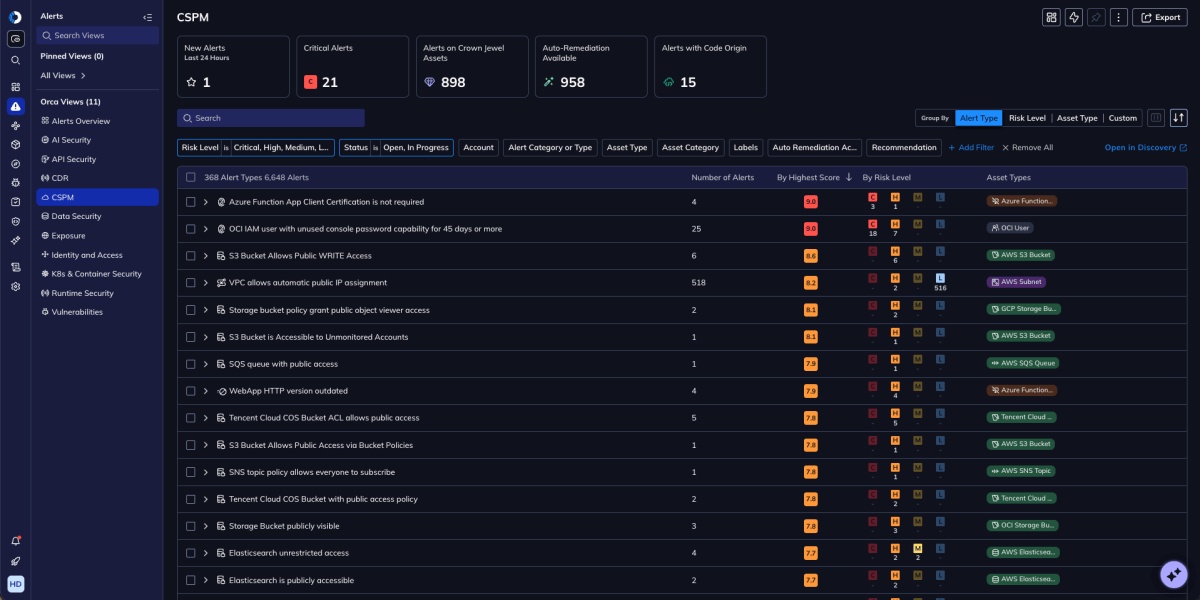
Attack Path Analysis
Along with contextualizing alerts, an optimal CNAPP diagnoses the interconnected risks between cloud assets and identifies potential attack paths that hackers could exploit to endanger your crown jewels. These solutions then prioritize these vulnerabilities so you can concentrate on the paths that matter most. Look for solutions that offer this capability.
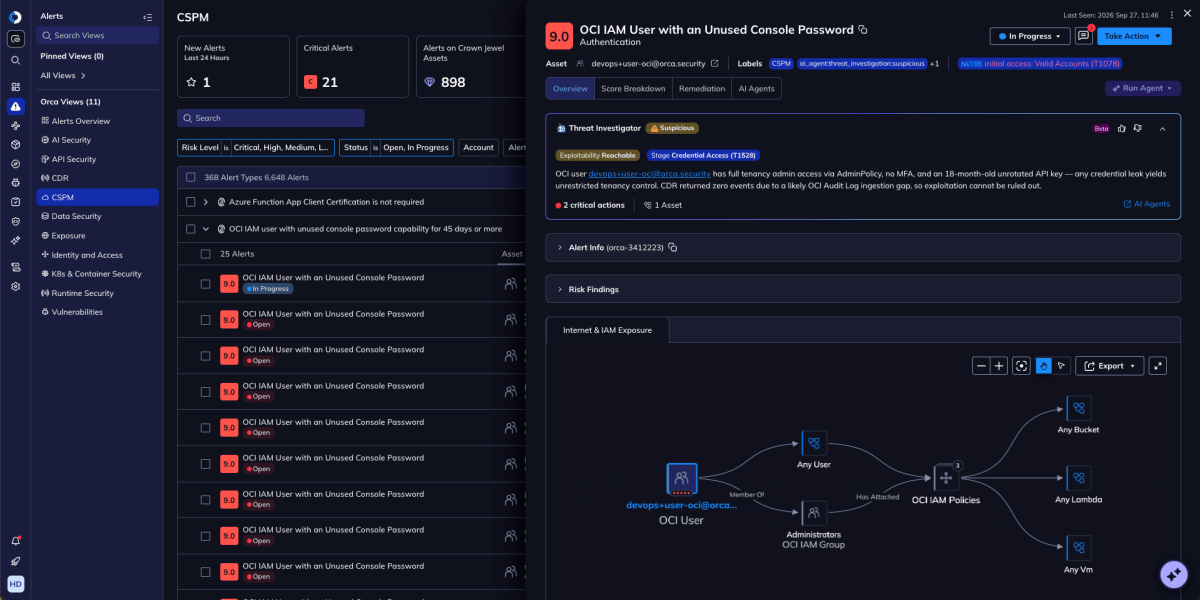
Compliance
CSPM’s core promise is helping cloud assets meet compliance frameworks and industry standards. Look for a platform that continuously checks configurations, policies, and workloads against key frameworks in one unified view, with the ability to combine and customize frameworks from an extensive library for both internal and external reporting.
Enhanced querying
Learning a query language or manually creating queries for every search scenario can slow down your teams. Look for CNAPP solutions that simplify search and make it more efficient for all use cases, Cloud Security Posture Management included. This entails offering AI-driven search, and out-of-the-box system queries and a query builder that tests and validates rules and displays available attributes and commands.
Because queries inevitably result in remediation needs, also look for solutions that integrate with common ticketing and developer tools, such as Jira, ServiceNow, Slack, etc. This enables you to infuse security into existing workflows and tools.
Remediation that adapts to how your team works
Remediation is also where security that fits the way you work matters most. Teams should get remediation guidance generated automatically rather than researched from scratch, with full transparency into how that guidance was generated so it can be validated before it’s applied, and the ability to choose which underlying AI service handles it.
Automation and agentic workflows
As cloud and AI environments multiply faster than teams can manually triage, automation has become table stakes rather than a bonus feature. Look for a platform that can run agentic workflows, automatically investigating an alert, gathering the relevant context, and either applying a fix or handing off a validated recommendation, so security teams spend less time on repetitive triage and more time on the risks that need human judgment.
Conclusion
CSPM remains a critical piece of any cloud security program. It gives organizations the ability to identify, control, and remediate risks and misconfigurations within their cloud. This remains a necessity for organizations to thrive in the cloud.
While the past called for adopting standalone CSPM solutions, CNAPPs now extend their capabilities. CNAPPs consolidate multiple cloud security solutions into one platform, providing better integration, visibility, functionality, usability, and cost efficiency than siloed cloud security solutions. This explains why institutions like Gartner expect the CNAPP market to largely replace traditional CSPM offerings.
Learn more about the Orca Cloud Security Platform
The Orca Cloud Security Platform delivers complete visibility, context that powers decisions, and security that fits the way you work. It’s a true agentless-first CNAPP that identifies, prioritizes, and remediates cloud, application, and AI security and compliance risk across AWS, Azure, Google Cloud, Kubernetes, Alibaba Cloud, Oracle Cloud, and Tencent Cloud.
Orca consolidates cloud configuration, workload, identity and entitlement security, multi-cloud compliance, vulnerability management, AI security, and more into a single platform. Its Unified Data Model correlates risk across all of it, recognizing when seemingly unrelated issues combine into a dangerous attack path, so teams can prioritize what actually matters and reduce alert fatigue.
After a quick setup, typically under 30 minutes, Orca gives teams deep visibility into every cloud asset and a clear path to a stronger security posture, the deep, accurate, actionable coverage modern teams need.
Schedule a demo to see it in action.
CSPM FAQs
Are CSPM and CNAPP the same?
No. CSPM secures cloud environments by addressing misconfigurations in them. CNAPP provides that same functionality, plus additional capabilities including those offered by CWPP, CIEM, DSPM, API security, container and Kubernetes security, AI security, and more. For complete coverage, most organizations now choose a unified CNAPP that includes CSPM alongside these additional capabilities from the start.
Why do cloud misconfigurations happen?
Cloud misconfigurations happen for several reasons. Unrestricted access controls, unreviewed default values, mismanaged secrets, and insufficient logging and monitoring are among the common causes.
What is a CSPM tool?
Gartner first coined the term “Cloud Security Posture Management” in 2014, signaling the emergence of a new category. CSPM enables security teams to identify, control, and remediate misconfigurations in their cloud infrastructure, from open ports not in use to storage buckets and virtual machines exposed to the internet.
While standalone CSPM tools still exist, organizations increasingly acquire CSPM capabilities through CNAPP solutions, an all-in-one alternative to traditional, standalone cloud security platforms.
What roles generally use a CSPM tool?
Security practitioners and teams rely on CSPM tools to identify and remediate misconfigurations that put their cloud environments at risk. While other roles are affected by CSPM findings, security personnel remain the primary users of the technology.
Who needs CSPM?
Any organization that relies on cloud computing needs CSPM capabilities, whether through a standalone tool or a CNAPP that includes CSPM alongside more comprehensive cloud security capabilities.
CSPM detects misconfigurations in the control plane, and as a result plays a necessary role in maintaining a strong security posture.




 Chat with an Orca Expert