



Table of contents
- Key Findings
- Attack Surface Risks in Fast-Paced Cloud Environments
- Why Traditional Testing Approaches Break Down
- On-Demand, Attacker’s-Eye Testing with Orca’s Attack Surface Red Agent
- Where the Context Advantage Comes From
- Expanding the AI Agent Pod
- Security for the Companies that Build
- Schedule an Orca Security Demo
Key Findings
- Building fast means shipping constant change: new applications, new services, new subdomains, new endpoints, new integrations. Every one of those is a potential new entry point, and most organizations only learn what’s actually exposed after a scan cycle, a bug bounty report, or an incident.
- The gap isn’t just calendar cadence. It’s that you can’t test something you shipped an hour ago without waiting on the next scheduled pentest or scanner cycle.
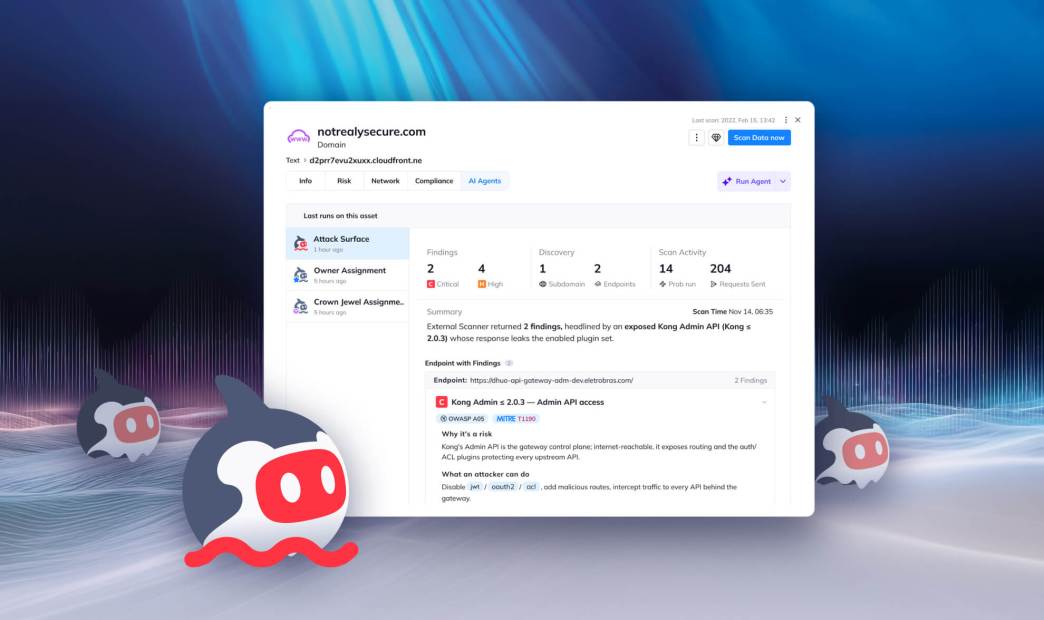
- Orca launches the Attack Surface Red Agent, an on-demand, AI DAST and AI Penetration testing that probes your organization’s external attack surface with an attacker’s-eye view to detect things such as broken authorization, exposed services, and more, the moment you need answers.
- It’s informed by cloud context Orca already has about the underlying assets, so findings arrive with real risk context instead of a raw scan output.That context, assembled before a single probe is sent, is what turns an on-demand test into something you can trust.
- The Attack Surface Red Agent belongs to Orca’s Red Pod, one of the purpose-built agent families (Red, Blue, Green) that make up Orca’s Core Agents, with Custom Agents available for teams who want to build their own.
Attack Surface Risks in Fast-Paced Cloud Environments
Teams that build fast don’t stop building outside of business hours, or between pentest cycles. New applications and services constantly get deployed, subdomains get spun up for a campaign and forgotten, APIs get exposed for a partner integration and never fully locked down. Every one of these is a normal, healthy byproduct of shipping quickly, but every one of them is also a potential entry point. Most security teams find out about them well after the fact, such as during an annual penetration test, in a bug bounty submission, or worse, during an active incident.
Traditional external attack surface penetration testing was built for a slower world. A pentest firm scopes an engagement, runs it over a few weeks, and delivers a report weeks later. A scanner runs on a schedule and flags what it can see at that moment. Both approaches produce a snapshot, and snapshots go stale the moment something in the environment changes, which, for a team that’s constantly building, is constantly.
The gap isn’t a lack of scanning tools. It’s that when something new ships, there’s no good way to test it right then, informed by everything you already know about the environment. What’s needed is a way to test what’s exposed on demand or on your own schedule, with real risk context behind every finding, instead of waiting on the next engagement to roll around.
Why Traditional Testing Approaches Break Down
Scheduled penetration tests are valuable for what they are: a deeply scoped, expert-led engagement that produces validated, high-confidence findings. Their real limitation isn’t depth, it’s cadence. A pentest captures the environment as it existed during a defined window, typically once or twice a year, so everything shipped after the engagement wraps goes unwatched until the next one.
Standalone attack surface scanners close part of that cadence gap by running far more often, sometimes daily. What most of them lack is context. A newly discovered endpoint gets flagged the same way whether it sits in front of a disposable test environment or a production database, because the scanner has no visibility into the cloud infrastructure behind it. The result is another queue of unprioritized findings.
The market has good answers for depth and good answers for frequency, but not both at once. What teams need is a balance of both, with deep context, the moment they actually need it. That’s the gap worth closing.
On-Demand, Attacker’s-Eye Testing with Orca’s Attack Surface Red Agent
The Attack Surface Red Agent tests your public-facing assets on demand, discovering and probing what’s exposed the moment you need answers.
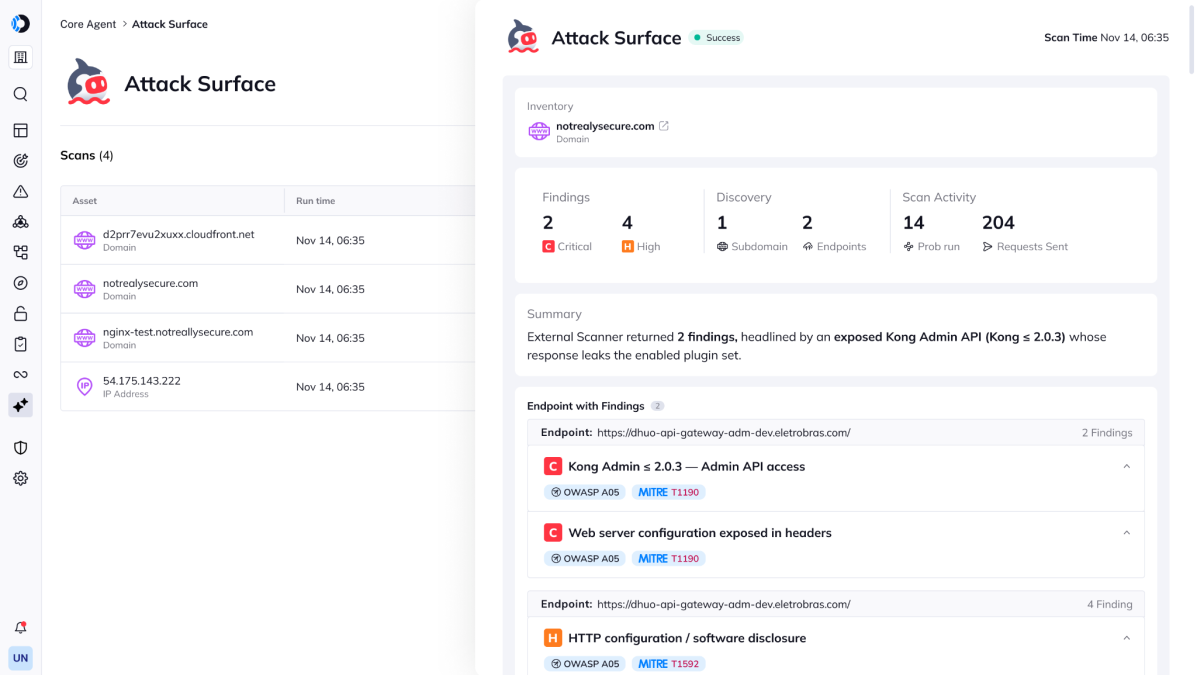
The Attack Surface Red Agent closes that gap. Point it at public-facing asset and it crawls what’s actually reachable, surfacing endpoints and probing them for web vulnerabilities and exposure risks the way an attacker would. Think of it as externally testing whatever your team just shipped, whenever you want to know what’s exposed.
It also complements the scheduled, expert-led penetration tests organizations already rely on. Run it whenever there’s new exposure to check, whether that’s the day a new subdomain goes live or the morning after a launch, so nothing new sits exposed and untested for months waiting on the next engagement. The asset inventory and findings it builds along the way can also help scope the next pentest more accurately, so testers start from a current picture of the attack surface instead of one that’s months out of date.
What the Attack Surface Red Agent brings that a standalone scanner can’t is the quality of context behind every finding. Because Orca already maintains a live asset graph of an organization’s cloud environment, the agent starts each test with expansive reconnaissance, already knowing the cloud infrastructure behind the asset it’s about to probe. That context isn’t bolted on after a finding comes back or pieced together during the test. It’s loaded in from the start, which is what lets a single on-demand run tell you what actually matters, not just what’s technically reachable, the moment you kick it off.
The practical effect is that a newly exposed endpoint sitting in front of a workload with an already-open critical misconfiguration gets treated very differently than the same endpoint sitting in front of an isolated test environment, and the agent can make that distinction immediately instead of waiting for a human to trace it manually.
Findings from the Attack Surface Red Agent land directly in Orca, right alongside everything else you already know about that asset. Work them there, or in whatever workflow your team already relies on. Orca feeds both, so there’s no separate offensive security console or standalone report to reconcile on your own.
Where the Context Advantage Comes From
AI-powered attack surface penetration testing is quickly becoming table stakes, and context is becoming the differentiator the market is reaching for. What matters is where that context actually comes from.
Tools that test infrastructure without any cloud awareness can tell you an endpoint is reachable, but not what’s actually at stake if it’s compromised. Tools that build context by crawling the environment at test time get there eventually, but only after the test is already underway. The Attack Surface Red Agent starts from a different position: that same reconnaissance context is already assembled before testing begins, not reconstructed as a byproduct of it.
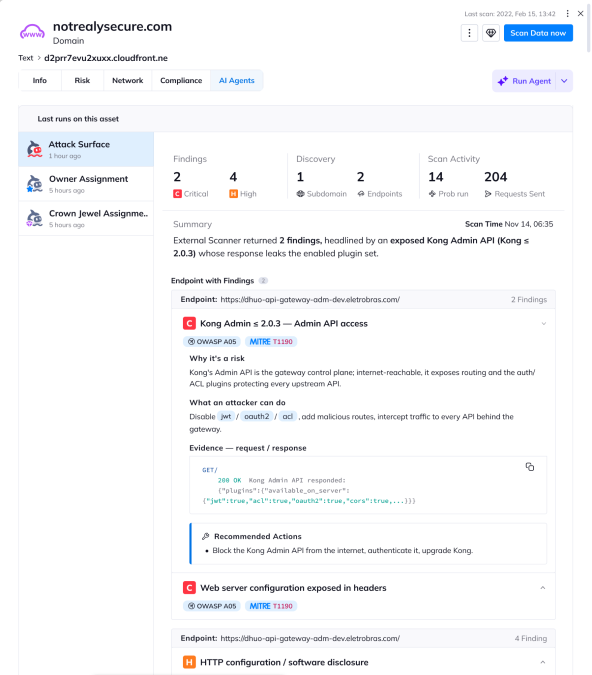
That’s the difference between enriching a finding after the fact and knowing the target before the test starts. The Attack Surface Red Agent delivers exactly the quality of context most attack surface penetration testing can’t, with enough to immediately know whether a finding is noise or something a builder needs to fix today.
Combined with Orca’s existing visibility across cloud, codes, and AI, the Attack Surface Red Agent turns the time between pentests from a blind spot into something you can test the moment you need to, giving the teams building fastest a way to keep pace with what they’re shipping.
Expanding the AI Agent Pod
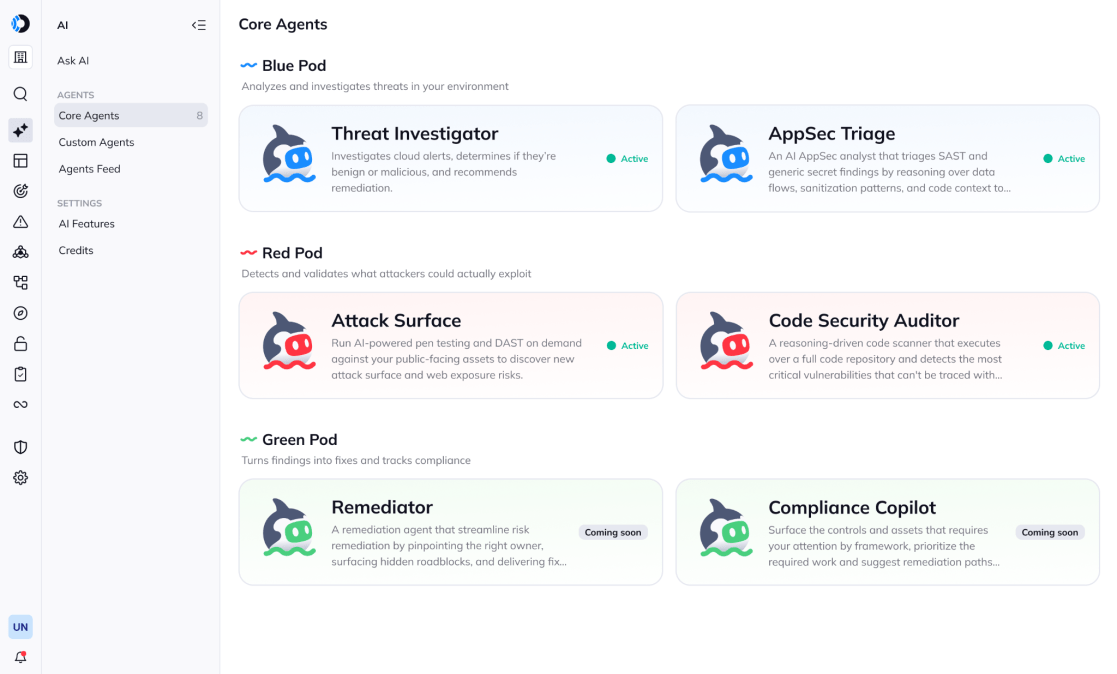
The Attack Surface Red Agent is one of Orca’s Core Agents, specialized agents built out of the box by the Orca team and organized into families by function, Red for attacking, Blue for investigation and triage, and Green for remediation, each purpose-built for a specific need. Orca’s Custom Agents add another layer of flexibility, letting you start from templates and frameworks or build entirely from scratch, so you can shape an agent around your own environment, processes, and use cases. Orca fits the way you work, not the other way around.
The Attack Surface Red Agent belongs to Orca’s Red Pod. Red Pod agents think the way an attacker does: they look for the way in, test whether it holds, and follow it as far as it goes. What reaches you isn’t a list of things that look risky. It’s what an attacker could actually use, with the evidence behind it.
Security for the Companies that Build
Orca offers a unified and comprehensive cloud security platform that identifies, prioritizes, and remediates security risks and compliance issues across AWS, Azure, Google Cloud, Oracle Cloud, Alibaba Cloud, and Kubernetes. The Orca Cloud Security Platform leverages Orca’s patented SideScanning™ technology to provide complete coverage and comprehensive risk detection, built for the companies that build.
Schedule an Orca Security Demo
Interested in seeing how the Attack Surface Red Agent and the Orca Security Platform can help you stay ahead? Schedule a personalized 1:1 demo.




 Chat with an Orca Expert