

Enterprise teams managing cloud environments across multiple providers and regions know the pain of tracking compliance manually. Spreadsheets fall out of date within hours, evidence collection for a single audit can consume weeks of engineering time, and every new framework adds another layer of coordination across departments that rarely share tooling or terminology.
This article delivers a practical automation checklist for enterprise cloud compliance. It covers the specific domains your solution must address, maps the major regulatory frameworks to a unified control set, profiles six leading platforms for 2026, and explains how to evaluate them. You’ll walk away with a clear picture of what compliance automation actually does and how to close the gap between your current process and continuous, audit-ready operations.
Why Manual Cloud Compliance Breaks Down at Enterprise Scale
Manual cloud compliance processes fail at scale because of three compounding factors: legacy systems that predate the regulations now applied to them, siloed teams tracking requirements independently in disconnected tools, and frameworks that update faster than any manual process can absorb. Automation closes the gap by replacing fragmented, human-driven evidence collection with continuous, machine-driven monitoring.
Most enterprises still rely on spreadsheet-based tracking spread across finance, IT, HR, and security teams. Each group maintains its own version of the truth, its own audit cadence, and its own interpretation of shared controls. When auditors request evidence, teams scramble to reconcile conflicting records, often discovering gaps only at the point of review. This fragmentation is the core reason buyers keep searching for ways to simplify multi-cloud compliance reporting, and it’s exactly what compliance automation is designed to solve.
Compliance automation replaces this patchwork with a single system that collects evidence, monitors controls, and generates audit-ready documentation without manual handoffs.
What Cloud Compliance Automation Actually Does
Cloud compliance automation is the use of software to continuously collect evidence, monitor control effectiveness, orchestrate remediation workflows, generate audit-ready documentation, and integrate across cloud services, all without requiring manual intervention for each task. It exists to simplify cloud compliance efforts that would otherwise consume entire teams.
The five core mechanics work together:
- Automated evidence collection pulls configuration snapshots, access records, and audit logs directly from cloud APIs on a continuous basis.
- Real-time monitoring watches for control deviations the moment they occur, rather than waiting for a scheduled review.
- Workflow orchestration routes findings to the right team with the right context, triggering remediation steps automatically when predefined conditions are met.
- Audit-ready documentation assembles evidence into structured reports aligned to specific framework requirements, eliminating last-minute assembly.
- Cross-system integration connects compliance data across identity providers, cloud platforms, ticketing systems, and CI/CD pipelines so nothing falls through the cracks.
Together, these mechanics reduce the mean time to resolution for compliance gaps from days or weeks to hours.
The Core Checklist: What an Enterprise Cloud Compliance Solution Must Cover
A compliance solution that only addresses a few technical controls leaves blind spots that auditors will find. The checklist below maps the full breadth of domains an enterprise cloud compliance platform must cover. Each domain represents a category of controls, not a single task, and your solution should provide visibility and evidence collection across all of them, including specialized areas like Kubernetes security and workload-specific benchmarks.
- Governance and risk ownership assigns accountability for compliance decisions to named roles and committees.
- Asset inventory and data classification maintains a real-time catalog of every cloud resource and the sensitivity level of the data it processes.
- Identity and access management enforces least-privilege access, MFA, and entitlement reviews across all accounts and services.
- Secure configuration validates that resource settings match hardened baselines such as CIS Benchmarks.
- Network segmentation verifies that workloads are isolated according to trust boundaries and data sensitivity.
- Data protection confirms encryption at rest and in transit, key rotation policies, and data loss prevention controls.
- Logging and monitoring ensures that security-relevant events are captured, retained, and alertable.
- Vulnerability and patch management tracks known vulnerabilities against remediation SLAs using feeds like the NIST National Vulnerability Database.
- DevSecOps and change management integrates compliance checks into CI/CD pipelines and change approval workflows, supported by kubernetes compliance tools where containerized workloads are in scope.
- Backup and recovery validates that backup schedules, retention periods, and recovery procedures meet regulatory requirements.
- Incident response confirms that runbooks, escalation paths, and notification timelines are documented and tested.
- Third-party risk extends compliance monitoring to SaaS vendors and partner integrations that handle regulated data.
With these domains mapped, the next step is aligning them to the specific frameworks your auditors and regulators require.
Framework Coverage: Mapping NIST, ISO 27001, SOC 2, and PCI DSS
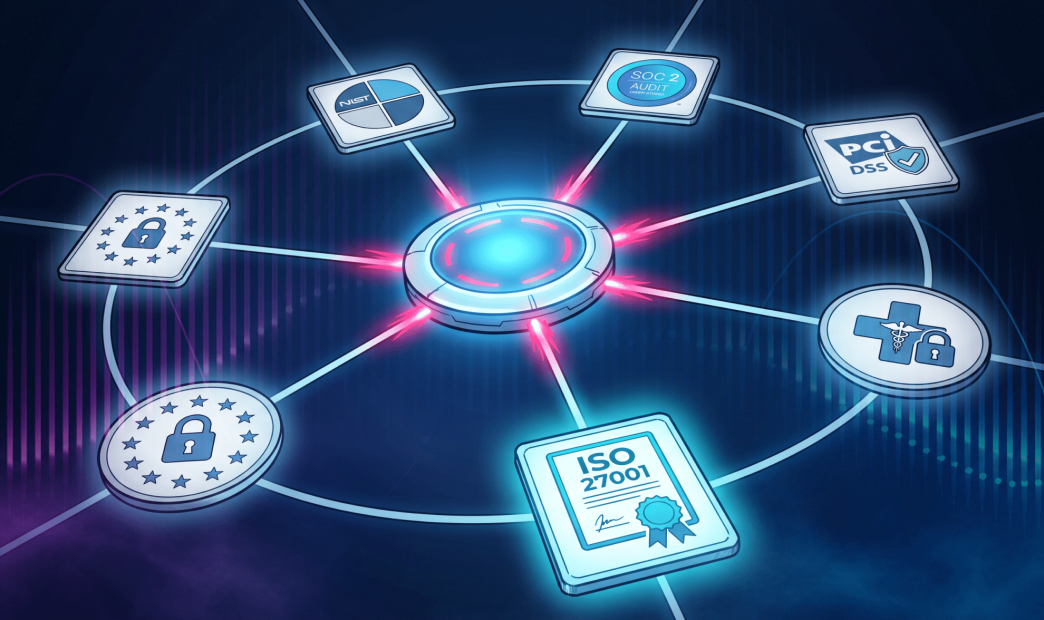
Enterprise buyers typically need coverage across six frameworks, each with a different scope. NIST SP 800-53 provides the most comprehensive federal control catalog and serves as the foundation for FedRAMP® authorization. ISO/IEC 27001 is the global standard for information security management systems. SOC 2 compliance in the cloud focuses on trust service criteria relevant to SaaS and service providers. PCI DSS compliance applies to any organization that stores, processes, or transmits cardholder data. HIPAA governs protected health information in the United States. GDPR sets data protection requirements for organizations handling EU residents’ personal data.
No single framework covers everything in a multi-cloud environment. The practical approach is to define one internal control set and map it to each applicable framework. When a single control satisfies requirements in NIST, ISO 27001, and SOC 2 simultaneously, you collect evidence once and present it three ways. This control-mapping approach eliminates duplicate evidence work and makes adding a new framework a mapping exercise rather than a new compliance program.
Top Cloud Compliance Solutions for Enterprises in 2026
The platforms below represent the leading options for enterprise cloud compliance automation in 2026, selected for their framework breadth, multi-cloud support, and ability to consolidate capabilities that buyers previously sourced from separate CWPP, CSPM, CIEM, and CNAPP tools. For a deeper look at posture management specifically, see our comparison of the best CSPM tools.
Orca Security
Orca Security is an agentless CNAPP built on SideScanning™ technology, which reads cloud workload data out-of-band without deploying agents. This approach provides full-stack context across workloads, identities, and data stores without agent management overhead. Full detail on Orca’s compliance automation capabilities appears in the dedicated section below.
Wiz
Wiz is a unified CNAPP that provides compliance capabilities across 100+ frameworks. Its Security Graph correlates compliance findings with data sensitivity, identity exposure, and network reachability, giving teams a contextual view of which violations carry the most operational risk.
Check Point CloudGuard
Check Point CloudGuard pairs security and compliance in a single policy engine. It offers 1,000+ best-practice recommendations and automates tasks across the full compliance lifecycle, from initial assessment through remediation and reporting.
Microsoft Defender for Cloud
Microsoft Defender for Cloud is a CNAPP with compliance controls well-suited to Microsoft-centric and hybrid environments. It syncs with frameworks including NIS2, NIST CSF, GDPR, several NIST 800-series publications, FedRAMP®, HIPAA, and the emerging EU AI Act.
Palo Alto Networks Cortex Cloud
Cortex Cloud (formerly Prisma Cloud) provides compliance monitoring across 20+ standards with broad third-party integrations. It supports multi-cloud and SaaS environments, making it a fit for organizations with diverse infrastructure footprints.
Qualys Cloud Platform
The Qualys Cloud Platform offers end-to-end compliance capabilities including policy audits, file integrity monitoring, unified asset management, and self-assessment tools. Its strength is in demonstrating compliance through granular, asset-level evidence.
These profiles give you a starting point. The next step is knowing what criteria to apply when evaluating them against your specific requirements.
How to Choose a Cloud Compliance Solution: Key Evaluation Criteria
Comparing platforms requires a structured evaluation framework that goes beyond feature lists. The criteria below reflect the capabilities that separate a compliance automation platform from a basic posture tool. Prioritize these when running your evaluation, and weight them based on your organization’s regulatory footprint and cloud architecture.
- Comprehensive framework coverage means the platform ships with mappings for the specific regulations you face today and can absorb new frameworks without custom engineering.
- Multi-cloud and hybrid visibility ensures a single pane of glass across AWS, Azure, GCP, and on-premises infrastructure, eliminating per-environment tooling.
- Context-aware risk prioritization correlates compliance findings with identity exposure, network reachability, and data sensitivity rather than assigning flat severity scores. This is the approach behind context-aware cloud vulnerability prioritization.
- Developer workflow integration embeds compliance checks into CI/CD pipelines, pull requests, and ticketing systems so violations are caught before deployment.
The differentiator buyers most often overlook is context-aware prioritization. A platform that flags 500 misconfigurations with identical “high” severity ratings creates noise. One that tells you which three misconfigurations expose sensitive data on a publicly reachable workload with excessive permissions tells you where to act first. Understanding why context matters in cloud security is the difference between a useful compliance tool and one that generates alert fatigue.
What Is the Difference Between Continuous Compliance and Point-in-Time Audits?
Point-in-time audits prove that controls worked during a specific review window. They do not prove controls worked last Tuesday, or the Tuesday before that. Cloud environments change constantly as teams deploy new resources, modify access policies, and update configurations. The question is not whether drift happens between audits, but how much. Organizations that evolve CSPM for compliance move from periodic snapshots to continuous monitoring that catches deviations as they occur.
Configuration drift is the specific risk of continuous monitoring addresses. A security group rule opened temporarily for troubleshooting, an IAM policy broadened during a sprint and never scoped back down, a storage bucket made public for a data migration: these changes happen between audit cycles and remain invisible until the next review. Continuous compliance monitoring flags these deviations in real time, giving teams the opportunity to remediate before an auditor or an incident surfaces them. This is one of the clearest examples of how CSPM improves cloud security in practice.
How Orca Security Automates Cloud Compliance for Enterprises
Orca Security ties together every domain in the checklist above, from governance and IAM to network segmentation and incident response, through a single mechanism: SideScanning™ technology that reads cloud workload data out-of-band, without deploying agents or impacting performance. That telemetry feeds into the Unified Data Model, which correlates findings across workloads, identities, data stores, and network paths.
The platform maps this unified dataset against 180+ out-of-the-box compliance frameworks, including NIST SP 800-53, CIS Benchmarks, ISO 27001, PCI-DSS, and FedRAMP®/StateRAMP. Instead of managing separate tools for Cloud Security Posture Management and Cloud Infrastructure Entitlement Management, teams get posture and entitlement data in one dashboard, mapped to the frameworks their auditors require.
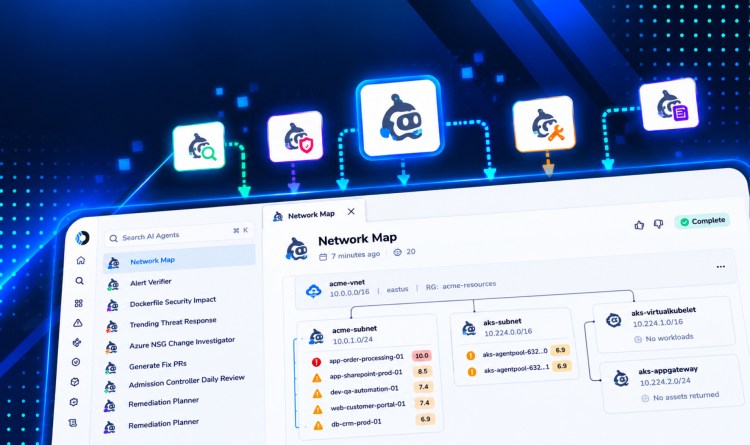
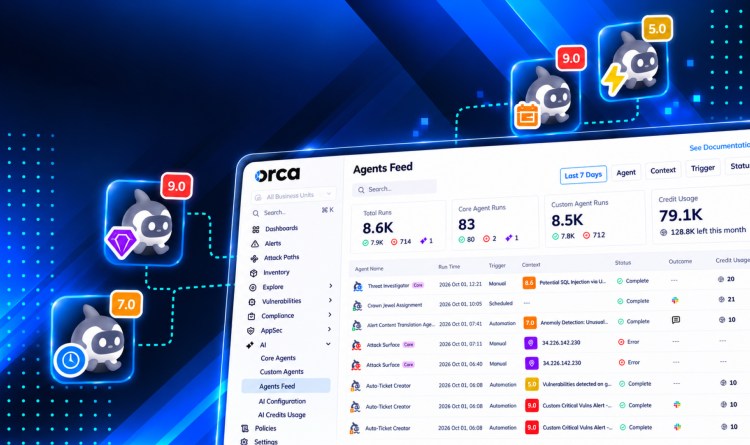
Orca’s Agentic AI can generate remediation steps and, where configured, execute them automatically, reducing the time from detection to resolution. Customers report audit preparation shifts from a multi-week scramble to a standing process that runs in the background.
Get a Demo to see how Orca maps your cloud environment against 180+ frameworks without deploying a single agent.
Frequently Asked Questions about Cloud Compliance Solutions for Enterprises
Enterprise buyers evaluating cloud compliance solutions often have questions that cut across the topics covered above. The following answers address the most common points of confusion around compliance automation, tooling categories, and implementation timing.
What’s the difference between cloud compliance and cloud security?
Cloud security refers to the technical controls and practices that protect cloud infrastructure, data, and workloads from threats. Cloud compliance is the process of demonstrating, with documented evidence, that those controls meet specific regulatory or framework requirements such as SOC 2, PCI DSS, or ISO 27001. You can have strong security without formal compliance, but you cannot have compliance without security controls in place.
How do cloud compliance automation tools differ from traditional, on-premises compliance management systems?
Cloud compliance automation tools continuously collect evidence and monitor configurations in real time across dynamic, multi-cloud environments. Traditional on-premises systems rely on periodic manual audits and static documentation designed for fixed infrastructure. The cloud-native approach keeps pace with environments where resources are created and destroyed in minutes.
Can cloud compliance automation platforms handle multi-cloud and hybrid environments effectively?
Yes. Agentless, cross-cloud visibility, such as SideScanning™-style out-of-band scanning, lets a single platform monitor AWS, Azure, GCP, and hybrid environments without deploying per-environment tooling. This unified approach eliminates the need to reconcile findings from separate tools for each provider.
What’s the difference between a CSPM tool and a dedicated cloud compliance automation platform?
CSPM focuses on detecting and remediating cloud misconfigurations against security best practices. A dedicated compliance automation platform layers framework-specific evidence collection, audit-ready reporting, and continuous control mapping on top of that posture data. Many modern CNAPPs combine both capabilities in a single platform.
When should an enterprise start evaluating a cloud compliance automation platform relative to its next audit cycle?
Start evaluation at least one to two quarters before your next audit cycle. This gives the platform time to collect baseline evidence and map your controls to required frameworks so documentation is already flowing when auditors request it. Waiting until the weeks before an audit turns what should be a continuous process into a reactive scramble.



 Chat with an Orca Expert