



Table of contents
- AI usage in the cloud continues to surge
- What are AI models?
- The most used AI models in 2026
- #1. gpt-4o (37.6%)
- #2. gpt-4.1-mini (34.7%)
- #3. text-embedding-ada-002 (29.1%)
- #4. gpt-4.1 (28.9%)
- #5. gpt-4o-mini (28.6%)
- #6. text-embedding-3-small (23.2%)
- #7. text-embedding-3-large (22.3%)
- #8. gpt-5.1 (22.3%)
- #9. gpt-5-mini (19.7%)
- #10. o4-mini (17.8%)
- AI model usage insights from the Orca Research Pod
- How Orca uses AI models to improve cloud security
- Learn more
Worldwide spending on AI continues to surge as organizations of all sizes embed AI into their cloud environments. Yet capturing real value from AI requires more than enthusiasm and budget. It demands a clear understanding of the underlying AI models driving outcomes.
In this post, we reveal the 10 most popular AI models of 2026 based on analysis of billions of cloud assets by the Orca Research Pod. This update refreshes the ranking covered in our Top 10 AI Models of 2025 blog, highlighting how model usage patterns have evolved as organizations scale their AI initiatives.
AI usage in the cloud continues to surge
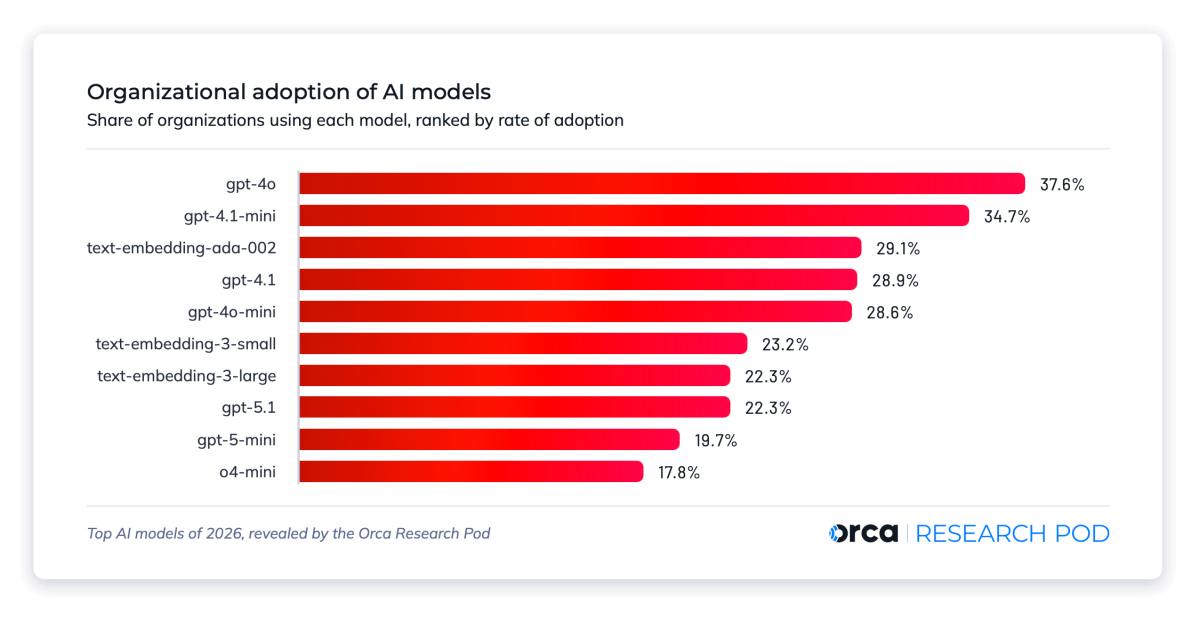
One of the most striking findings in this year’s analysis is that no single model dominates the way GPT-3.5 once did. GPT-3.5 commanded 79% adoption in 2024, while today’s top model, gpt-4o, reaches just 37.6% of AI cloud adopters. This shift reflects a more mature and fragmented AI landscape, where organizations are diversifying across models based on cost, latency, capability, and use case fit.
All 10 models in this year’s ranking are Azure OpenAI deployments, underscoring Microsoft’s continued dominance as the enterprise AI platform of choice. Three embedding models placing in the top 10 confirm that Retrieval-Augmented Generation (RAG) has become a standard architectural pattern in production cloud environments. Meanwhile, the GPT-5 family and reasoning model o4-mini signal that the newest generation of OpenAI models is moving from preview to production at scale.
What are AI models?
An AI model is a computer program trained to perform a specific task (or set of tasks) by learning patterns from data. Different models excel at different things; language, vision, speech, coding, retrieval, multimodal reasoning, and more. Some models are general-purpose and can handle a wide range of prompts, while others are optimized for speed, cost, embeddings, or domain-specific performance.
AI models typically work alongside two related building blocks:
- AI services: Cloud-specific capabilities offered by cloud providers that let teams deploy, fine-tune, or consume AI functionality at scale.
- AI packages: Frameworks, libraries, or accelerators that help train, customize, optimize, or operationalize models.
Together, these components power the AI-driven applications showing up across today’s cloud-native stacks.
The most used AI models in 2026
Below are the 10 most widely adopted AI models observed in cloud environments, based on the Orca Research Pod’s analysis of 426 organizations using at least one AI model in the cloud. Percentages represent the share of those organizations with a specific model deployed in their cloud estate.
#1. gpt-4o (37.6%)
OpenAI’s flagship gpt-4o (“omni”) retains the top spot in 2026, appearing in 37.6% of AI-adopting cloud environments. GPT-4o is a high-intelligence, multimodal model that reasons across text, images, and audio, supporting real-time voice interaction, complex analysis, and rich generative experiences.
Where it’s used: Conversational interfaces, knowledge assistants, multilingual Q&A, cloud operations copilots, and cloud security workflows that benefit from natural-language interaction.
#2. gpt-4.1-mini (34.7%)
GPT-4.1-mini is new to the rankings this year and immediately lands at #2, reflecting rapid enterprise adoption of this lighter-weight variant of GPT-4.1. It offers strong instruction-following and reasoning at reduced cost and latency, making it a practical alternative to full-sized frontier models for high-volume workloads.
Where it’s used: Customer-facing chat, automated content generation, lightweight agents, and developer tools where speed and cost-efficiency are prioritized.
#3. text-embedding-ada-002 (29.1%)
Despite newer embedding options available, text-embedding-ada-002 holds at #3, a testament to the enormous installed base of RAG pipelines and vector search architectures built on this model. It converts text into numeric vectors that capture semantic similarity, enabling search, clustering, recommendations, and retrieval-augmented generation.
Where it’s used: Search relevance, deduplication, content tagging, recommendation engines, and grounding large language models (LLMs) with enterprise data.
#4. gpt-4.1 (28.9%)
GPT-4.1 climbs into the top five this year, recognized for its improved reasoning quality, better adherence to instructions, and reduced hallucinations compared to its predecessors. Its reliability profile makes it attractive for regulated or accuracy-sensitive workflows.
Where it’s used: Policy generation, compliance documentation, report drafting, analysis review tasks, and other high-assurance enterprise use cases.
#5. gpt-4o-mini (28.6%)
GPT-4o-mini brings much of GPT-4o’s flexibility to teams with tight latency, throughput, or cost constraints. Lighter-weight yet still multimodal, it’s well suited for scaling AI assistants across large user bases or embedding AI into edge or real-time applications.
Where it’s used: In-app copilots, field/edge devices, customer support chats, and thin-client experiences where every millisecond and dollar counts.
#6. text-embedding-3-small (23.2%)
text-embedding-3-small delivers strong semantic performance in a smaller, faster, and more cost-efficient package than its larger sibling. It’s ideal for large-scale indexing jobs, high-QPS search, or workloads running in constrained environments.
Where it’s used: Log enrichment, lightweight semantic tagging, personalization at scale, and near-real-time similarity search.
#7. text-embedding-3-large (22.3%)
text-embedding-3-large improves semantic fidelity and recall for enterprise-scale search and retrieval. Its richer vector representations help systems understand nuanced language across long or technical documents.
Where it’s used: Knowledge graph enrichment, legal/technical corpus search, AI copilots that reference policies or codebases, and advanced RAG.
#8. gpt-5.1 (22.3%)
GPT-5.1 represents one of OpenAI’s most capable reasoning models and marks the GPT-5 family’s arrival in the enterprise top 10. Its strong performance on complex, multi-step tasks is driving adoption in scenarios where accuracy and depth of reasoning are paramount.
Where it’s used: Advanced code generation, complex document analysis, multi-step planning and orchestration, and agentic workflows requiring deep reasoning.
#9. gpt-5-mini (19.7%)
GPT-5-mini brings the capabilities of the GPT-5 family to cost-sensitive and latency-sensitive workloads. Its presence in the top 10 alongside gpt-5.1 signals that enterprises are already experimenting with next-generation models at scale.
Where it’s used: Batch automation, lightweight agents, operational scripting, and embedded intelligence in cloud tooling where budget and throughput are key constraints.
#10. o4-mini (17.8%)
Rounding out the list, o4-mini is OpenAI’s efficient reasoning model showing meaningful traction as the first dedicated reasoning model to crack the enterprise top 10. Its presence reflects growing enterprise investment in models optimized for step-by-step logical reasoning, math, and coding tasks.
Where it’s used: Code review automation, mathematical reasoning, structured problem-solving, and use cases where chain-of-thought accuracy matters more than raw generation speed.
AI model usage insights from the Orca Research Pod
The Orca Research Pod continuously analyzes billions of scans of cloud assets across the globe and hundreds of thousands of code repositories to surface emerging technology patterns and security risks. Their latest findings on AI model adoption informed this 2026 ranking.
How Orca uses AI models to improve cloud security
Orca became the first CNAPP to integrate with GPT-3 back in early 2023, applying generative AI to accelerate risk detection, simplify investigations, and streamline remediation workflows.
Since then, we’ve continued to evolve the Orca Cloud Security Platform to secure AI innovation in the cloud and leverage AI to enhance cloud security. Our AI Security Posture Management (AI-SPM) capabilities give organizations full and deep visibility into AI risks across more than 50 AI models and packages.
Meanwhile, Orca AI powers AI-driven capabilities throughout our Platform, including AI-driven discovery of assets and risks using natural-language search, on-demand guidance for triage and investigation, automated generation of remediation code and instructions, multi-lingual support across 50+ languages, and more.
Learn more
Ready to secure your AI innovation in the cloud? Schedule a personalized 1:1 demo to see how Orca helps you secure your entire multi-cloud or hybrid-cloud estate.





 Chat with an Orca Expert