



Table of contents
- Key Takeaways
- Understanding Man-in-the-Middle Attacks
- How Do Man-in-the-Middle Attacks Work?
- What Are the Common Types of Man-in-the-Middle Attacks?
- Man-in-the-Middle Attack Examples
- How Do You Detect Man-in-the-Middle Attacks?
- How Do You Prevent Man-in-the-Middle Attacks?
- MITM Attacks and Orca Security
- Frequently Asked Questions about Man-in-the-Middle (MITM) Attacks
Modern cloud environments dramatically expand man-in-the-middle (MITM) attack surfaces through API-driven communication, Kubernetes east-west traffic, service meshes, and distributed identity systems. Traditional perimeter-focused protections are no longer enough when workloads communicate constantly across dynamic cloud infrastructure.
In cloud environments, attackers target not only user traffic but also service-to-service API calls, session tokens, and internal workload communications. Misconfigured TLS, weak certificate validation, and overly permissive network policies can create interception opportunities inside environments that organizations often assume are trusted by default.
As organizations adopt containers, microservices, and multi-cloud architectures, MITM prevention increasingly depends on continuous visibility into traffic paths, identity relationships, and workload exposure rather than relying only on edge security controls.
Key Takeaways
- A man-in-the-middle attack positions an attacker between two communicating parties to intercept or alter data without detection, mapped to MITRE ATT&CK technique T1557.
- In cloud environments, MITM risk extends beyond the network edge to API traffic, east-west service calls between microservices, and Kubernetes pod communications.
- The primary prevention controls are enforcing TLS 1.2 or 1.3 with strong cipher suites, mutual TLS for service-to-service traffic, and continuous posture checks that catch misconfigured listeners before exploitation.
- Certificate validation, network segmentation using security groups and Kubernetes network policies, and short-lived session tokens eliminate the conditions MITM attacks require.
This article covers the most common MITM attack types, real-world examples, detection signals, and prevention controls that matter most in cloud environments.
Understanding Man-in-the-Middle Attacks
A man-in-the-middle attack is a cyberattack in which the attacker positions themselves between two communicating parties and intercepts, reads, or modifies the traffic without either party knowing. The attacker can steal data, inject false messages, or downgrade encryption. MITRE ATT&CK maps this to technique T1557 (Man-in-the-Middle).
In cloud and hybrid setups, MITM is not limited to Wi-Fi or LAN. Internal API calls between microservices, traffic between Kubernetes pods, and requests to API gateways can all be intercepted if TLS is weak, network policies are too permissive, or services are exposed to the wrong network segments.
How Do Man-in-the-Middle Attacks Work?
MITM attacks typically begin when an attacker inserts themselves into the communication path between a user and a service. They do this by poisoning routing or name resolution (ARP or DNS), by controlling a network segment through a rogue Wi-Fi access point, or by tricking the victim into using a malicious proxy or certificate. Once positioned, they read or alter traffic before forwarding it. The victim and the legitimate service each believe they are talking only to the other.
In the cloud, the same principle applies to API and service-to-service traffic. Weak TLS settings, permissive security groups, and exposed internal services create the same interception opportunities. An internal API that listens on 0.0.0.0 with TLS disabled is a MITM opportunity for any process or pod that can reach that network segment.
What Are the Common Types of Man-in-the-Middle Attacks?
ARP Spoofing
On local networks, ARP maps IP addresses to MAC addresses. Attackers send fake ARP replies so that traffic for a given IP goes to the attacker’s MAC instead. This is primarily a LAN or on-premises concern when the attacker already has network access.
DNS Spoofing
DNS resolves domain names into IP addresses. Attackers poison caches or compromise DNS so that names resolve to attacker-controlled IPs. In cloud environments, misconfigured DNS or service discovery can send microservices to the wrong endpoints, creating a MITM condition for internal traffic.
SSL/TLS Hijacking
SSL stripping keeps the initial request on HTTP so the session never upgrades to HTTPS. In other cases, the attacker presents a fake certificate and runs two TLS connections: one to the victim, one to the real server. Downgrade attacks force the use of weaker cipher suites or older protocol versions.
Wi-Fi Eavesdropping
Rogue or “evil twin” access points imitate a legitimate network. Users who connect send their traffic through the attacker’s infrastructure. Unencrypted traffic is directly visible; encrypted traffic can still be targeted with TLS downgrade techniques.
Session Hijacking
The target here is not the login itself but the token or cookie that proves the user is already authenticated. Attackers steal these via network interception or cross-site scripting, then act as the authenticated user. In cloud environments, session or API tokens often carry broad IAM permissions, making token theft high impact.
Man-in-the-Browser
Malware or a malicious browser extension intercepts data inside the browser after decryption. Network monitoring and TLS controls do not help against this technique; only endpoint and browser security controls are effective.
Email Interception and Business Email Compromise
Attackers who access mailboxes or intercept email traffic can read threads and inject messages at critical moments. A common pattern is to wait for payment instructions and then send a follow-up directing payment to a different account. This is MITM at the application layer rather than the transport layer.
Man-in-the-Middle Attack Examples
Real incidents show how trust in certificates and routing can be abused.
DigiNotar (2011). Attackers compromised the DigiNotar certificate authority and issued fraudulent certificates, including for Google domains. That allowed MITM of HTTPS traffic for users who trusted DigiNotar. Academic analysis published in the Journal of Strategic Security documented the full certificate chain compromise. The incident confirmed that TLS only provides protection if the certificate chain itself is trustworthy.
Lenovo Superfish (2015). Preinstalled “Superfish” software on Lenovo consumer laptops injected a root CA and decrypted HTTPS traffic to insert advertisements. That same mechanism enabled full MITM interception of any HTTPS session. CISA’s alert from February 2015 advised removing the software and the compromised root certificate from affected systems.
BGP Hijacking of Amazon Route 53 (2018). A BGP announcement briefly redirected traffic intended for Amazon’s DNS service. The Internet Society documented the event in April 2018. This is MITM at the routing layer: traffic was sent through an unintended path where it could have been observed or altered in transit.
These cases show that MITM risk depends on trust in intermediaries: certificate authorities, BGP routing tables, and preinstalled software. Reducing that risk means validating certificates and knowing what network paths sit between users or services and the resources they access.
How Do You Detect Man-in-the-Middle Attacks?
Detection works best when you combine network signals with identity and data context. A suspicious connection is only actionable when you know what it can reach: which credentials, which data, and what the blast radius would be if the session were compromised. For a broader framework on how detection fits within cloud security programs, see the Orca Security Cloud Security Learning Hub.
Network Anomaly Indicators
Watch for certificate warnings or unexpected certificate changes, DNS results that resolve to unfamiliar IPs, unusual routing or intermediaries, and latency spikes that suggest extra hops. These can be monitored at the network and TLS layer through flow logs and certificate transparency monitoring.
Runtime Behavior Signals
Look for processes that change network interfaces or routing tables, unauthorized socket creation, containers that start listening on new ports, or host-level traffic redirection. In cloud workloads, such changes often precede or accompany MITM or lateral movement attempts. Correlate these with image and deployment provenance so that unexpected listeners are flagged even when they use common ports.
Correlating Network Signals With Identity and Data
A suspicious connection becomes meaningful when tied to the identity (user, service account, or pod) and to the sensitivity of the data or APIs it can access. Detection should answer: could this path reach sensitive data or privileged credentials, and how far could an attacker move from this position? In cloud environments, that means mapping the connection to IAM roles, instance profiles, and data classifications so that high-risk paths are prioritized over noise.
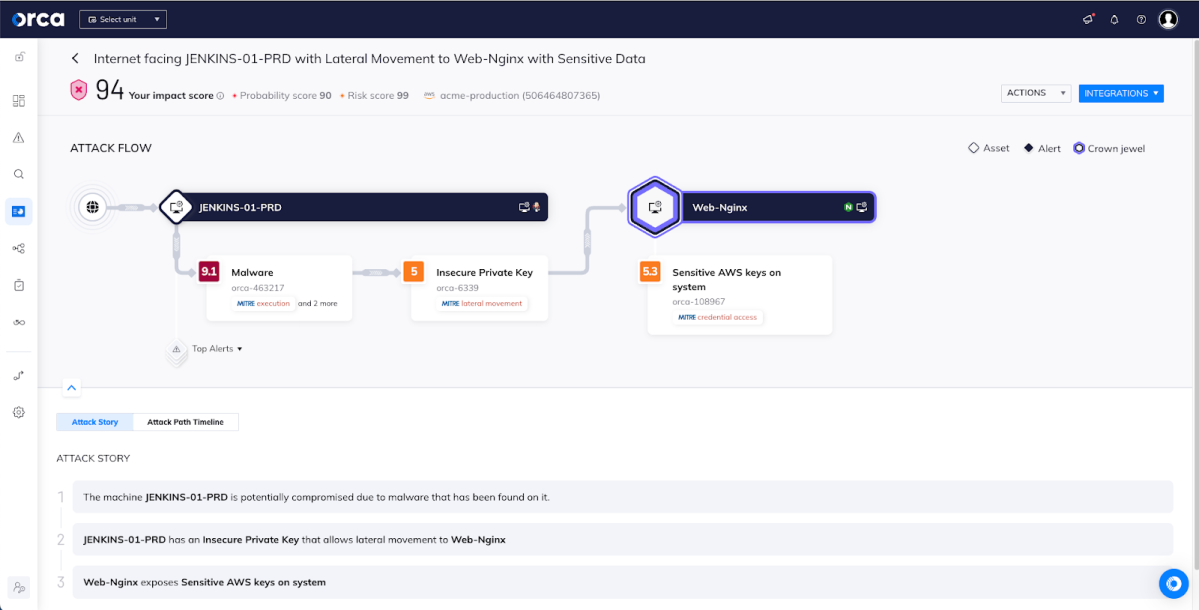
Orca Security’s runtime sensor adds behavioral detection at the workload level for organizations that require process-level and file-level telemetry alongside cloud API monitoring. Both collection methods feed a unified detection engine that correlates signals across the control plane, workload runtime, network layer, and identity systems into single incident timelines. Each incident finding includes the MITRE ATT&CK technique mapping, the full attack timeline, and a prioritized list of affected resources sorted by business impact. Orca Security was positioned in the Gartner Magic Quadrant for Cloud-Native Application Protection Platforms (CNAPP) in 2023, evaluated on criteria that include runtime threat detection, agentless coverage, and multi-cloud support.
How Do You Prevent Man-in-the-Middle Attacks?
Preventing man-in-the-middle (MITM) attacks is fundamentally about reducing implicit trust across networks, devices, and communications. This aligns closely with Zero Trust principles, which assume that no user, device, network, or connection should be trusted by default and that every access request must be continuously verified.
MITM attacks succeed when attackers exploit trust relationships between communicating parties, whether through compromised certificates, insecure networks, weak authentication, or misconfigured infrastructure. While TLS encryption is a critical control, it is only one part of a broader defense strategy.
Effective prevention combines encryption with Zero Trust practices such as strong identity verification, certificate management, least-privilege access controls, network segmentation, device security, and continuous monitoring. Together, these controls reduce the opportunities for attackers to intercept, manipulate, or redirect communications.
Enforce Modern TLS Configurations
Use TLS 1.2 or 1.3, disable legacy protocols and weak cipher suites, and enforce mutual TLS (mTLS) for service-to-service traffic. NIST SP 800-52 Rev 2 specifies the minimum TLS versions and cipher suites for federal systems and provides the most widely referenced baseline for cloud deployments. Apply these consistently across cloud and on-premises so that no segment accepts connections that can be downgraded or intercepted.
Enforce Certificate Validation and Transparency
Validate certificate chains and use certificate transparency logs to detect rogue or misissued certificates. In cloud environments, this applies to both public-facing and internal service endpoints. A service that accepts self-signed certificates without validation is as exploitable as one with no TLS at all.
Segment Networks and Restrict Traffic Paths
Limit which workloads can communicate with which others. Use security groups, Kubernetes network policies, and VPC segmentation so that even if one segment is compromised, traffic to sensitive systems does not cross attacker-controlled paths. NIST SP 800-53 Controls SC-7 (Boundary Protection) and SC-8 (Transmission Confidentiality) support this principle: reduce the number of paths where an attacker can sit in the middle.
Protect Credentials and Session Tokens
Harden authentication, use short-lived tokens, and protect session cookies with Secure, HttpOnly, and SameSite attributes. In APIs, limit token scope and rotate credentials immediately when compromise is suspected. Stolen tokens with broad cloud IAM permissions are high-value MITM targets in any cloud environment.
Run Continuous Posture Management
Prevention is not a one-time configuration check. New services, copied security group rules, and default configurations regularly reintroduce weak TLS or over-exposed listeners. Continuous posture checks against CIS Benchmarks and NIST SP 800-53 baselines help teams find and fix these conditions before they are exploited. Prioritize findings that affect traffic paths and certificate validation, as those have the most direct impact on MITM risk.
MITM Attacks and Orca Security
In cloud environments, MITM risk is not only at the network edge. East-west traffic between microservices, pod-to-pod communication in Kubernetes, and API gateway traffic can all be intercepted when TLS is misconfigured, network policies are too permissive, or critical internal services are over-exposed. Detecting these conditions requires correlating network and configuration data with identity and data sensitivity.
Orca Security provides cloud security posture management (CSPM) and attack path analysis across AWS, Azure, GCP, and Kubernetes. Orca’s agentless SideScanning™ reads workload and configuration data from cloud provider APIs and block storage, so you can see which services are exposed, how they are configured for TLS, and how they connect to other assets across the full cloud estate.
Orca Security maps each finding to the specific CIS Benchmark control or NIST SP 800-53 control it violates. The attack path analysis shows how a misconfigured listener or weak TLS service connects to sensitive data or privileged credentials, with findings prioritized by actual exploitability and blast radius rather than CVSS score alone. See the full platform at Orca Security or Get a Demo.
Frequently Asked Questions about Man-in-the-Middle (MITM) Attacks
A MITM attack intercepts communication between two parties, while session hijacking focuses specifically on stealing or abusing an authenticated session token. Session hijacking is often one outcome of a successful MITM attack, especially in cloud environments where API tokens and IAM sessions carry broad privileges.
No. TLS significantly reduces MITM risk, but attackers can still exploit weak certificate validation, compromised certificate authorities, SSL stripping, or endpoint compromise. Strong TLS configurations, certificate transparency monitoring, and mutual TLS are required for effective protection.
Kubernetes environments rely heavily on east-west traffic between pods and services. Weak network policies, exposed internal services, and disabled or misconfigured mTLS can allow attackers inside the cluster to intercept or manipulate traffic between workloads.
Mutual TLS is an authentication method where both the client and server validate each other’s certificates before establishing communication. Unlike standard TLS, which only verifies the server, mTLS prevents unauthorized services from impersonating trusted workloads.
Man-in-the-middle attacks are fundamentally attacks on trust. They succeed when systems assume that a network connection, device, certificate, or communication path is trustworthy without sufficient verification. Zero Trust addresses this problem by removing implicit trust and requiring continuous validation of identities, devices, certificates, and access requests.
Instead of relying on network location or perimeter defenses, Zero Trust architectures verify every connection and enforce least-privilege access. Controls such as mutual TLS, strong identity verification, certificate validation, network segmentation, and continuous monitoring make it significantly harder for attackers to intercept, manipulate, or redirect communications without detection.
From this perspective, preventing MITM attacks is not a separate security objective but one outcome of implementing Zero Trust architecture correctly.





 Chat with an Orca Expert