



Table of contents
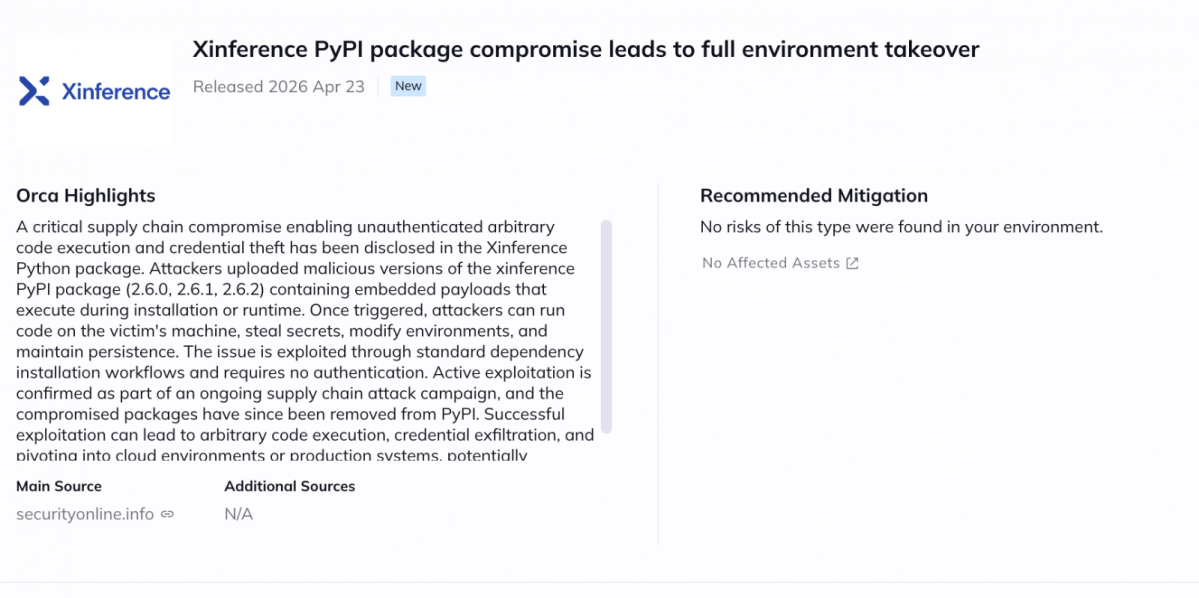
A critical supply chain compromise (no CVE assigned) was disclosed affecting the Xinference Python ecosystem, allowing attackers to execute arbitrary code and fully compromise developer environments via malicious package versions. Due to the potential full system compromise and credential theft, immediate remediation is required.
What is the Xinference PyPI Package Compromise?
The issue originates from the PyPI distribution process, where attackers uploaded malicious versions of the xinference package (2.6.0, 2.6.1, 2.6.2) containing embedded payloads that execute during installation or runtime. By installing these compromised versions, attackers gain the ability to execute code on the victim’s machine, potentially stealing secrets, modifying environments, and maintaining persistence. No authentication is required to exploit this issue, as it is triggered through standard dependency installation workflows.
The following components are affected: xinferencePyPI package, versions 2.6.0, 2.6.1, and 2.6.2. These components are widely used in AI/LLM-related workflows and development environments, particularly where automated dependency installation is enabled. Other frameworks or services relying on these compromised versions may also be impacted.
Assessing the Impact: Credential Theft and Full Environment Takeover
At the time of writing, malicious packages have been identified and removed from PyPI, and public indicators of compromise are available. Active exploitation is confirmed as part of an ongoing supply chain attack campaign. Regardless, the severity and ease of exploitation make this vulnerability high risk, especially in CI/CD pipelines and internet-connected development environments.
Successful exploitation could allow attackers to execute arbitrary code, exfiltrate sensitive credentials, and potentially pivot into cloud environments or production systems, leading to data exposure or full infrastructure compromise.
How to Mitigate the Xinference Compromise: Immediate Remediation and Recovery
Users should immediately remove affected versions (2.6.0, 2.6.1, 2.6.2) and upgrade to clean versions released by maintainers (post-removal/yanked releases). Any environment that installed these versions should be considered compromised and undergo full credential rotation and incident response.
How can Orca help?
Orca enables customers to quickly identify assets running vulnerable versions, understand their exposure in context—including internet accessibility, runtime reachability, and asset criticality—and prioritize remediation based on real risk rather than CVSS alone. Orca’s platform highlights affected assets directly in the newItem view, helping security teams focus on the most critical remediation paths first.





 Chat with an Orca Expert