


Table of contents
- Key Takeaways
- Demystifying AI Agents vs. Security Agents
- Why Are Security Teams Shifting to Agentless Approaches and AI Automation?
- What Is an AI Agent in Cybersecurity?
- What Is Agentless Security for Cloud Assets?
- What Is the Difference Between AI Agents, Security Agents, and Agentless Security?
- How These Technologies Work Together
- Looking Beyond the Buzzwords
- How Orca Helps
- Frequently Asked Questions
Key Takeaways
- AI agents and security agents are fundamentally different technologies that solve different problems.
- AI agents use artificial intelligence to investigate issues, make decisions, and automate tasks.
- Security agents are software components installed on systems to collect telemetry and enforce controls.
- Agentless security provides visibility and risk detection without requiring software deployment across cloud assets.
- AI agents, security agents, and agentless security are not competing approaches. Many organizations use all three together.
- Security teams should focus less on whether a solution uses “agents” and more on whether it provides the visibility, context, and automation needed to reduce risk.
Demystifying AI Agents vs. Security Agents
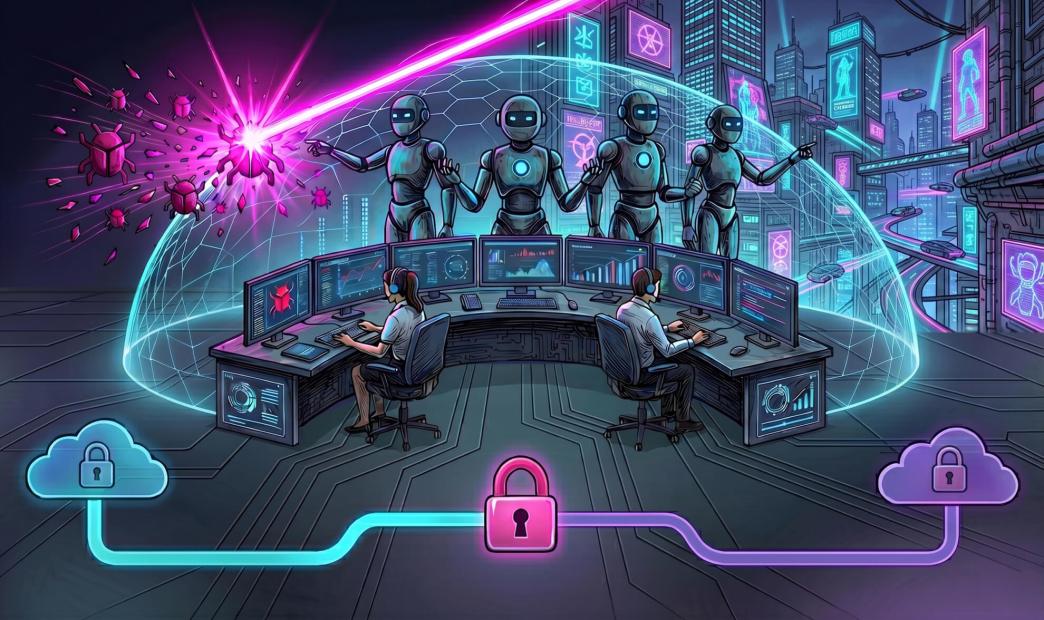
Few terms in cybersecurity have become more overloaded than “agent.”
On one side, vendors are racing to introduce AI agents capable of investigating alerts, prioritizing vulnerabilities, generating remediation guidance, and automating security operations. On the other, organizations continue to evaluate agentless and agent-based security platforms for protecting cloud environments, applications, identities, and infrastructure.
Because both conversations involve the word “agent,” many buyers assume they are discussing the same technology. Some even wonder whether AI agents and agentless security are competing approaches.
They are not.
AI agents and security agents serve entirely different purposes. One is focused on intelligence and automation. The other is focused on data collection and enforcement. Agentless security represents yet another approach, providing visibility without requiring software installation across workloads.
Understanding these distinctions is becoming increasingly important as organizations adopt AI-powered security capabilities while continuing to modernize their cloud security programs.
Why Are Security Teams Shifting to Agentless Approaches and AI Automation?
The cybersecurity industry is currently experiencing two major shifts.
The first is the rapid adoption of AI.
Security teams are being asked to manage growing volumes of alerts, vulnerabilities, cloud assets, applications, and AI technologies without a corresponding increase in staffing. As a result, vendors are introducing AI agents that can assist with investigations, triage findings, answer security questions, and automate workflows.
The second shift is the continued movement toward cloud-native architectures.
Organizations now operate thousands of cloud resources across multiple environments. Deploying and maintaining software agents across every asset can create operational challenges, coverage gaps, and administrative overhead. This has increased demand for agentless approaches that provide visibility without requiring software installation on every workload through APIs and integrations.
These trends are happening simultaneously, leading many security professionals to ask:
“What exactly is the difference between AI agents, security agents, and agentless security?”
Let’s break it down here.
What Is an AI Agent in Cybersecurity?
An AI agent is a software system that uses artificial intelligence to perform tasks with varying degrees of autonomy.
Unlike traditional automation tools that follow predefined workflows, AI agents can reason through problems, analyze context, make decisions, and take action based on the information available to them.
In cybersecurity, AI agents may be used to:
- Investigate security findings
- Prioritize vulnerabilities
- Analyze attack paths
- Generate remediation recommendations
- Answer security questions
- Automate repetitive analyst workflows
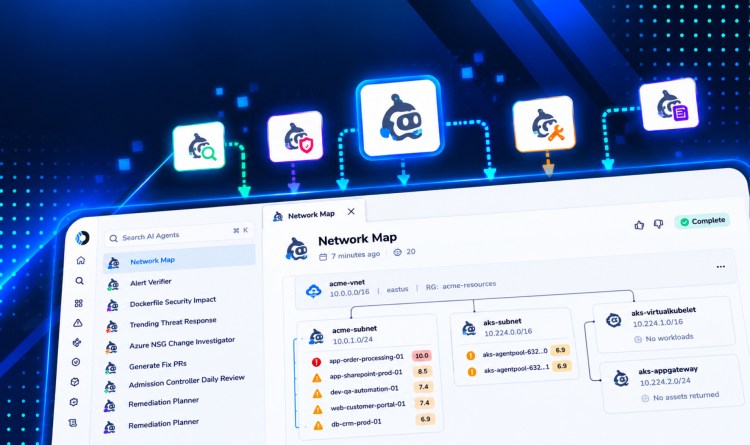
For example, Orca’s AI-powered AppSec Triage Agent can analyze a newly discovered finding, evaluate its validity, determine potential impact, adjust severity, and recommend remediation steps without requiring manual investigation from a security analyst.
Key Characteristics of AI Agents
- Use AI models and reasoning capabilities
- Analyze context from multiple data sources
- Make recommendations or decisions
- Automate workflows
- Continuously improve efficiency for security teams
- Their primary purpose is intelligence and automation.
What Is a Security Agent?
A security agent is software that is installed directly on a workload, endpoint, server, virtual machine, or other system.
Security agents collect telemetry, monitor activity, and sometimes enforce security controls directly on the asset where they are installed.
Examples of a security agent include:
- Endpoint detection and response (EDR) agents
- Runtime protection agents
- Vulnerability management agents
- Endpoint security software
- Host-based monitoring agents
Because security agents operate directly on a system, they can often provide highly detailed visibility into processes, memory activity, network connections, and runtime behavior.
Key Characteristics of Security Agents
- Installed on systems or workloads
- Collect telemetry locally
- May enforce security controls
- Require deployment and maintenance
- Consume system resources
Their primary purpose is data collection and enforcement.
What Is Agentless Security for Cloud Assets?
Agentless security provides visibility and security analysis without requiring software deployment across cloud assets.
Instead of installing software on every workload, agentless platforms typically leverage cloud-native integrations such as APIs, control plane access, snapshots, configuration data, and metadata to discover assets and identify risks.
This approach allows organizations to gain broad visibility across cloud environments without the operational burden of deploying and managing agents everywhere.
Agentless security can help organizations identify:
- Misconfigurations
- Vulnerabilities
- Identity risks
- Data exposures
- Compliance issues
- Application security findings
- AI security risks
Key Characteristics of Agentless Security
- No software installation required on workloads
- Broad cloud visibility
- Faster deployment
- Reduced operational overhead
- Continuous asset discovery
Its primary purpose is scalable visibility and risk identification.
What Is the Difference Between AI Agents, Security Agents, and Agentless Security?
Although these technologies are often discussed together, they solve different challenges.
| Category | AI Agents | Security Agents | Agentless Security |
|---|---|---|---|
| Primary Purpose | Automation and decision-making | Telemetry collection and enforcement | Visibility and risk discovery |
| Installed on Systems | No | Yes | No |
| Uses AI Reasoning | Yes | No | Not required |
| Requires Software Deployment | Typically No | Yes | No |
| Collects Telemetry | Sometimes | Yes | Indirectly |
| Automates Security Tasks | Yes | Limited | Limited |
| Reduces Operational Overhead | Yes | No | Yes |
The most important distinction is that AI agents focus on what to do, while security agents focus on collecting information and agentless security focuses on discovering risk.
How These Technologies Work Together
The reality is that modern security programs often use all three approaches simultaneously.
Consider a cloud security workflow:
First, an agentless security platform discovers a publicly exposed cloud workload containing a critical vulnerability.
Next, a security agent running on that workload provides detailed runtime telemetry showing that the vulnerable service is actively running and internet accessible.
Finally, an AI agent analyzes the finding, evaluates exploitability, determines business impact, prioritizes remediation, and recommends the most effective fix.
Each technology contributes a different capability. The agentless platform provides broad visibility. The security agent provides deep telemetry. The AI agent provides intelligence and automation. Rather than replacing one another, they complement one another.
Looking Beyond the Buzzwords
As AI continues transforming cybersecurity, organizations will likely encounter even more uses of the term “agent.”
The key is understanding what problem each technology is designed to solve.
AI agents help security teams investigate, prioritize, and respond faster.
Security agents provide direct telemetry and enforcement on individual systems.
Agentless security delivers scalable visibility across modern cloud environments without the operational burden of software deployment.
The future of cybersecurity is not about choosing between AI agents and agentless security. It is about combining visibility, context, and automation to help security teams identify and remediate risk more effectively.
Organizations evaluating security platforms should focus less on whether a solution uses agents and more on whether it delivers the outcomes that matter most: comprehensive visibility, actionable context, and faster remediation.
How Orca Helps
Modern security teams need more than visibility alone. They need the ability to identify risk across cloud environments, applications, identities, and AI technologies, understand what matters most, and take action quickly. Orca combines agentless security, AI-powered capabilities, and runtime telemetry to help organizations secure their entire attack surface from a single platform. By leveraging an agentless-first architecture, Orca delivers comprehensive visibility across cloud infrastructure, applications, identities, data, and AI services without requiring organizations to deploy and manage agents across every asset.
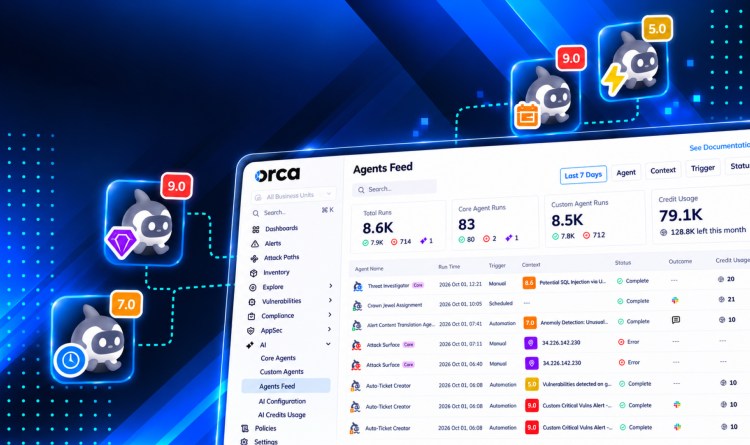
At the same time, Orca uses AI-driven capabilities to help teams prioritize and remediate risk faster. From AI-powered triage and investigation to contextual remediation guidance, Orca helps security teams reduce manual effort and focus on the issues that matter most. For organizations that require deeper runtime insights, Orca also supports sensor-based telemetry to provide additional visibility into workload activity and behavior. The result is a unified platform that combines broad agentless visibility, deep runtime context, and intelligent automation to help organizations secure their cloud environments, applications, and AI systems throughout the entire lifecycle.
Frequently Asked Questions
No. AI agents use artificial intelligence to analyze information, make decisions, and automate workflows. Security agents are software components installed on systems to collect telemetry and enforce security controls.
It can, but the two technologies are independent. An agentless security platform may incorporate AI agents to automate investigations or remediation workflows while still gathering visibility without deploying software agents.
Many organizations use both approaches. Agentless security provides broad visibility and rapid deployment, while security agents may provide deeper telemetry in specific environments.
AI agents can significantly reduce manual work by automating investigations, prioritization, and remediation guidance. However, human expertise remains essential for strategic decision-making, governance, and incident response.
Table of contents
- Key Takeaways
- Demystifying AI Agents vs. Security Agents
- Why Are Security Teams Shifting to Agentless Approaches and AI Automation?
- What Is an AI Agent in Cybersecurity?
- What Is Agentless Security for Cloud Assets?
- What Is the Difference Between AI Agents, Security Agents, and Agentless Security?
- How These Technologies Work Together
- Looking Beyond the Buzzwords
- How Orca Helps
- Frequently Asked Questions



 Chat with an Orca Expert