


Table of contents
- 1. The Imperative of Near Real-Time Runtime Security
- 2. The Evolution from Agent-Based to Sensor-Based Solutions
- 3. The Role of Agentic AI in Detection and Response
- 4. The Importance of Integrating Agentless and Agent-Based Approaches
- 5. Challenges and Opportunities with Modernizing Runtime Security
- Conclusion
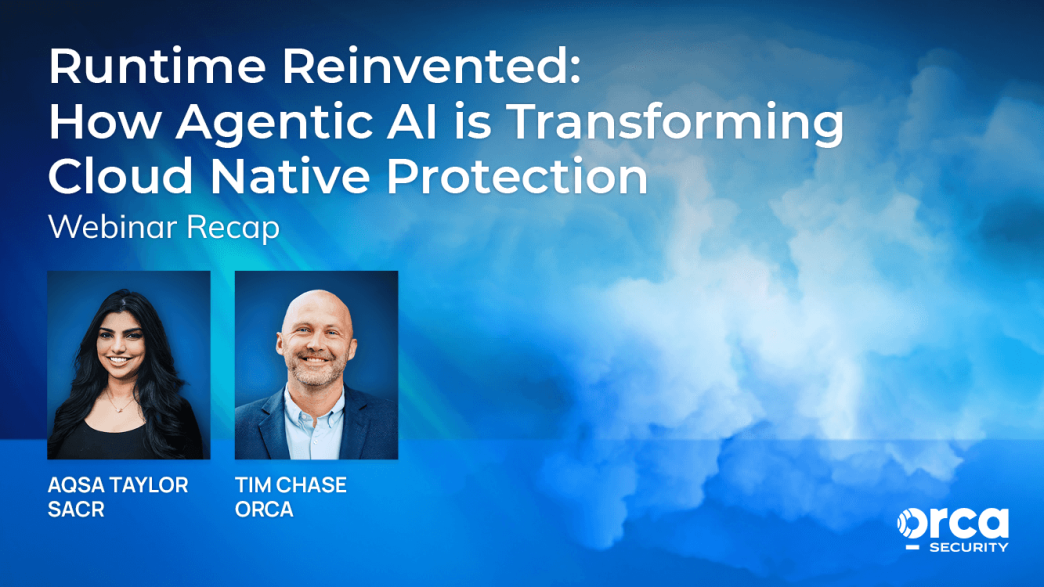
In the webinar titled “Runtime Reinvented: How Agentic AI is Transforming Cloud Native Protection,” experts from Orca Security and Software Analyst Cyber Research came together to discuss the rapidly evolving landscape of runtime security. Featuring Aqsa Taylor, Chief Research Officer at Software Analyst Cyber Research, and Tim Chase, Field CISO at Orca Security, the session offered valuable insights into how agentic AI advances, cloud adoption, and emerging operational challenges reshape security strategies. Here are the top five takeaways from this engaging conversation:
1. The Imperative of Near Real-Time Runtime Security
One of the significant talking points was the necessity for near real-time visibility in runtime security. Aqsa Taylor highlighted that the attack surface is expanding rapidly due to agentic AI. This not only introduces new attack techniques but also scales existing ones, reducing the breakout time for attackers to less than an hour. Consequently, organizations must ensure faster remediation and detection, making near real-time security insights essential to cope with this accelerated threat landscape.
2. The Evolution from Agent-Based to Sensor-Based Solutions
Tim Chase elaborated on the shift from traditional agent-based solutions to more modern, lightweight sensors. Earlier approaches often led to performance issues due to stacking multiple agents. However, advancements such as eBPF have allowed for the development of sensors that are less resource-intensive yet capable of monitoring processes and network activities effectively. These sensors can provide extensive telemetry without impacting production workloads, representing a significant step forward in runtime security.
3. The Role of Agentic AI in Detection and Response
Agentic AI’s impact on both attackers and defenders cannot be overstated. As Aqsa Taylor pointed out, while AI can empower defenders with advanced threat detection and faster response times, it equally assists attackers by automating and scaling attacks. Therefore, organizations need to adopt platforms that can provide visibility into AI interactions and use AI to bolster their defenses against these autonomous threats.
4. The Importance of Integrating Agentless and Agent-Based Approaches
The conversation underscored the necessity of integrating both agentless and agent-based security solutions. While agentless approaches provide comprehensive visibility without intrusiveness, which is ideal for environments with stringent approval processes, agent-based solutions offer in-depth runtime monitoring. The consensus was that a hybrid approach, leveraging the strengths of both, is essential for robust cloud security. This integration enables organizations to prioritize high-risk areas and achieve a more thorough security posture.
5. Challenges and Opportunities with Modernizing Runtime Security
Looking ahead, one of the primary challenges in modernizing runtime security lies in dealing with the increasing scale of data and integrating identity management, especially with the proliferation of non-human identities. Tim Chase emphasized the need for accurate, context-rich data to empower automated security agents and enhance their decision-making capabilities. Meanwhile, opportunities arise as vendors recognize the convergence of cloud security and AI, leading to more integrated and intelligent platforms that can provide end-to-end visibility and response capabilities.
Conclusion
As cloud adoption accelerates and the threat landscape evolves, understanding and implementing effective runtime security strategies becomes critical. This webinar provided thought-provoking insights and practical advice on harnessing the power of agentic AI and modern security technologies. By integrating comprehensive telemetry, leveraging both agentless and agent-based solutions, and focusing on real-time response capabilities, organizations can better protect their cloud environments against sophisticated threats.
For those interested in diving deeper into these topics, the speakers suggested further resources and learning opportunities, including publications from Software Analyst Cyber Research and courses on security metrics by Tim Chase. Engaging with these materials can provide additional guidance on navigating the complexities of cloud security in today’s fast-paced digital world.
Table of contents
- 1. The Imperative of Near Real-Time Runtime Security
- 2. The Evolution from Agent-Based to Sensor-Based Solutions
- 3. The Role of Agentic AI in Detection and Response
- 4. The Importance of Integrating Agentless and Agent-Based Approaches
- 5. Challenges and Opportunities with Modernizing Runtime Security
- Conclusion




 Chat with an Orca Expert