



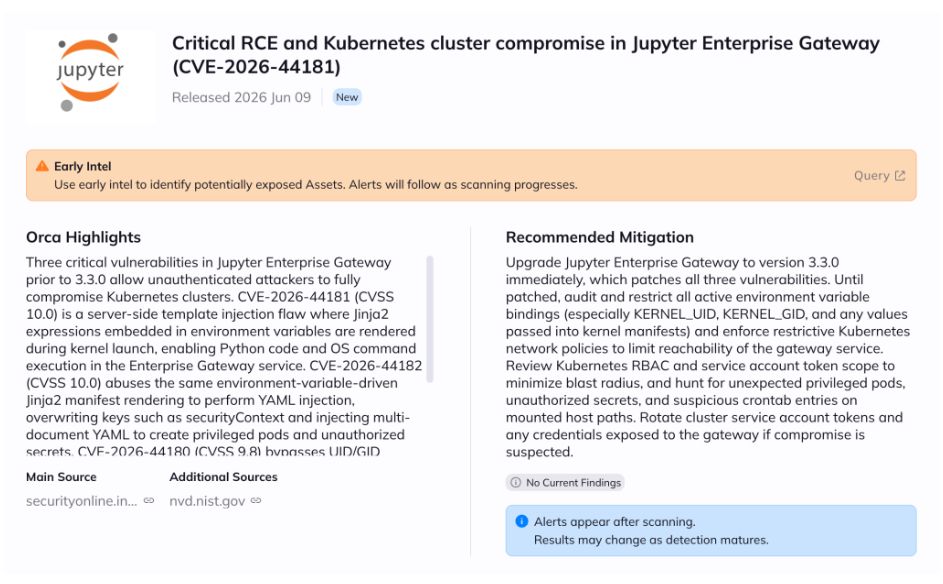
Three critical vulnerabilities (CVE-2026-44182, CVSS 10.0; CVE-2026-44181, CVSS 10.0; CVE-2026-44180, CVSS 9.8) were disclosed affecting Jupyter Enterprise Gateway, a widely used component for remote Jupyter kernel management on Kubernetes clusters, allowing attackers to achieve full remote code execution, create privileged pods, and compromise entire Kubernetes clusters via YAML injection and template injection in the manifest rendering pipeline. Due to the potential for complete infrastructure compromise, immediate patching is required.
About CVE-2026-44182, CVE-2026-44181, and CVE-2026-44180
The issues originate from the Jinja2 template rendering path used to generate Kubernetes manifests, where inadequate input sanitization of user-supplied environment variables leads to multiple injection vectors. CVE-2026-44182 allows YAML injection via environment variables during manifest rendering, enabling attackers to overwrite security-critical keys like securityContext and inject multi-document YAML to create unintended Kubernetes resources such as privileged pods or secrets. CVE-2026-44181 enables Server-Side Template Injection (SSTI) through the same rendering path, where KERNEL_XXX environment variables are interpolated without sanitization, allowing execution of arbitrary Python code and OS commands within the Enterprise Gateway service. CVE-2026-44180 allows bypass of the _enforce_prohibited_ids security control that prevents kernel launches with UID/GID 0, enabling container escapes and host filesystem abuse. No authentication is required to exploit these issues.
Affected Systems
The following components are affected: Jupyter Enterprise Gateway, all versions before 3.3.0 for CVE-2026-44182, versions 2.0.0-rc.2 through 3.2.x for CVE-2026-44181, and versions 2.0.0-rc.1 through 3.2.x for CVE-2026-44180. These components are used by data science and machine learning teams running Jupyter notebooks with Kubernetes-based kernel orchestration in enterprise environments. Organizations with internet-facing Jupyter deployments or shared multi-tenant Kubernetes clusters are at particularly high risk.
Users should upgrade to Jupyter Enterprise Gateway version 3.3.0 immediately. In addition, administrators should audit all active environment variable bindings for kernel configurations, enforce restrictive Kubernetes network policies to limit lateral movement, and review Kubernetes RBAC to minimize service account permissions for the Enterprise Gateway.
At the time of writing, proof-of-concept details are available through the published advisories, and no confirmed in-the-wild exploitation has been reported. Regardless, the severity and ease of exploitation make these vulnerabilities extremely high risk, especially in internet-facing deployments.
Risk Impact
Successful exploitation could allow attackers to execute arbitrary code on the Enterprise Gateway service, create privileged Kubernetes pods to escalate access, and steal Kubernetes service account tokens, leading to full cluster compromise, container escapes to the host, data exposure through reading sensitive configurations, and service disruption through destructive actions like deleting persistent volumes.
How Orca Can Help
Orca enables customers to quickly identify assets running vulnerable versions of Jupyter Enterprise Gateway, understand their exposure in context, including internet accessibility, runtime reachability, and asset criticality, and prioritize remediation based on real risk rather than CVSS alone. Orca’s agentless SideScanning can detect vulnerable packages installed in cloud workloads, containers, and Kubernetes clusters. Orca’s platform highlights affected assets directly in the newItem view, helping security teams focus on the most critical remediation paths first.






 Chat with an Orca Expert