

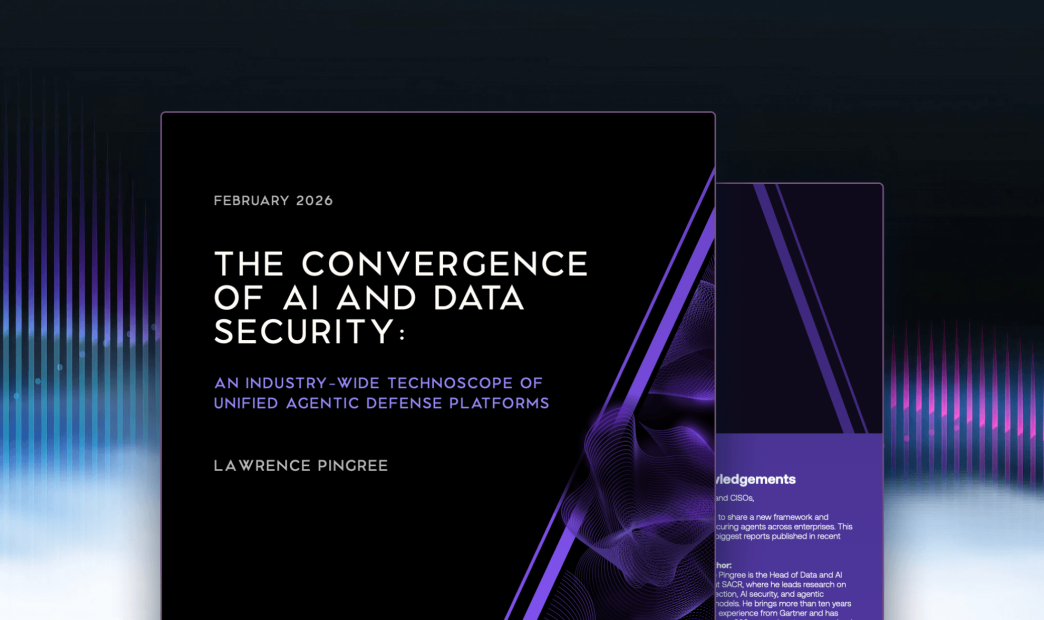

Software Analyst Cyber Research (SACR) has published its report, The Convergence of AI and Data Security: An Industry-Wide Technoscope of Unified Agentic Defense Platforms. In this evaluation of 15 leading vendors shaping the emerging Unified Agentic Defense Platform (UADP) category, Orca Security was recognized for its unique strengths in AI posture management, agentless visibility, and contextual risk scoring.
We see this recognition as confirmation that Orca’s platform approach—unifying cloud security, data security, and AI governance into a single context and reasoning engine—is well-positioned for the agentic era. Here are three key takeaways from the report.
Mastering SACR AI Security: Why Rapid Visibility is the Foundation of Agentic Defense
The SACR report makes a compelling case that the security landscape is undergoing its most significant architectural shift since the move to the cloud. With 72% of organizations already using or testing AI agents and more than half of deployed agents lacking active monitoring, the first challenge for any CISO is simply knowing what’s out there. Shadow AI, like unauthorized models, forgotten training sets, unsanctioned developer tools, represents one of the most urgent risks enterprises face today.
SACR recognized Orca as offering the fastest path to visibility for ungoverned AI estates. As the report’s key takeaway on Orca states: “For the CISO, Orca Security represents the fastest path to visibility for an ungoverned AI estate.” This speaks directly to the value of our patented SideScanning technology and Unified Data Model, which allow customers to connect a cloud account and immediately discover AI models, self-hosted AI, MCP servers, and AI services.
Using the “Contextual Trinity” to Optimize SACR Security and Reduce Alert Noise
One of the report’s central themes is the fight for context. SACR argues that the winners in the UADP market will be those who best correlate identity, data, and intent. This is what Pingree calls the “contextual trinity.” Alert fatigue continues to plague security teams, and the report emphasizes that static, rule-based tools are fundamentally inadequate for the probabilistic nature of AI-driven threats.
Orca’s approach to contextual risk scoring was highlighted as a key strength. Rather than showing security teams a wall of 1,000 isolated vulnerabilities, the Orca Platform maps specific toxic combinations. For example, an internet-facing VM with a known vulnerability that also has access to a sensitive S3 bucket containing AI training data. SACR noted that this attack path precision can reduce alert noise by up to 90%, allowing teams to focus on the risks that matter most. This is exactly the kind of intelligence-driven prioritization that the agentic era demands.
2026 AI Compliance: Meeting EU AI Act and NIST Standards in the Agentic Era
Here’s what makes AI security even more urgent: regulators aren’t waiting for the security industry to figure this out.
The EU AI Act becomes fully applicable in August 2026. HIPAA now has explicit requirements around AI agents handling protected health information. The SEC’s 4-day breach disclosure rule applies to AI-related incidents. And NIST’s AI Risk Management Framework is quickly becoming the standard that boards and auditors use to measure whether you’re doing enough.
That’s a lot of new obligations landing at once. And the organizations that treat AI governance as a compliance checkbox, rather than a genuine security capability, are going to struggle to meet any of them.
The good news is that building real AI governance isn’t separate from the security work you’re already doing. It runs through the same questions: What assets do you have? What data do they touch? What does normal behavior look like and what does a deviation signal? The frameworks are familiar. The application to AI just requires intention.
The organizations that build that muscle now won’t just be more compliant. They’ll be more resilient.
The SACR AI Market Landscape: Unifying DSPM and AI-SPM into UADP
The report introduces the UADP framework as the convergence of Data Security Posture Management (DSPM), adaptive Data Loss Prevention (DLP), AI Security Posture Management (AI-SPM), and runtime enforcement into a single integrated category. SACR’s lead author, Lawrence Pingree, frames the urgency well: “Effective AI and Agent security requires use of real-time behavioral analysis, control of all content, prompts, tool interactions, user, role and human context by using predictive intent to depict problematic outcomes.”
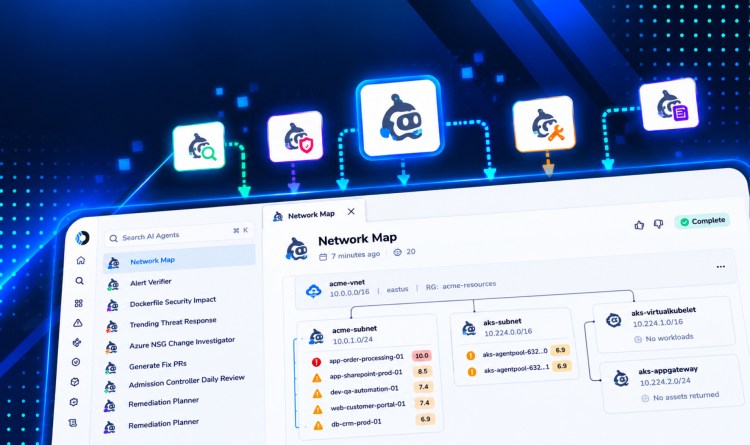
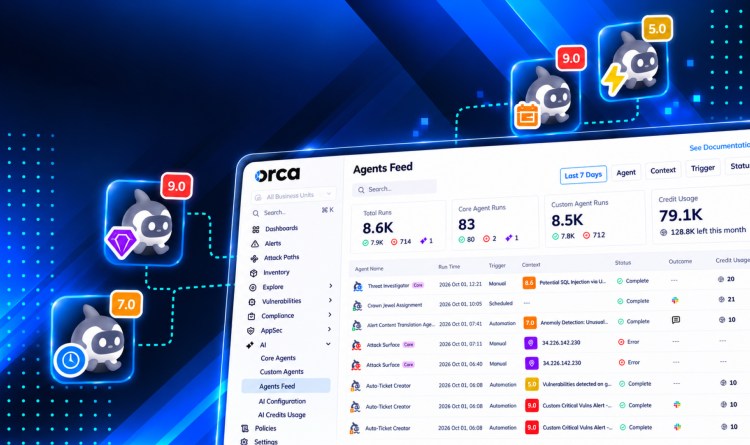
Orca has been building toward exactly this convergence. Our integrated DSPM natively classifies sensitive data within the cloud infrastructure that supports AI, rather than treating data security as a separate silo. Our AI-SPM capabilities automatically discover AI models, generate an AI Bill of Materials (AI-BOM), and identify sensitive data within AI training sets. And with Orca AI, our customers can leverage a generative AI teammate that performs natural language investigation and autonomous remediation, turning security teams from vulnerability responders into security architects.
The Future of Agentic Defense: Scaling Security with the Orca Platform
The SACR report validates what we’ve been building toward: a unified platform where cloud security, data security, and AI governance converge. As enterprises move from AI experimentation to deploying autonomous agents with real operational authority, the need for comprehensive, context-rich visibility will only grow.
We’re continuing to invest in deepening our runtime capabilities, expanding our hybrid cloud sensor, and strengthening the agentic defense capabilities our customers need. Whether you’re just beginning to assess your AI security posture or looking to consolidate your security stack for the agentic era, the Orca Platform is built to help you see every risk — from code to cloud, runtime, and AI.
Interested in learning more? Explore the Orca Platform or schedule a personalized 1:1 demo.



 Chat with an Orca Expert