

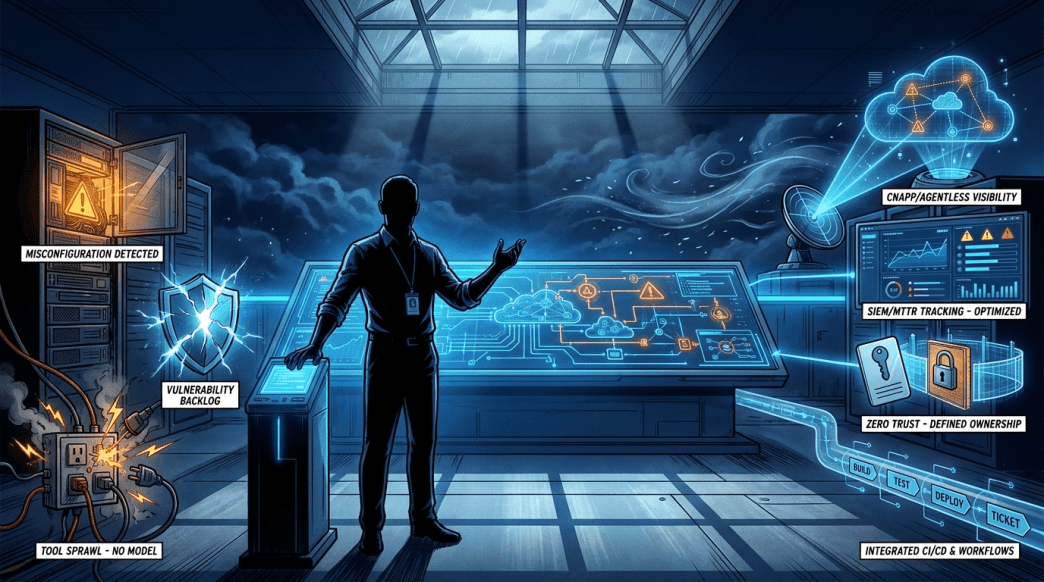


Getting a security platform live is an achievement. But if you are just watching a dashboard light up with findings, that is monitoring, not a security program. Bridging the gap between ‘seeing risk’ and ‘reducing risk’ is where your investment either pays off or quietly disappoints.
Closing that gap requires deliberate operational choices that don’t happen automatically at go-live: clear outcome metrics, defined ownership, workflows that connect findings to action, and the right decision about what to manage in-house versus what to delegate.
This is a practical guide to making those choices effectively.
Define Outcomes Before You Measure Progress
Most organizations configure their platform, confirm that alerts are firing, and move on. That approach optimizes for tool adoption rather than security outcomes. A platform surfacing thousands of findings is only valuable if the data is prioritized and acted upon consistently.
Setting outcome-based KPIs at deployment creates a baseline that makes progress visible and accountability possible. The metrics that matter most:
- Mean Time to Remediate (MTTR) by severity: This single metric reveals more about operational maturity than any dashboard, showing how long it takes to close a critical or high finding from the moment it surfaces.
- Percentage of critical findings closed within SLA: A direct measure of whether the team can keep pace with the risk being identified. Orca’s 2026 State of Application Security Report found that 77% of organizations retain high or critical container vulnerabilities for more than 90 days, a gap that traces back to missing SLA accountability more often than missing visibility.
- Compliance score trends across active frameworks like SOC 2, CIS, NIST, and PCI-DSS, tracked continuously rather than checked only at audit time.
- Risk score trajectory over time: Shows whether overall posture is improving or degrading as the environment grows.
- Alert response rate: The fraction of findings that are being triaged and actioned versus aging unreviewed in the queue.
Orca’s compliance dashboards and Executive Risk Summary make these metrics available without additional instrumentation. The discipline of reviewing them on a defined cadence and assigning ownership over what happens when they move in the wrong direction is what turns a reporting feature into a security program.
Different stakeholders need different views of this data. Engineering teams need actionable finding details. Compliance leads need framework-mapped posture reports. Executives need a narrative that connects risk trends to business exposure. Building those reporting cadences from the start rather than fitting them in later prevents the common pattern where findings accumulate in a platform nobody is consistently reviewing.
How to Operationalize Cloud Security: Ownership, Workflows, and Automated Remediation
A platform without a process is an expensive dashboard. Running a cloud security solution as a functioning program requires changes to how people work, not just what tools they use.
The most common failure mode is the absence of clear ownership. When nobody is explicitly responsible for reviewing real-time alerts, remediating configuration drift, or tuning the platform as the environment changes, findings accumulate regardless of how capable the platform is. A functional operating model addresses this directly:
- Assign ownership for alert review, remediation, and platform management as separate responsibilities. These tend to collapse into one person by default, and when they do, none of them get done consistently under pressure.
- Embed security into engineering workflows rather than running it as a parallel process. Findings need to reach the teams who can act on them in the tools and formats they already use, like ticketing systems, sprint planning, and developer communication channels. A finding that lives only in a security dashboard is a finding that gets deferred.
- Shift left by configuring pre-production scanning. Vulnerabilities caught before deployment cost a fraction of what they cost to remediate in production and never appear in the findings backlog at all.
- Integrate the platform with the broader toolchain. Connecting findings to SIEM, ticketing systems, and CI/CD pipelines creates automated workflows that generate action without requiring manual handoff. A critical finding that automatically opens a ticket and notifies the right team is more likely to get addressed than one that sits in a queue waiting for someone to notice it.
- Apply automation to compress the manual review burden. AI-driven triage can handle initial alert review, gather context, assess exposure, and recommend action without a human processing every finding. Applied consistently, this frees security staff for decisions that require actual judgment.
None of this requires a large team. A single security engineer with well-defined workflows, properly integrated tooling, and AI-assisted triage can run a program that would otherwise require significantly more headcount, but only if the operational model is built intentionally.
When to Bring in Managed Cloud Security Services and Which Kind
For many organizations, building this operational model internally is not realistic. Security headcount is constrained and cloud security expertise is genuinely scarce. The ISC2 Cybersecurity Workforce Study tracks this gap annually and has consistently put the global shortfall in the millions of unfilled roles, with demand continuing to outpace supply. Competing priorities compress the time available for platform tuning, process design, and continuous improvement. In these cases, a managed services partner can close the gap, but the right choice depends on what you are actually trying to achieve.
Two distinct models are worth understanding:
An MSP (Managed Services Provider) that manages your cloud environment alongside cloud security brings a structural advantage that a security-only provider cannot match: operational context. When the same partner managing your infrastructure receives a finding, there is no handoff between the team that sees the issue and the team that can fix it. They understand the environment, the change history, and the business logic behind the configuration being flagged. For organizations where cloud operations and cloud security are genuinely intertwined, which describes most of them, this integration shortens response time significantly and reduces the overhead of coordinating between separate vendors.
An MSSP (Managed Security Services Provider) or MDR (Managed Detection & Response) is a better fit when the primary need is security posture management and incident response, and cloud operations are handled separately or in-house. MSSPs are optimized for detection, investigation, and response, with remediation handed back to the customer or a separate infrastructure team. This model works well when the organization has capable cloud operations staff but lacks security expertise or 24/7 coverage capacity.
In either case, the selection criteria that matter most are outcomes-focused, not activity-focused:
- Accountability to measurable security outcomes like MTTR and compliance posture improvement, rather than activity metrics like coverage hours and ticket volumes.
- Deep platform expertise. Tuning a CNAPP, configuring automated workflows effectively, and adapting as the environment changes requires hands-on experience across multiple customer environments, not general platform familiarity.
- A clear escalation model for critical findings outside business hours, which reveals whether the engagement provides genuine continuity or simply shifts the on-call burden to a different organization.
- An engagement model that builds internal capability over time, leaving the customer’s team with better visibility and sharper judgment than they had before.
Cloud security platforms give security teams the visibility, context, and intelligence to run a mature program. Whether that potential translates into measurable outcomes depends on the decisions made after deployment: the metrics set, the processes built, the integrations configured, and the ownership established.
Organizations that treat deployment as the finish line will find the findings piling up. Those that treat it as the operational starting point, and build the operating model to match, find themselves closing risk faster than it accumulates.
Evaluate Where Your Cloud Security Program Stands
Speak with an Orca partner or request a managed services assessment to evaluate where your program stands and what it would take to get to the next level.



 Chat with an Orca Expert