



Table of contents
- Key Takeaways
- Why Are Security Teams Looking for Cortex (Prisma Cloud) Alternatives?
- What Should You Look for in a Cortex (Prisma Cloud) Alternative?
- What Are the Best Cortex (Prisma Cloud) Alternatives in 2026?
- How Should You Evaluate Your Options Before Making a Decision?
- Why Orca Is the Strongest Cortex (Prisma Cloud) Alternative
- Frequently Asked Questions
Key Takeaways
- Security teams evaluating CNAPP alternatives are most often driven by operational friction, not feature gaps: agent lifecycle overhead, fragmented visibility across multiple consoles, and licensing models that are difficult to forecast at scale.
- The most effective CNAPP platforms in 2026 combine agentless-first architecture for immediate coverage, a unified data model that connects risk signals across infrastructure and identity, and prioritization built on exploitability and attack path context rather than raw alert volume.
- Deployment speed and total cost of ownership matter as much as capability breadth. A platform that requires weeks to fully configure defers security value and consumes team capacity that could be directed at remediation.
- The right choice depends on your environment, your team’s operational capacity, and how much of your security stack you need to consolidate under a single platform.
Palo Alto Networks is one of the most recognized names in cloud security, offering CNAPP capabilities through Prisma Cloud, now being rebranded and unified under the Cortex platform. Palo Alto Networks has invested heavily in cloud security capabilities, and for many organizations, that investment produced real coverage. But in 2026, a growing number of security teams are reaching a familiar crossroads. The platform they selected for its breadth has introduced a different problem: operational complexity that consumes time security teams cannot afford to lose.
The friction is specific. It shows up as agent deployments that must be repeated across every new workload. It shows up as context-switching between separate consoles for posture, compute, and runtime. It shows up in budget conversations where licensing costs are difficult to model as the cloud environment grows.
CISOs evaluating alternatives are not reducing their security ambitions. They are looking for a platform that delivers equivalent or greater coverage with significantly less operational burden. This article provides a practical evaluation of the leading Cortex Cloud alternatives in 2026, the criteria that should govern the decision, and what separates the platforms that deliver Day 1 value from those that reproduce the problem you are trying to solve.
Why Are Security Teams Looking for Cortex (Prisma Cloud) Alternatives?
The most common reasons security teams evaluate Cortex Cloud alternatives are operational, not functional. Agent complexity, fragmented visibility across multiple consoles, and a pricing model that becomes harder to justify as cloud environments scale are the recurring themes in conversations about switching.
These are not generic CNAPP complaints. They are inherent to how Cortex Cloud was built.
Agent deployment at the speed of your cloud
Cortex Cloud runtime and workload coverage depends on deploying agent-based Defenders alongside individual workloads. That process must be repeated as new workloads spin up. In environments with hundreds or thousands of ephemeral workloads, maintaining full Defender coverage is a persistent operational commitment, not a one-time configuration task.
The practical implication is that every workload that does not yet have a deployed Defender represents a gap in coverage. In a fast-changing cloud environment, that gap is never fully closed. Security teams end up managing agent lifecycles instead of managing risk.
Multiple consoles, fragmented visibility
Cortex Cloud’s platform was assembled through multiple acquisitions, and the architecture reflects that history. Posture management, compute security, and runtime protection operate through separate interfaces, each requiring distinct configuration. Security teams investigating an incident or tracing a risk across layers must navigate between dashboards and manually reconcile signals that do not share a common data model.
That fragmentation slows investigation. It also introduces the risk of missed connections between related findings because the correlation has to happen in a person’s head rather than in the platform.
A licensing model that is hard to forecast
Cortex Cloud operates on a credit and module-based licensing structure. This billing model is difficult to predict, particularly as cloud environments grow and additional capabilities, including certain runtime features and expanded agent coverage, carry separate cost implications. When security spend becomes hard to forecast, internal consolidation conversations become harder to win.
The forecasting problem is sharper for organizations already running Prisma Cloud. Their transition to Cortex Cloud requires a full platform replacement, with the corresponding deployment effort, integration work, and configuration cost. Prior investment in Prisma does not carry forward as a credit against that work.
Deferred time to value
Full deployment of Cortex Cloud, including both agentless connections and Defender rollouts across existing workloads, can take weeks to complete. Security value is deferred during that window. Organizations that evaluated Cortex Cloud alongside alternatives cited that deployment burden as a factor in their decision to choose a different platform.

Insurance Innovator Lemonade Goes from 0 to 100% Cloud Visibility with Orca Security

What Should You Look for in a Cortex (Prisma Cloud) Alternative?
The right cloud security alternative should deliver comprehensive cloud coverage without multiplying operational complexity. That means unified visibility, full-stack coverage, clear risk prioritization, and a pricing model that scales predictably with your environment.
Use these criteria to structure your evaluation:
Agentless-first architecture for immediate coverage
Can the platform deliver full visibility across your cloud estate without requiring agents on every workload? Agentless-first means coverage begins on Day 1, including assets that would otherwise remain unprotected during agent rollout windows. Look for platforms that combine agentless scanning for continuous visibility with optional lightweight runtime sensors where deeper detection is required.
A unified platform with one data model
Does the platform consolidate CSPM, CWPP, CIEM, DSPM, AppSec, and CDR in a single interface with a shared data model? Unified context is what makes attack path analysis meaningful: connecting a misconfiguration, an identity risk, and a vulnerable workload into a single exploitable scenario that your team can act on.
Contextual risk prioritization
How does the platform help your team decide what to fix first? Prioritization should account for exploitability, reachability, and business impact, not just CVSS severity. Alert fatigue is a real cost. The quality of prioritization directly determines how efficiently your team operates.
Developer and remediation workflow integration
Can risks be traced back to source code? Can the platform generate a fix and initiate a pull request from within the interface? These capabilities reduce the cost of remediation and keep security embedded in engineering workflows rather than creating handoff friction between security and development teams.
Deployment speed and ongoing overhead
How long does it take to achieve full coverage? What ongoing maintenance does the platform require? Platforms that deploy quickly and auto-discover new assets require less dedicated staffing to operate. For more guidance on what to evaluate, see 5 Considerations for Evaluating CNAPP Vendors.
Predictable, consolidated pricing
Does the pricing model scale transparently with your cloud footprint? Can you cover the full capability set under a single agreement rather than assembling modules with separate and compounding cost implications?
What Are the Best Cortex (Prisma Cloud) Alternatives in 2026?
The leading Cortex Cloud alternatives in 2026 include Orca Security, Wiz, CrowdStrike Falcon Cloud Security, Lacework (now FortiCNAPP), and Aqua Security. Each takes a meaningfully different approach to cloud-native application protection.
Orca Security
Overview
Orca Security is a unified cloud security platform that delivers full visibility across your entire cloud estate through patented SideScanning technology, which analyzes workloads via snapshots and APIs without requiring agents on individual workloads. Onboarding follows a three-step activation process and the platform deploys in minutes, with a complete asset inventory and prioritized risk view available on Day 1. Once connected, Orca continuously monitors the cloud estate and auto-discovers new assets without reconfiguration or agent rollouts across AWS, Azure, Google Cloud, Oracle Cloud, Alibaba Cloud, Tencent Cloud, and Kubernetes.
Lean security teams and fast-growing cloud environments tend to hit the same wall with agent-based platforms: deployment overhead that multiplies with every new workload, licensing costs that get harder to forecast as the environment scales, and security value that keeps getting pushed out while agent rollouts try to catch up. Orca was built specifically to remove each of those friction points.
Strengths
- Agentless SideScanning delivers 100% cloud estate coverage with zero agent lifecycle management, eliminating the per-workload deployment overhead that slows security programs at scale
- Unified data model correlates signals across infrastructure, applications, identities, data, and AI in a single interface, enabling attack path analysis that connects misconfigurations, identity risks, vulnerable workloads, and sensitive data into complete exploitable scenarios
- AI-SPM discovers AI assets, identifies shadow AI risks, and enforces governance across AI infrastructure and pipelines, extending coverage to the expanding AI attack surface
- Orca AI enables natural-language investigation, context-aware code fix generation, and one-click pull requests directly from the platform, reducing the manual effort required between alert and resolution
- One SKU based on workload count covers any mix of assets scanned, sensors deployed, and code repositories, with no per-module charges and no unpredictable usage overages
- 200-plus compliance frameworks supported with automated asset discovery, out-of-the-box checks, and one-click report generation; Orca is the first CNAPP to manage security posture for Tencent Cloud
Ideal for
Security teams that need full cloud coverage on Day 1 without agent deployment overhead, CISOs consolidating CSPM, CWPP, CIEM, DSPM, AppSec, AI Security, and CDR under a single platform, and organizations operating across more than two cloud providers where coverage consistency and unified visibility are critical requirements.
Wiz
Overview
Wiz is an agentless cloud security platform that connects to cloud environments via read-only API connections and builds a Security Graph that correlates identity risks, misconfigurations, vulnerabilities, and network exposure into exploitable attack paths across AWS, Azure, GCP, and other providers.
Strengths
- Fast deployment with agentless-first architecture and broad multi-cloud API coverage
- Security Graph provides deep contextual risk correlation across multiple signal types
- Strong developer workflow integrations and ASPM capabilities
- Broad enterprise customer base with demonstrated scalability
Ideal for
Mid-to-large enterprises seeking unified cloud security with fast time to value, strong DevSecOps integrations, and contextual attack path analysis across multi-cloud environments.
CrowdStrike Falcon Cloud Security
Overview
CrowdStrike Falcon Cloud Security extends the Falcon platform’s threat intelligence and endpoint protection capabilities into cloud-native environments, offering cloud workload protection, posture management, and threat detection built on CrowdStrike’s XDR foundation.
Strengths
- Strong runtime threat detection rooted in endpoint security expertise and adversary intelligence
- Native compatibility with existing Falcon platform deployments
- Deployment flexibility with both agentless and agent-based coverage options
Ideal for
Organizations with an existing CrowdStrike investment looking to extend detection and response capabilities into cloud workloads, particularly where endpoint and cloud threat correlation is a primary security priority.
Lacework (FortiCNAPP)
Overview
Lacework, now integrated within Fortinet’s portfolio as FortiCNAPP, uses machine learning-based behavioral analysis to detect anomalies across cloud workloads, baselining normal behavior and surfacing deviations that may indicate threat activity.
Strengths
- Behavioral anomaly detection that adapts to environment-specific patterns without relying on manually written rules
- Unified posture and runtime visibility across major cloud providers
- Reduced manual tuning requirements compared to static rule-based detection approaches
Ideal for
Enterprises in dynamic multi-cloud environments where unknown threat patterns and behavioral drift are primary concerns, and where teams have the capacity to invest in model calibration during initial deployment.
Aqua Security
Overview
Aqua Security is a cloud-native security platform with deep roots in container and Kubernetes protection, providing full-lifecycle coverage from image scanning through runtime across containers, VMs, Kubernetes, and serverless environments.
Strengths
- Deep Kubernetes and container runtime protection with granular workload visibility
- Strong CI/CD pipeline integration and developer-facing tooling across the software development lifecycle
- Open-source heritage through Trivy with enterprise support and compliance coverage
Ideal for
Organizations with significant container and Kubernetes footprints where DevSecOps integration and shift-left security practices are central to the security program, and where runtime workload protection depth is the primary evaluation criterion.
How Should You Evaluate Your Options Before Making a Decision?
Before selecting a Cortex Cloud alternative, structure your evaluation around three dimensions: operational fit, coverage completeness, and organizational scale. A platform that scores well on all three is worth advancing. A platform that requires trade-offs should be assessed against which dimension you are least able to compromise on.
Step 1: Define your coverage baseline
Map your current cloud environment across providers, workload types (VMs, containers, serverless, Kubernetes), and any on-premises requirements. Identify where coverage gaps exist today, specifically where agent deployment lag or incomplete rollouts are leaving workloads unprotected. Use this baseline to filter alternatives: a platform that cannot match your coverage footprint on Day 1 should not advance to a proof of concept.
Step 2: Run a time-to-value assessment
Ask every vendor how long it takes to achieve full coverage of your existing estate, and what that requires from your team. Platforms that require agent rollouts across existing workloads before delivering meaningful signal will reproduce the operational burden you are trying to address. A practical benchmark: if a platform cannot provide a complete asset inventory and prioritized risk list within the first week of deployment, that is worth understanding before you commit.
Step 3: Test prioritization quality, not just alert volume
Request a proof of concept that surfaces your riskiest findings. Evaluate whether the platform’s prioritization model accounts for exploitability, reachability, and actual exposure, or whether it defaults to severity scoring alone. Alert reduction is only meaningful if the remaining alerts are the right ones. Ask vendors how they measure and validate signal-to-noise ratio in customer environments. The 4 Benefits of Choosing a CNAPP is a useful reference for understanding what consolidated prioritization should look like in practice.
Step 4: Model total cost of ownership
Request a three-year cost model that accounts for licensing fees across all required capabilities, agent deployment and maintenance labor, integration engineering time, and the staffing required to operate the platform at scale. Platforms with modular pricing may appear competitive at entry but accumulate cost as your requirements expand.
Step 5: Validate integration into your existing workflow
Confirm that the platform integrates with your ticketing system, SIEM, and developer toolchain, and that those integrations are bidirectional and automated where possible. A security finding that requires manual handoff to engineering is a finding that moves slowly through remediation. For cloud-native development environments in particular, the quality of developer integrations has a direct effect on remediation velocity.
Why Orca Is the Strongest Cortex (Prisma Cloud) Alternative
Security teams evaluating Cortex Cloud alternatives are not looking for a simpler product. They are looking for a platform that delivers the same breadth of coverage without the operational overhead that has made comprehensive protection feel like a burden.
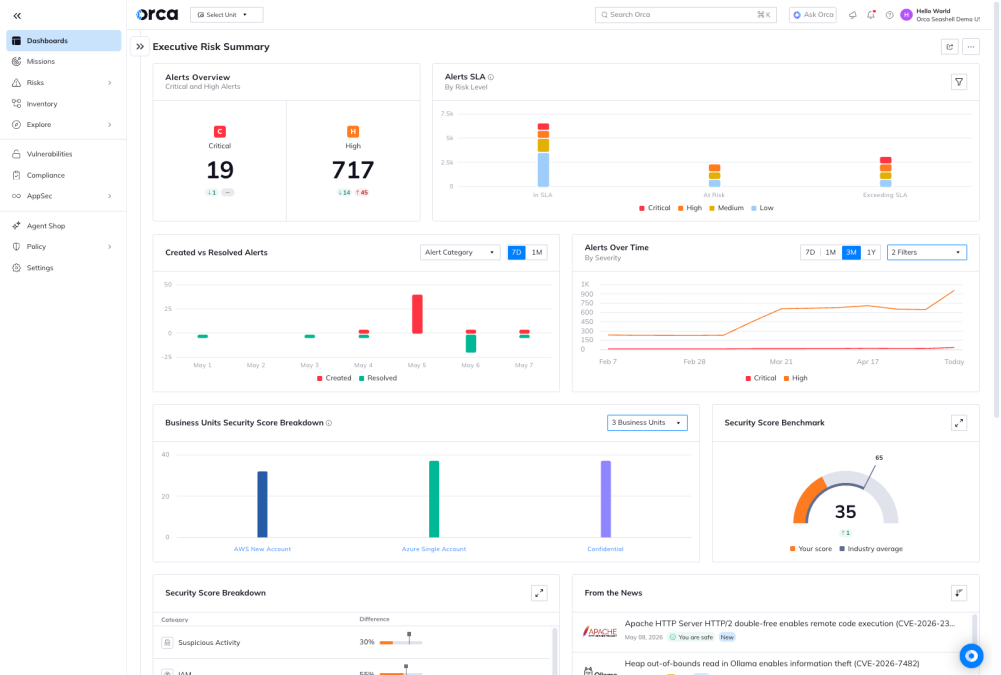
The Orca Cloud Security Platform addresses this directly. Patented SideScanning technology delivers full cloud estate visibility in minutes with no agents to deploy or maintain. From Day 1, security teams gain a prioritized, contextualized view of the risks that matter most: attack paths that connect misconfigurations, identity risks, vulnerable workloads, and sensitive data into scenarios that represent real exposure.
Where Cortex Cloud requires complex onboarding, multiple consoles, and ongoing agent lifecycle management, Orca requires a three-step onboarding process and auto-discovers every new asset from that point forward. Where module-based licensing introduces cost complexity, Orca offers a single SKU aligned to workload count, predictable at any scale.
For CISOs consolidating across CSPM, CWPP, CIEM, DSPM, AppSec, AI Security, and CDR without expanding their team’s operational burden, the Orca Cloud Security Platform provides full coverage without full complexity. The AI-driven remediation capabilities, bi-directional Jira integration, and native developer toolchain support mean that findings move from identification to resolution faster, with less manual effort at every step.
The case for consolidating under Cortex has also weakened on the AppSec side. Palo Alto recently removed SAST from the Cortex Cloud AppSec offering, so teams that planned to standardize application security testing under Cortex now need a separate tool to close that gap. Orca’s AppSec coverage includes SAST as part of the same platform, with no additional licensing or integration work required.
If you are actively evaluating alternatives to Cortex Cloud, see the platform in your environment. Book a personalized demo with Orca Security and get a Day 1 view of the risks across your cloud estate.
Frequently Asked Questions
Achieving full coverage in Cortex Cloud requires both agentless cloud connections and Defender agent rollouts across existing workloads, a process that commonly takes several weeks to complete at scale. Agentless-first alternatives can connect to your cloud environment through read-only APIs or snapshot analysis and deliver a complete asset inventory within the first day of deployment, which means security value is not deferred while your team manages an agent rollout backlog.
A complete TCO model has to extend past license fees and account for the categories that consistently change the math on Cortex Cloud comparisons. Agent lifecycle cost grows with the workload fleet, since every workload requires a Defender deployment and ongoing maintenance. Separate consoles for posture, compute, runtime, and AppSec produce integration work that has to be owned by someone on the security team. Manual configuration drives staffing overhead that scales with every capability added and every new account onboarded. Deployment windows of several weeks carry a cost of deferred coverage, where security value paid for is not yet delivered. Coverage gaps belong in the same model. Cortex Cloud’s current AppSec documentation positions SAST primarily as data ingested from external scanners like Snyk, Semgrep, SonarQube, and Veracode, meaning a customer consolidating static analysis under Cortex will still need to license and operate one of those tools. Platforms with modular pricing often appear competitive in initial negotiations but accumulate cost as capabilities are added, so a three-year projection that includes anticipated environment growth is more informative than a first-year comparison.
The most reliable evaluation method is a proof of concept run against your live environment, not a demo environment. Ask the vendor to surface your top 25 most critical findings and explain the prioritization logic behind each one. Platforms that account for exploitability, attack path reachability, and business context will produce a materially shorter and more actionable list than platforms that default to severity scoring alone. A high signal-to-noise ratio is only meaningful if the signals that remain are the ones your team would actually act on first.
Ask each vendor to map their capabilities directly against the tools you are currently running for CSPM, CWPP, CIEM, DSPM, AppSec, and CDR, and identify where gaps remain after consolidation. Then ask how many of those capabilities are delivered from a single data model versus integrated through separate modules or acquisitions, since platforms built on a unified data model produce more reliable cross-signal correlation than those that aggregate findings from separately developed engines. Finally, ask what the pricing impact is if you add capabilities after initial contract signing, because the consolidation case weakens significantly if each additional capability carries a separate cost conversation.



 Chat with an Orca Expert