


Table of contents
- Key Takeaways
- What is generative AI
- Why generative AI matters for modern cloud security teams
- How Can Generative AI Be Used in Cybersecurity?
- Generative AI Cybersecurity Use Cases in the Cloud
- How Attackers Use Generative AI
- Benefits of Generative AI in Cybersecurity
- Generative AI Security Risks and Challenges
- GenAI vs. Traditional Security Automation: When to Trust, When to Verify
- Best Practices for Securely Adopting Generative AI
- The Future of Generative AI in Cybersecurity
- How Orca Security Approaches GenAI in Cloud Security
- Frequently Asked Questions about Generative AI in Cybersecurity
Key Takeaways
- Generative AI in cybersecurity is the use of large language models (LLMs) and other generative systems to accelerate security tasks, from alert triage and detection engineering to incident response, reporting, and vulnerability remediation.
- The honest read is that GenAI is a force multiplier for both sides. It speeds defenders through triage, investigation, and reporting, and it lowers the skill and time an attacker needs to run a convincing campaign.
- Its biggest value today is collapsing the time analysts spend reading and writing: turning a noisy alert queue into a ranked shortlist, and turning scattered logs into a draft investigation a human can check.
- The risks are specific, not disqualifying: hallucinated findings, poisoned training data, sensitive data sent to a model, and analysts who stop verifying. Each one has a control, and the control is almost always keeping a human in the loop.
- GenAI is only as trustworthy as the data and context behind it. Orca feeds agentless, full-stack cloud context into AI-driven workflows so the answers an analyst gets are grounded in the real environment, not a plausible guess.
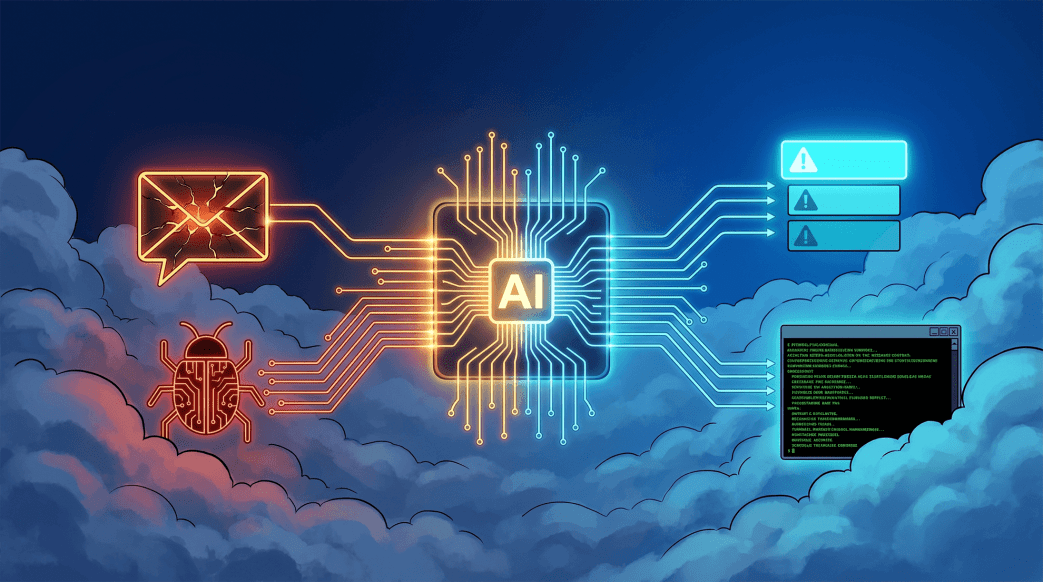
Generative AI in cybersecurity applies LLMs and other generative systems to security operations, from triaging alerts and writing detections to summarizing investigations and generating reports. The same technology that helps defenders move faster also helps attackers, which is why the topic carries both promise and risk.
The useful framing is not “is GenAI good or bad for security.” It changes both sides of the fight at once. A defender can compress an hour of log reading into a two-minute summary. An attacker can produce a flawless spear-phish in a language they do not speak. Both are true, and a security team has to plan for both. The broader role of AI in cybersecurity includes machine learning, predictive analytics, and other AI-driven security technologies beyond generative models. This article focuses specifically on how generative AI is changing cloud security operations.
It explains what generative AI is, how security teams use it today, how attackers weaponize it, the real risks of relying on it, and when GenAI output should be trusted versus verified. The focus throughout is practical cloud security operations, where these capabilities are already moving from experimentation into day-to-day practice.
What is generative AI
Generative AI is a class of machine-learning model that produces new content, text, code, images, audio, from patterns it learned in training data, rather than only classifying or scoring existing inputs. In security, the relevant type is the large language model: a system trained on huge volumes of text and code that predicts the next token in a sequence, which lets it write, summarize, translate, and explain.
How does generative AI work?
Two model families matter for this topic.
LLMs (the technology behind ChatGPT, Claude, and code assistants) handle language and code tasks: reading a log, drafting a query, explaining a misconfiguration.
Generative adversarial networks (GANs) pit two models against each other to produce realistic synthetic media, and along with newer diffusion models they sit behind today’s convincing deepfakes. You do not need the math to use either one. You need to know what each is good at and where it fails.
The practical difference from older security AI is interface and output. Classic machine learning in security scores an event as anomalous or benign. A generative model reads the same event and writes you a paragraph explaining what it is, what it touches, and what to do next. That shift, from a score to an explanation, is what makes GenAI feel new to a SOC analyst. It also introduces a new failure mode: the explanation can be wrong and still sound right.
Why generative AI matters for modern cloud security teams
Cloud environments generate more signal than any team can read. A mid-size estate produces thousands of alerts a week across identities, workloads, data stores, and network paths, and most of them never get human attention. GenAI matters because it works on language and context at the speed the cloud produces it. To use it well, a team first needs solid AI security fundamentals so they can tell a grounded answer from a confident guess.
The teams that benefit most are the ones that are understaffed and drowning in context-switching. An analyst who spends the morning copying log lines between consoles can ask a model to assemble the same picture in one pass. The model does not replace the analyst’s judgment. It removes the clerical work that sits between the analyst and the decision.
How Can Generative AI Be Used in Cybersecurity?
Defenders use generative AI to compress the time between a signal and a decision. The strongest use cases are the ones where the bottleneck is reading, writing, or correlating language and code, because that is exactly what an LLM is built for. The list below covers where it is already earning its place in security operations.
Faster alert triage and risk prioritization
The first place GenAI pays off is the alert queue. An LLM can read a batch of raw alerts, cluster the related ones, strip the duplicates, and hand back a ranked shortlist with a one-line rationale per item. The analyst stops reading 400 alerts and starts reviewing 12 decisions.
The value is the rationale, not just the ranking. A model that says “this exposed key is high priority because the identity it belongs to can reach a production database” gives the analyst something to verify in seconds. The risk is that the same fluency hides mistakes, so the ranking is a starting point a human confirms, not an answer that closes the ticket on its own.
Threat detection and analysis
Generative models help on the authoring side of detection, not the real-time matching side. An engineer can describe a behavior in plain language and get a draft detection rule, a regex, or a query for their SIEM, then refine it instead of writing it from scratch. For cloud detection and response, that turns a half-day of rule tuning into an afternoon of review.
GenAI also explains detections that already fired. When a rule trips, an analyst can ask the model what the underlying technique is, which assets it touched, and whether the pattern matches a known campaign. The model reads the telemetry and writes the narrative. The detection engine still does the detecting.
Incident response and investigation support
During an incident, the slow part is often reconstruction: pulling together what happened, in what order, across which systems. A generative model can take scattered logs and draft a timeline, a scope assessment, and a first-pass root-cause narrative while the responder keeps working the live problem. Pairing that with a tested incident response process keeps the speed without losing rigor.
The model is also a fast translator between roles. It can turn a technical timeline into an executive update or a regulator-ready summary, which is the kind of writing that usually eats a responder’s night. A human still owns the facts and signs the report. The model owns the first draft.
Threat intelligence and reporting
Threat intelligence drowns teams in reading. New advisories, vendor write-ups, and CVE disclosures arrive faster than anyone can absorb them. A generative model can summarize a 30-page report into the five facts that matter for your environment and flag whether you run the affected software.
This is also where GenAI builds the reports nobody wants to write. Weekly risk summaries, board decks, and audit narratives all start from data the model can read and structure. The analyst edits for accuracy and adds the judgment a model cannot supply.
Security automation and the understaffed SOC
Most SOCs run short-staffed, and the shortage shows up as work that never gets done: alerts left unreviewed, playbooks left un-updated, documentation left stale. GenAI absorbs the language-heavy parts of that backlog. It drafts playbook steps, writes the ticket, generates the customer notification, and proposes the next action for an analyst to approve.
The realistic framing is augmentation, not replacement. A model that drafts and proposes lets a small team behave like a larger one, because the humans spend their hours deciding instead of typing. The decisions, and the accountability for them, stay with people.
Vulnerability and exposure management
Generative AI helps most with the explanation and remediation side of prioritizing vulnerabilities, not the scoring side. Given a finding, a model can explain what the vulnerability is, whether it is reachable in your specific setup, and what a fix looks like, including a draft patch or configuration change.
That closes the gap between “you have a critical CVE” and “here is what to do about it.” An engineer who would have spent an hour researching a fix gets a reviewed starting point in minutes. The prioritization logic that decides what to fix first still belongs to the security team and its context about exploitability and blast radius.
Generative AI Cybersecurity Use Cases in the Cloud
In cloud environments, the most valuable GenAI use cases share one trait: they turn the cloud’s overwhelming context into something a person can act on. The cloud is where these applications are furthest along, because it produces the volume and the structured telemetry that make language models useful. Three concrete examples show the pattern.
Natural-language querying of the cloud
Instead of writing a complex query across asset inventory, IAM, and network data, an analyst asks in plain English: “show me internet-exposed workloads with access to a database holding customer data.” The model translates the question into the underlying queries and returns the toxic combination. This is where AI in application security and cloud security converge: the question is human, the answer is grounded in the real graph of the environment.
Blast-radius explanation on demand
A misconfigured storage bucket is a finding. What an analyst needs is the consequence: who can reach it, what identities chain off it, and what data sits behind it. A generative model with access to cloud context writes that explanation in seconds, so the responder triages by impact instead of by severity label.
Automated investigation drafts
When an alert fires in a cloud account, a model can assemble the related events, the identities involved, and the recent changes into a draft investigation before an analyst opens the case. The analyst arrives to a story, not a stack of logs. The honest caveat: every one of these only works if the context feeding the model is accurate, which is why the data layer matters more than the model.
How Attackers Use Generative AI
Attackers use generative AI to remove the two things that used to limit them: skill and time. The same capabilities that help defenders write and translate also let a low-skill attacker produce high-quality lures, working malware, and convincing impersonations at scale. This section stays tight on purpose, because the broader role of AI in cybersecurity extends well beyond generative models.
Phishing and social engineering at scale
Generative text models killed the easiest phishing tell. The broken grammar and odd phrasing that used to flag a scam are gone, replaced by clean, native-sounding messages a model writes in any language in seconds. Social engineering now scales: an attacker can generate thousands of tailored lures, each referencing a real project, a real manager, or a real vendor scraped from public sources.
The defensive implication is direct. Awareness training that taught people to spot bad grammar is obsolete. The signal moves to context and verification, who is really asking, through what channel, for what, rather than how polished the message reads.
Malware generation and variation
LLMs that write code can write malicious code, and they can rewrite it endlessly. An attacker can use a model to generate functional malware, then produce dozens of variants that behave the same but look different to signature-based tools. This is polymorphism at the speed of a prompt.
Commercial models block obvious requests, so attackers route around the guardrails with jailbreaks or use unrestricted open-source models. The result is the same: the cost of producing novel-looking malware drops toward zero, which is why behavior-based detection matters more than signatures.
Deepfakes and impersonation
Generative adversarial networks produce synthetic voice and video convincing enough to defeat human judgment on a phone call. The attack is straightforward: a finance employee gets a video call from someone who looks and sounds like the CFO, authorizing an urgent wire transfer. The face is generated. The money is real.
This breaks identity controls that quietly relied on recognition. “I know that voice” and “I can see it’s them” are no longer trustworthy. The control that holds up is out-of-band verification through a separate, known channel before any high-impact action.
Exploit development and automated hacking
Generative models accelerate the offensive research loop. They explain unfamiliar code, suggest where a vulnerability might live, draft exploit logic, and help chain steps together, which compresses the time from a disclosed flaw to a working exploit. The same assistance that helps a defender understand a CVE helps an attacker weaponize it.
The reach extends to the software supply chain. Models lower the effort to craft malicious packages and the convincing documentation around them, which feeds software supply chain attacks. Faster offense on one side forces faster, context-aware defense on the other.
Benefits of Generative AI in Cybersecurity
The benefit that matters is speed against a workload no team can staff for. Security operations are gated by how fast humans read, correlate, and write, and generative AI attacks exactly that gate. Used well, it produces a few measurable gains.
- Less time per alert. Triage that summarizes and ranks turns a full queue into a short list of decisions, so analysts spend attention on judgment rather than sorting.
- Faster investigations. Auto-drafted timelines and scope assessments cut the reconstruction work that slows every incident.
- A larger effective team. Drafting playbooks, tickets, and reports lets a small SOC cover more ground without adding headcount.
- Lower barrier to expertise. A junior analyst who can ask a model to explain a finding operates closer to a senior’s level, which spreads scarce expertise further.
- Better communication. Translating technical findings into executive and regulator-ready language happens in minutes, not hours.
The common thread is leverage, not autonomy. Each benefit comes from a human deciding faster because the reading and writing around the decision got cheaper. None of them come from handing the decision to the model.
Generative AI Security Risks and Challenges
The risks of using generative AI for security are real, and they cluster around one fact: a model can be confidently wrong, and security is a field where confident wrongness is expensive. These are the risks of relying on GenAI as a security tool, distinct from the separate discipline of securing the GenAI applications your organization deploys. Each risk below has a matching control.
Hallucinations, false positives, and model reliability
A generative model can invent a CVE, cite a control that does not exist, or describe an attack path that is not there, and it will do so in the same authoritative tone it uses when it is right. In security, a hallucinated finding wastes a responder’s time, and a hallucinated all-clear hides a real one. Fluency is not accuracy.
The control is verification by design. Treat model output as a draft that a human confirms against the source of truth, and prefer systems that cite the underlying evidence so an analyst can check the claim rather than trust the prose.
Data poisoning and adversarial attacks
Models learn from data, and data can be tampered with. In a poisoning attack, an adversary corrupts training or fine-tuning data so the model learns to miss a specific threat or to flag benign activity as malicious. Adversarial inputs go further, crafting events designed to slip past or mislead the model at run time.
For security teams, the lesson is that an AI detection layer is itself an attack surface. The control is provenance and monitoring: know where training data comes from, validate it, and watch model outputs for the drift that signals manipulation.
Data privacy and new AI attack surfaces
Using a generative model means sending it data, and security data is among the most sensitive an organization holds: logs, configurations, source code, incident details. Sent to a third-party model without controls, that data can leak, persist, or train a model you do not own. Each integration also adds a new surface that attackers probe with prompt injection and similar techniques, which is the focus of dedicated LLM security risks guidance.
The control combines data security posture management with clear rules about what data may reach which model. Shadow usage makes this harder, because analysts pasting sensitive data into consumer tools create exposure nobody approved, the shadow AI risks that grow quietly inside security teams themselves.
Over-reliance and the need for human oversight
The subtlest risk is human, not technical. When a tool is right most of the time, people stop checking it, and skills atrophy. An analyst who lets the model triage for six months may lose the instinct to catch the case the model gets wrong, which is precisely the case that matters.
The control is to keep humans accountable for decisions, not just present for them. Use GenAI to draft and propose, require a person to approve anything with real consequence, and rotate analysts through manual work often enough that the underlying skill stays sharp.
GenAI vs. Traditional Security Automation: When to Trust, When to Verify
The practical question is not whether to use generative AI, but where it fits next to the deterministic automation security teams already run. Traditional automation is rule-based and predictable: given the same input, it produces the same output every time, which is exactly what you want for blocking a known-bad IP or rotating a key. Generative AI is probabilistic: it produces a plausible output that varies and can be wrong, which is what you want for reading, explaining, and drafting.
The dividing line is consequence and reversibility. Trust GenAI to accelerate work a human will review or that is easy to undo. Verify, or use deterministic automation instead, when an action is high-impact and hard to reverse. AI agents vs. agentless security goes deeper on how these approaches differ in the cloud.
| Task | Better Fit | Why |
|---|---|---|
| Blocking a known-malicious IP or hash | Traditional automation | Deterministic, must be exact and repeatable |
| Summarizing an alert queue into a ranked list | GenAI, human-reviewed | Language-heavy, output is a draft an analyst confirms |
| Rotating a credential or quarantining a host | Traditional automation | High-impact, needs predictable and auditable behavior |
| Drafting a detection rule or investigation timeline | GenAI, human-reviewed | Speeds authoring; a human validates before it ships |
| Explaining a finding’s blast radius | GenAI, with grounded context | Needs synthesis the analyst checks against real data |
| Auto-executing a production change | Traditional automation, gated | Too consequential for probabilistic output |
The rule that travels: let generative AI do the reading and the first draft, let deterministic automation do the irreversible acting, and keep a human between the draft and the consequence.
Best Practices for Securely Adopting Generative AI
Adopting generative AI safely is a governance problem more than a technology problem. The teams that do it well decide what data may reach which model, where a human must sign off, and how they will catch the model when it drifts, before they roll it into the SOC. The practices below come down to two areas: securing the pipeline and governing its use.
Securing the AI pipeline, models, and data
The AI pipeline, training data, models, prompts, and outputs, is infrastructure, and it needs the same posture management as the rest of your cloud. That means knowing which models are in use, what data flows into them, and who can reach them. AI security posture management gives security teams the inventory, visibility, and misconfiguration checks needed to secure those assets.
Concrete controls carry the weight here. Validate and track the provenance of training and fine-tuning data. Restrict and log access to models and prompts. Encrypt data in transit to and from any model, and keep sensitive security data inside boundaries you control rather than sending it to consumer endpoints. Standards bodies are converging on this: the OWASP Top 10 for LLM Applications and the MITRE ATLAS knowledge base both catalog the specific attack techniques these controls defend against.
Governance, guardrails, and human-in-the-loop oversight
Governance decides who may use which tools, for what, and with what data, and then enforces it. Start with an approved-tools list and clear data-handling rules, because the alternative is shadow usage you cannot see. Map your program to a recognized framework so the controls are defensible: the NIST AI Risk Management Framework is the common reference, and an AI security strategy for CISOs translates it into a practical security program.
The non-negotiable guardrail is human-in-the-loop oversight on anything consequential. Define which actions a model may take automatically, which it may only propose, and which require explicit human approval. For teams in regulated sectors, AI security best practices add the audit and documentation requirements that auditors will ask for.
The Future of Generative AI in Cybersecurity
The near-term direction is agentic: models that do not just draft a response but take steps toward executing it, opening cases, gathering evidence, and proposing remediations across systems. That raises the stakes on the same governance questions this guide has covered. The more a model can do, the more its blast radius matters, and the more carefully its permissions and oversight have to be designed.
The other certainty is an escalating loop. As defenders adopt GenAI to move faster, attackers adopt it to attack faster, and each advance pressures the other. The teams that stay ahead will be the ones whose AI is grounded in accurate context and governed with discipline, not the ones who adopt the flashiest model. Cloud security predictions for 2026 point in the same direction for security teams: more autonomous systems, greater reliance on grounded context, and stronger governance.
How Orca Security Approaches GenAI in Cloud Security
Generative AI is only as good as the context behind it, and in the cloud that context is the whole game. A model that answers “what can this exposed identity reach?” is useful only if it can see the real graph of identities, workloads, data, and network paths. That grounding is what separates a trustworthy answer from a plausible guess.
The Orca Cloud Security Platform uses agentless SideScanning™ to build a full-stack picture of a cloud estate without deploying agents, then applies that context to AI-driven workflows so analysts get answers rooted in their actual environment. As a cloud-native application protection platform, it prioritizes by exploitability and blast radius rather than raw severity, which is exactly the judgment GenAI needs feeding it. Orca also extends posture management to the AI services and models running in your cloud, so the same platform that uses AI also helps you secure it.
To see how agentless context grounds AI-driven cloud security on real data, get a demo.
Frequently Asked Questions about Generative AI in Cybersecurity
Not today. Generative AI can summarize evidence, draft timelines, explain attack paths, and recommend next steps, but it should not independently investigate or remediate incidents. Security investigations still require human validation because models can hallucinate facts or miss important context. The most effective approach is to let GenAI accelerate analysis while analysts remain responsible for decisions.
It can help, but it does not eliminate alert fatigue on its own. Generative AI reduces the time analysts spend reviewing alerts, summarizing investigations, and preparing reports, allowing teams to focus on higher-value work. However, poor detection quality and excessive false positives still need to be addressed through better detection engineering and risk prioritization.
Organizations should avoid submitting sensitive logs, source code, credentials, cloud configurations, incident details, customer data, or other confidential information to consumer AI services unless those tools are explicitly approved for handling that data. Enterprise AI platforms with appropriate governance and data protection controls are a safer choice for security teams.
Generative AI helps security teams perform work by summarizing alerts, drafting investigations, generating reports, and answering questions in natural language. AI security posture management focuses on securing AI systems themselves by discovering models, identifying misconfigurations, monitoring sensitive data exposure, and enforcing security controls. One uses AI to improve security operations; the other secures AI deployments.
The safest starting point is low-risk, human-reviewed work such as alert summarization, investigation drafts, threat intelligence summaries, and documentation. As governance, data controls, and operational confidence mature, organizations can gradually expand GenAI into more automated workflows while keeping human approval for high-impact decisions.
Table of contents
- Key Takeaways
- What is generative AI
- Why generative AI matters for modern cloud security teams
- How Can Generative AI Be Used in Cybersecurity?
- Generative AI Cybersecurity Use Cases in the Cloud
- How Attackers Use Generative AI
- Benefits of Generative AI in Cybersecurity
- Generative AI Security Risks and Challenges
- GenAI vs. Traditional Security Automation: When to Trust, When to Verify
- Best Practices for Securely Adopting Generative AI
- The Future of Generative AI in Cybersecurity
- How Orca Security Approaches GenAI in Cloud Security
- Frequently Asked Questions about Generative AI in Cybersecurity





 Chat with an Orca Expert